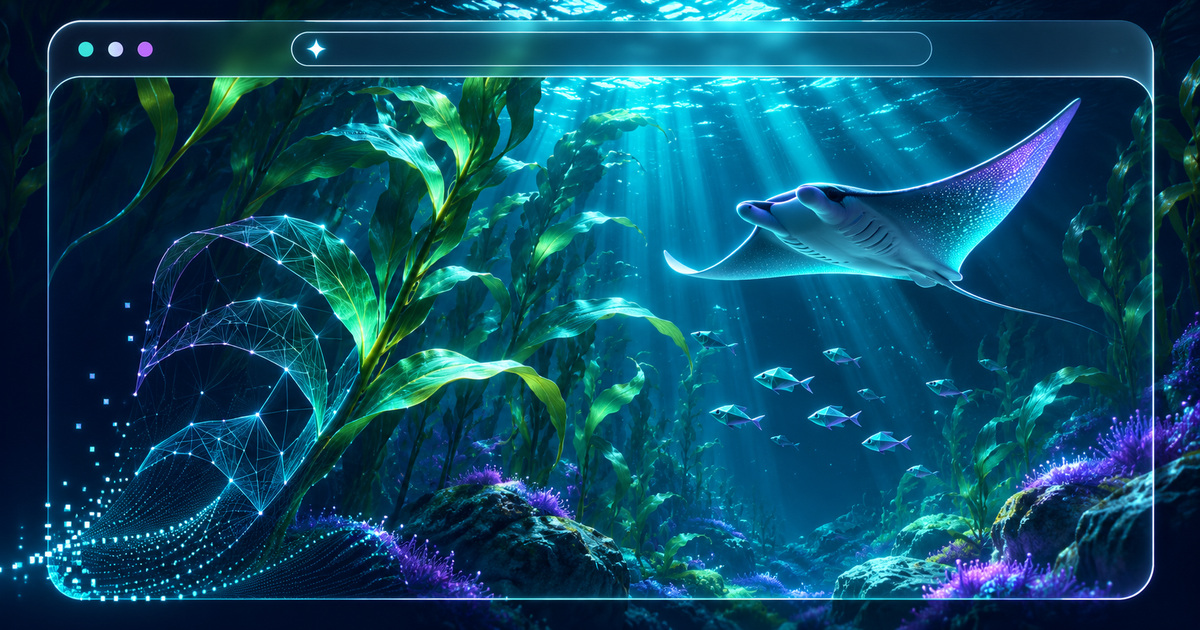
On November 16, Kaldata highlighted Abyssal Garden as an impressive example of programming with Claude. Behind the headline about a 97 KB underwater simulation is Noniv’s public repository, readable source code and a standalone HTML file. SIExpo inspected those materials. They support a more precise description: an artistic interactive scene, rather than a scientific model of an ocean ecosystem.
What is actually available
The index.html retrieved during our check contains 99,514 bytes: approximately 97.2 KiB when divided by 1,024, or 99.5 decimal KB. The repository description says 97 KB, while its README says 96 KB. Reporting the exact inspected file is more useful than trying to reconcile every rounded headline. The latest visible commit is dated November 14; today’s development is the new Bulgarian coverage of the project.
The underlying idea is procedural graphics. Programs describe vegetation, geometry and appearance instead of shipping a large collection of prepared images and models. The README identifies direct WebGPU rendering and sound synthesized through Web Audio. Readable source files are also available. We inspected the files without running the build or performing our own performance test.
The distinction matters. A short file can specify rules that generate many objects. Once loaded, the browser still needs to construct geometry, allocate memory and render the scene. Download size therefore does not equal working memory, nor does it promise low power consumption.
What the AI attribution establishes
Kaldata attributes creation to Claude Fable 5.2. The repository contains a saved assignment prioritizing visual quality, stable frame timing and a small bundle. It helps explain the intended result, but is not a complete record of conversations, revisions and checks. The specific model attribution and the assertion that all code was generated therefore remain attributed to the publication, rather than independently authenticated by SIExpo.
Public code is a different kind of evidence from an account of how it was produced. We can inspect the delivered artifact without knowing every human intervention along the way. The project uses the MIT licence; reuse requires preserving the relevant copyright and licence notices.
Editorial assessment: evaluating this kind of demonstration
For a developer, an interesting question is whether the code remains understandable and editable after the first attractive result. A practical assessment would compare the original assignment with the delivered file, check behavior when WebGPU is unavailable and measure frame timing on a specified machine. These are suggested checks, not benchmark results obtained by our publication.
Another question concerns slower hardware. The documentation describes detail levels and experimental touch controls, but does not guarantee equivalent compatibility across browsers and devices. For a public website, an acceptable fallback screen and clear requirements may matter as much as maximum visual quality on a powerful computer.
A useful evaluation should also keep visual success separate from maintainability. A scene that looks convincing in one demonstration may still need accessibility work, regression checks and a clearer separation between rendering and interaction before it becomes part of a larger application. Those are engineering questions to investigate, not defects we claim to have found here.
Abyssal Garden’s value lies in its inspectable technical artifact. It provides concrete material for studying compact procedural graphics and assessing AI-assisted development. One scene does not establish a model’s general superiority, automatic product readiness or physical accuracy of the world it depicts.
Editorial verification: 2026-11-16T07:49:49.341104+00:00.