Agile Robots has announced a $500 million Series F at an $8.5 billion valuation. SoftBank Group led the round, with NVIDIA, Hitachi Group and T.Capital participating. The company connects the financing to expansion in the United States, other markets and additional manufacturing capacity. This is a physical-AI financing development, rather than evidence that general-purpose robots have already solved every factory task.
A date discrepancy worth preserving
The official page displays November 10, 2026 in its header, while the release itself begins with a Munich dateline of November 12. We retain that discrepancy instead of silently replacing it with a convenient single date. DPA published its own report on the funding on November 12.
That report describes a factory near Munich with stated capacity for up to 10,000 humanoid robots annually. This is company-reported capacity, not a verified number of completed or delivered machines. Likewise, the broader portfolio of more than 20,000 installed robotic solutions should not be converted into a claim that this many humanoids have been deployed.
What physical AI includes here
An earlier product announcement from October 21 helps explain the research direction. Agile ONE SN is a compact developer platform with preconfigured NVIDIA Isaac GR00T software. The described workflow spans demonstration data, simulation, training and real-world validation. Availability is scheduled for early 2027; the October announcement is not presented here as a new November shipment.
A partnership with Hitachi, announced on September 29, provides another piece of context. It links Agile Robots' hardware and software with Hitachi's industrial integration and edge-AI technologies. The focus is on tasks involving variation, where a fixed sequence of movements is insufficient. Broader coordination among machines and people is an ambition, rather than an already measured aggregate outcome.
Editorial analysis: from a demonstration to a repeatable process
For an industrial customer, seeing a successful movement is only part of an evaluation. The next questions concern repeatability across different parts, detection of failures and how the production line continues when intervention is needed. Even a well-executed demonstration does not establish all those conditions.
Future deployments are therefore worth examining through the specific task, observation period and frequency of human assistance. Success also needs a clear definition: moving an object, completing a cycle and maintaining flow throughout a working period are different achievements. These are editorial assessment criteria, not findings from a SIExpo factory trial.
Product changes create another practical issue. A robot that handles one arrangement may require new data or configuration for another. The time required for that change and the method of revalidation affect its value as a production tool. Promised flexibility needs to be considered alongside evidence for the particular operation.
A useful deployment account would make those boundaries visible rather than hiding them behind a single success percentage. It would also distinguish a controlled test from routine production. That distinction helps readers understand whether a reported improvement can reasonably transfer to their own setting.
What the new financing changes
Capital can support engineering teams, manufacturing and service in additional markets. It does not turn stated annual capacity automatically into realised sales, and does not establish the performance of every machine in the portfolio.
Agile Robots is significant because it brings together several robot types, software and industrial partnerships. The next important question is how that combination performs in traceable deployments. For readers, separating financing, manufacturing capacity and actual field operation is more useful than treating them as one impressive number. The funding advances the company's expansion plans; operational evidence will determine how those plans translate into sustained industrial work.
Sources: Agile Robots — Series F release; header November 10, dateline November 12, Agile Robots — earlier Agile ONE SN research platform, Agile Robots — earlier Hitachi manufacturing partnership, DPA via Yahoo — funding report and attributed factory capacity.
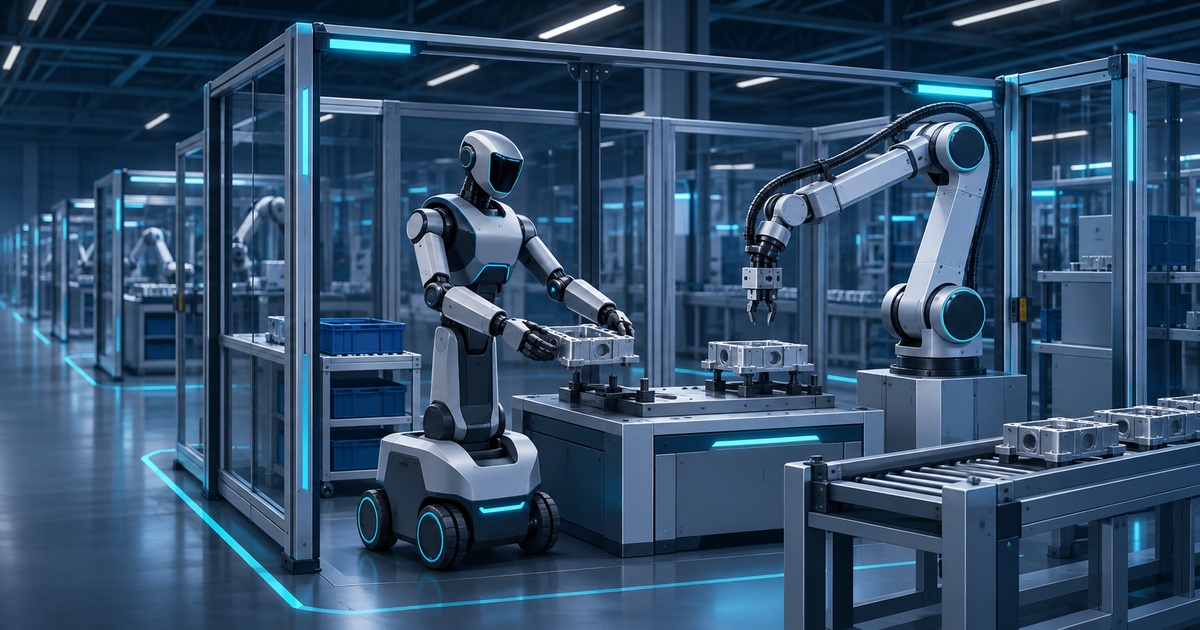
The cover is a conceptual AI illustration, not a documentary photograph.
Editorial verification: 2026-11-12T17:35:22.913550+00:00.