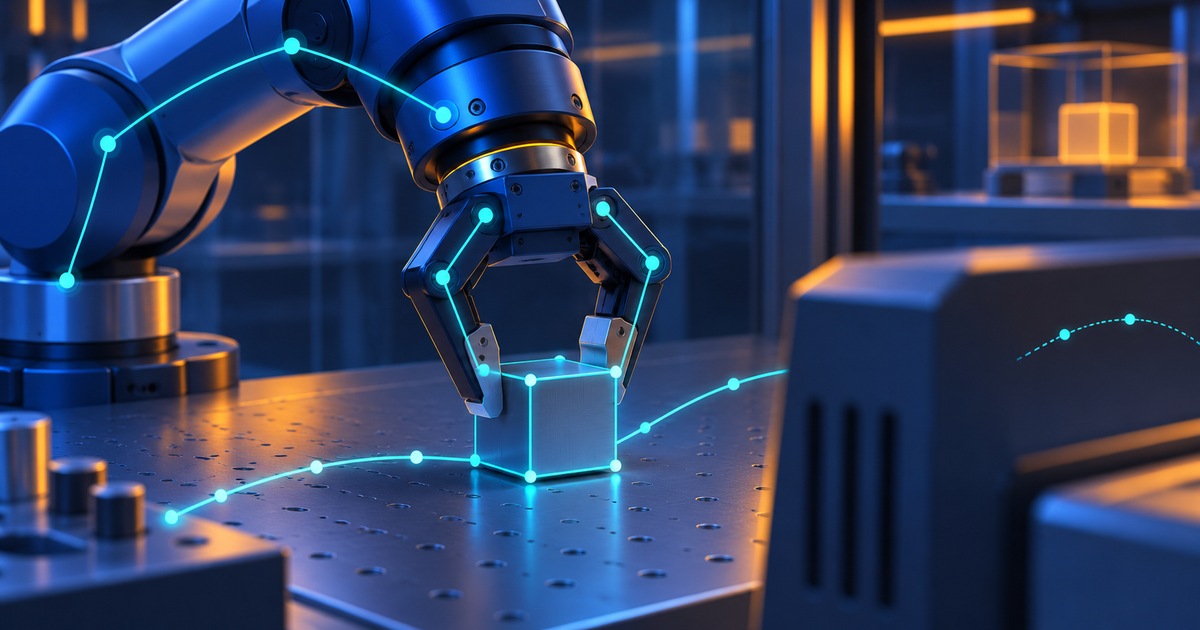
Ai2 released RoboTrack on November 23, providing resources for training, evaluation and point tracking in manipulation video. RoboTrack-Bench contains 307 clips with 2,522 manually annotated tracks. Its dataset card says 57% of points become occluded at least once. This creates a specific perception challenge: a point of interest temporarily disappears behind a gripper or another object.
What the evaluation measures
The card describes point positions and visibility frame by frame, with separate tracking metrics. Those scores are not percentages of completed robotic tasks. A robot might observe an object more accurately while choosing an unsuitable grasp or missing another constraint.
Our analysis is that evaluating perception separately is valuable because it helps locate a failure. When an attempt fails, an engineer needs to distinguish an incorrect observation, a poor plan and inaccurate execution. One overall success score rarely explains which component needs changing.
Models, data and their licenses
The repository describes RoboTrack-15M as simulated training data with 15 million tracks. It presents RoboTracker and RoboTracker-Warp as separate models. Their licenses also differ: the main model uses Apache 2.0, while Warp weights use non-commercial CC-BY-NC 4.0. Downloadable files do not imply identical rights to incorporate them into a commercial product.
The benchmark combines video from multiple sources whose terms remain relevant. Before downloading or redistributing, check the particular component: annotations, footage, code or weights. An umbrella description of the project does not override its component terms.
Reading results beyond the laboratory
The clips form a bounded sample of environments and robots. The card notes that Franka accounts for a large share of robot examples. That is a reason to evaluate transfer to another camera, lighting setup or gripper, rather than dismissing the benchmark itself.
For an internal trial, we would keep the protocol, model revision and occluded-frame list fixed. A useful question is whether the system correctly acknowledges missing visibility or produces a plausible but unsupported trajectory. This is a suggested evaluation criterion, not an additional measurement we performed.
The cost of an error also depends on its destination. A tracking mistake in an offline visualization differs from one passed to a moving actuator. Keeping that boundary explicit prevents a perception improvement from becoming an unsupported assurance about the entire machine.
RoboTrack offers a new basis for studying a particular component of robotic systems. Its materials let readers inspect the evaluation and applicable licenses. They do not certify a completed robot's safety or universal reliability across production environments.
Cover: AI editorial illustration, not a documentary photograph.