ASPIRE v1.0 now has public code, while the 16 October announcement draws attention to stronger models behind the robotics agent. A dated Robotics Daily report describes Jim Fan's announcement; NVIDIA's official repository confirms the version and public availability. This is not the first introduction of the idea: the research was published in June 2026.
The repository reports 99% success on 80 LIBERO-Pro tasks and selected tasks from other environments. These are developer-reported results. They must not become a claim that a physical robot completes 99% of arbitrary work. Public code is an inspectable artefact; numerical reproduction remains a separate exercise.
What accumulates around the model
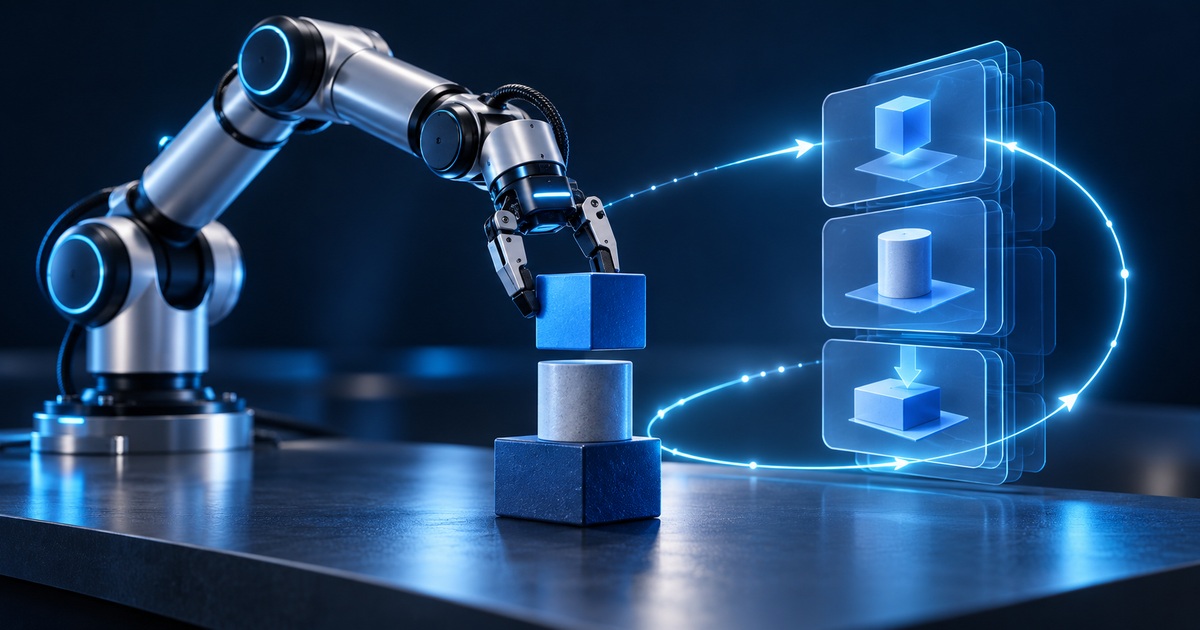
The original paper describes a cycle in which the system writes control programs, inspects execution traces, repairs errors and saves validated skills. This accumulates reusable experience around the model. It does not justify calling every repair stored in a program library a new training update to the model's weights.
The official project page explicitly identifies the need for safe resets, monitoring and calibration on real robots. A predefined command interface bounds possible behaviours, while long-term memory management remains incomplete. Those qualifications are an important part of the project, not a footnote after the demonstrations.
A model change needs a new test
Our editorial interpretation is that an agent framework and the model inside it should be evaluated together while remaining distinguishable. If only the model changes, improvement could come from better diagnosis of an error or selection of a more suitable repair. It does not by itself show that mechanics, cameras or low-level control have become more reliable.
A practical evaluation should separate a task the system has previously repaired from a genuinely new arrangement. A library that helps only with a familiar case can still provide useful reuse, but that differs from broad skill transfer. Failed attempts, recovery time and human assistance also belong in the account, rather than only the final successful video.
Opening the code makes it possible to ask those questions about a concrete system. It does not remove model and testing costs or make arbitrary access to physical equipment safe. SIExpo has not run ASPIRE on a robot. The verified development is the public version and its documented approach, alongside limitations that should stay visible when subsequent results are compared. That distinction lets readers assess a real research contribution without mistaking a simulation score for a general industrial guarantee.
Editorially checked: 2026-10-17T06:16:30.867317+00:00 (UTC). Cover: conceptual AI illustration; not a photograph of an actual event.