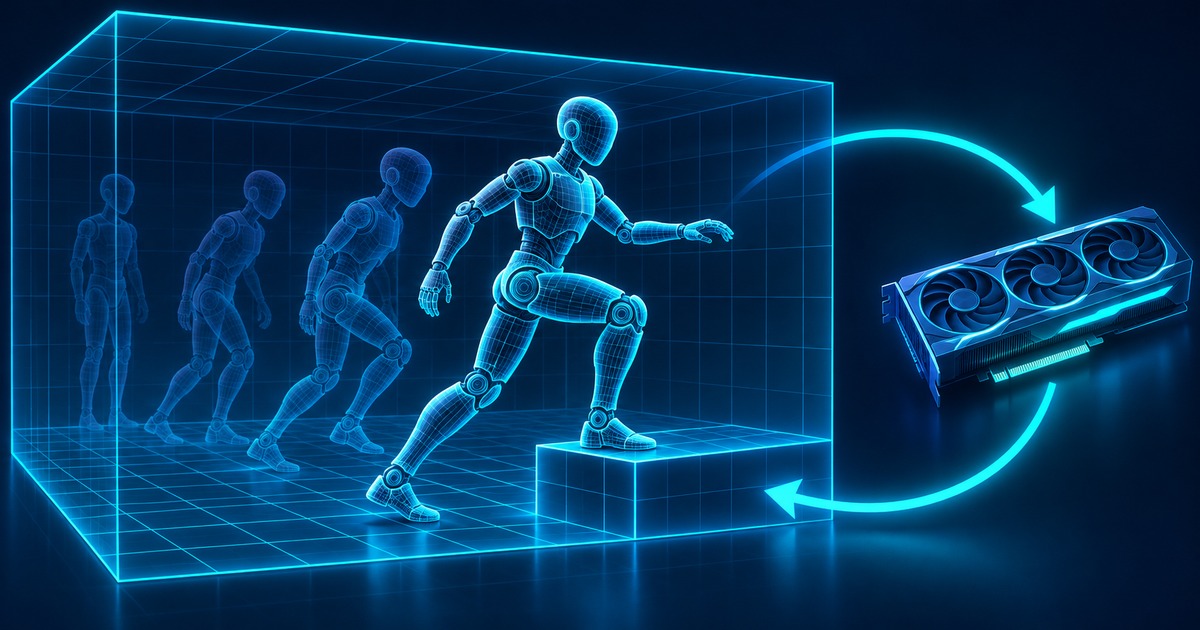
The BlinkMimic preprint, submitted to arXiv by Fuyi Chen on November 12, describes faster training of a humanoid motion controller. The author reports reaching a particular evaluation criterion in approximately 3.4 minutes on one RTX 4090. The experiment uses a simulated Unitree G1 and a library of 40 LAFAN1 motions.
This does not demonstrate that a physical robot learns any arbitrary new skill in three minutes. The distinction matters: the work measures training to track reference motions within a defined simulation.
How the result is obtained
The approach relies on a differentiable dynamics model. Such a model predicts how simulated motion develops and enables optimization of the control policy through imagined sequences. The earlier SuperMimic work is acknowledged as a foundation; BlinkMimic also builds on changes introduced by InstantTrack.
The preprint's new components include a decreasing training step size, directing resets toward problematic sections and GPU graph capture of the iteration. The author separates time per iteration from the number of iterations required to reach the quality target. That helps distinguish more efficient computation from better use of training attempts.
The published repository uses mjlab and MuJoCo Warp and provides code and results for individual random seeds. It offers material for inspection and reproduction, rather than independent replication by another laboratory. SIExpo has not run the training.
Why 2.9 and 3.4 minutes are different
The repository reports two criteria. The earlier one is the first normalized return of at least 0.82, reached in approximately 2.9 minutes on average. The stricter one requires that threshold, no failed clip and three consecutive checkpoints, taking approximately 3.4 minutes. Figures are averaged across three seeds.
Normalized return is a score under the experiment's reward function, not a universal percentage of human-level quality. No failures across the 40 evaluated clips likewise does not establish reliability across all possible motions.
The author's timing includes compilation, GPU graph capture, evaluation probes and checkpoint writing. Process startup and data loading are excluded. Some comparison times for SuperMimic are estimates, a qualification that must accompany comparisons.
What it means for robot learning
Editorial analysis: a shorter experimental cycle can let researchers compare more ideas on the same hardware. Its value depends on comparing the same task, the same success criterion and the relevant computation cost.
A useful next step is evaluation on new motions and changed conditions that were not used to tune the method. Transfer to a physical robot is a separate question, where contacts, sensors and actuators can differ from the simulation. The reported results do not automatically answer that question.
The constructive scientific development is specific and inspectable: a published recipe, criterion, hardware configuration and multiple runs support faster training in simulation. Open code gives other teams a way to examine the conditions and limitations instead of relying only on a short video or an impressive headline number.
Sources: Fuyi Chen: BlinkMimic research preprint, BlinkMimic: Code, per-seed results and timing methodology, SuperMimic: Differentiable world model background.
The cover is a conceptual AI illustration, not a documentary photograph.
Editorial verification: 2026-11-13T17:42:40.897636+00:00.