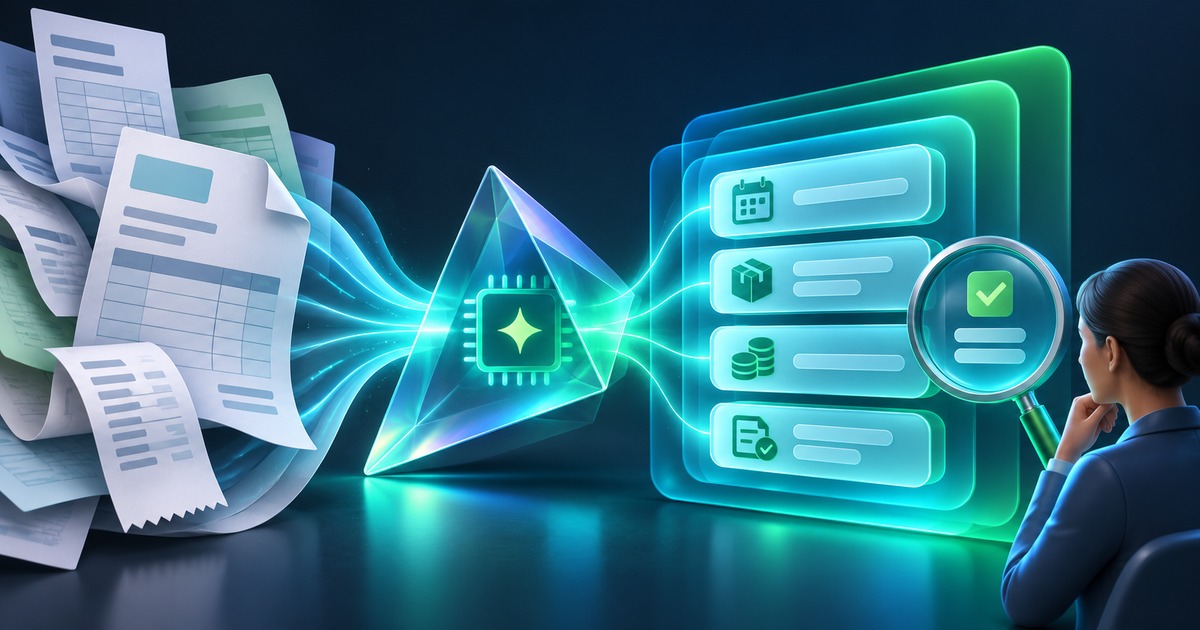
Dharma-AI introduced Field Extractor on November 4: a two-billion-parameter model for extracting fields from document images. The authors describe open extraction and schema-directed output, including null for missing values. Their 546-document test combines field matching, value similarity and valid JSON, rather than measuring the share of entirely correct documents. These are vendor measurements, not an independent SIExpo evaluation.
The cost comparison puts self-hosted L40S execution beside token-priced APIs. It is neither a customer price nor an identical operating model on both sides. The substantive development is specialization for a defined document task, rather than demonstrated superiority over every general-purpose model.
What happens after the page is read
Consider an illustrative invoice. Its readable text contains a supplier name, several dates and more than one amount. An accounting application needs to know which date is the payment deadline and which amount is the total. Merely retaining every character in a transcription does not answer those questions. Mapping content into structured fields adds an interpretation task.
Errors in that process can be quiet. A number looks plausible, the field has the expected name and the import finishes, yet the value came from a different row. Our editorial recommendation is to retain a connection to the source document and page so disputed extractions can be reviewed. This is a suggested integration design, not a newly announced product feature.
A schema checks structure
The official JSON Schema documentation explains that defining properties does not automatically require every field or forbid extra fields. Separate rules, including required and additionalProperties, address those constraints. Null and an absent property are also distinct. These details matter when the receiving application relies on a specific data contract.
A structural check cannot, by itself, determine whether an amount matches the original invoice. In a pilot, we would separate format validation from content validation. One establishes whether the next system can process the object; the other compares its values with the actual source. Successfully parsing JSON is consequently an insufficient acceptance criterion.
There is also a practical distinction between rejecting an incomplete object and silently filling a gap. A receiving application needs an explicit way to handle a missing deadline without treating it as a genuine date. We would make that behavior visible to the reviewer and test it before allowing the output to trigger downstream work. This is an editorial requirement for the surrounding workflow.
The background paper describes a different model
The April DharmaOCR preprint examines specialized OCR and repetitive, excessively long generations. Its authors connect that failure to increased latency and cost as well as quality. It supplies background for specialization, but its models and results should not be merged with the new Field Extractor. We do not claim that the April weights are the checkpoint announced in November.
FUNSD, a public resource used in document research, contains annotated noisy scanned forms and relationships between semantic entities. Such a dataset supports reproducible work on particular tasks. It does not automatically represent every organization's forms, languages or scanning conditions.
A useful acceptance exercise
We would select documents from the intended workflow, including empty fields, multi-page tables and damaged scans. Each field would have a recorded expected value and an explicit rule for errors needing human review. A mistaken payment deadline, for example, may matter more than a variation in descriptive wording even when an aggregate score looks strong.
The same exercise should cover repeated processing. If an invoice arrives twice, a valid extraction should not automatically create a second operation in the receiving system. That is an integration issue around the model. The new proposal is worth evaluating as a narrowly specialized tool, while preserving the distinction between its authors' reported results and performance established on an organization's own documents.