Eka Robotics announced a $150 million Series A on October 20, 2026, led by Andreessen Horowitz and F-Prime. It is developing a vision-force-action model connecting visual information, contact forces and actions, trained through simulation and reinforcement learning. The company reports up to 1,500 object-picking operations per hour under the described conditions. That is a company result rather than a universal speed for every industrial task.
SiliconANGLE reports a stated $1.45 billion valuation and identifies co-founders Pulkit Agrawal and Tuomas Haarnoja. Funding is a business event. A company valuation does not measure the reliability, safety or maturity of a particular robotic installation. Nor does it establish a customer’s eventual operating costs or acceptance criteria.
What contact adds to vision
Our technical explanation begins with a hypothetical example: an object appears correctly held but starts slipping. The image describes part of the situation. A change in contact may provide different information about the next required step. That makes combining signals a substantive manipulation question rather than simply adding another camera.
Using feedback does not automatically resolve every physical case. A soft fruit, rigid component and cable impose different conditions for success. We would describe the permitted changes to each object and how its final position is verified. That is our proposed method, not a report from testing Eka’s system. The example is intended to explain why a task definition matters alongside a model architecture.
Speed needs a clear denominator
When comparing throughput, we would ask what counts as one operation. Picking, moving, correctly placing and checking the result can be separate stages. If one report counts the first and another counts the whole cycle, their figures describe different work. Retries and human intervention also need a stated treatment, rather than disappearing from the comparison.
For a real pilot, we would record completed cycles together with downtime and corrections. A selected demonstration can establish a capability but does not by itself measure behavior over an extended working period. That boundary guides our reading of the announced speed; we are not claiming to have discovered a particular defect or measured a different result.
From simulated experience to a particular line
In our view, transfer to a new environment requires separating general capability from local operating conditions. Object presentation, workspace layout and acceptance criteria are parts of the complete task. Even a promising grasping movement does not alone establish how the finished workflow will operate. Integration work should remain visible when assessing the system’s practical value.
We would begin with a limited, supervised task and a predefined way to stop when the outcome is uncertain. Results could then distinguish cases completed without help from those requiring engineering work. This is an editorial evaluation recommendation, not instructions for a hazardous experiment or evidence of safety certification. SIExpo has not tested the model or hardware.
According to Eka’s plan, the funding provides resources to expand tasks and deployments. Whether that produces sustained production performance remains to be assessed under specific conditions. We do not turn an investment round into a promise of a general robot ready for every job. The news combines a concrete financing announcement with a technical direction whose operational results still need appropriately scoped evidence.
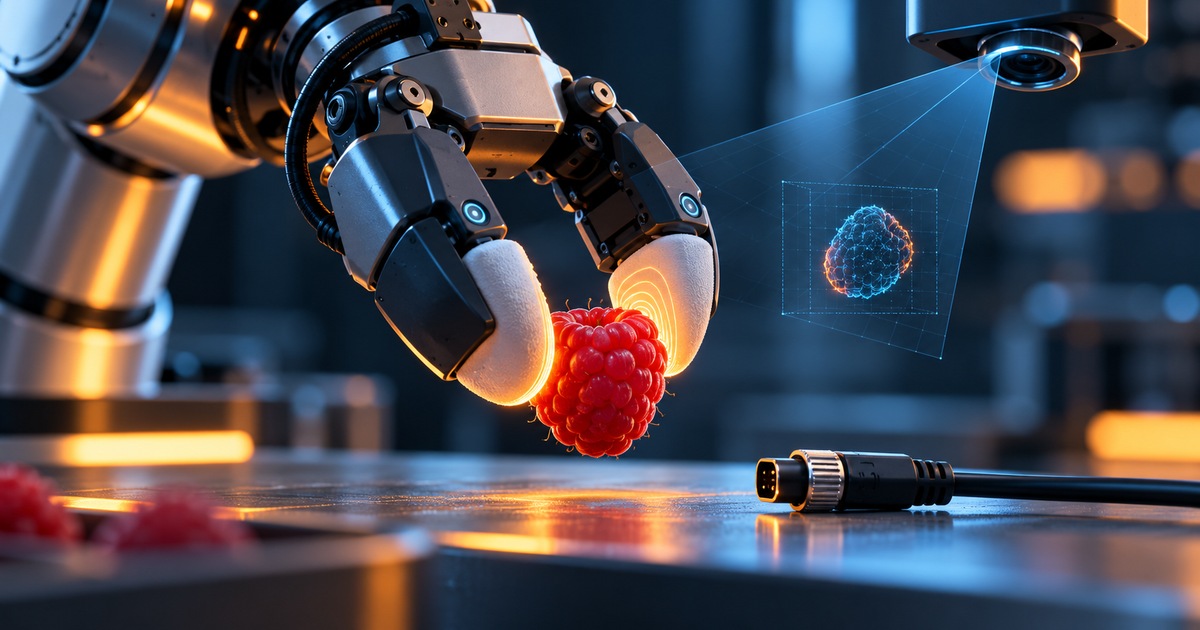
Cover: conceptual AI illustration of a feedback-sensitive gripper, not a photograph of Eka hardware or proof of its performance.
Sources checked: 2026-10-22T16:06:53.737225+00:00.