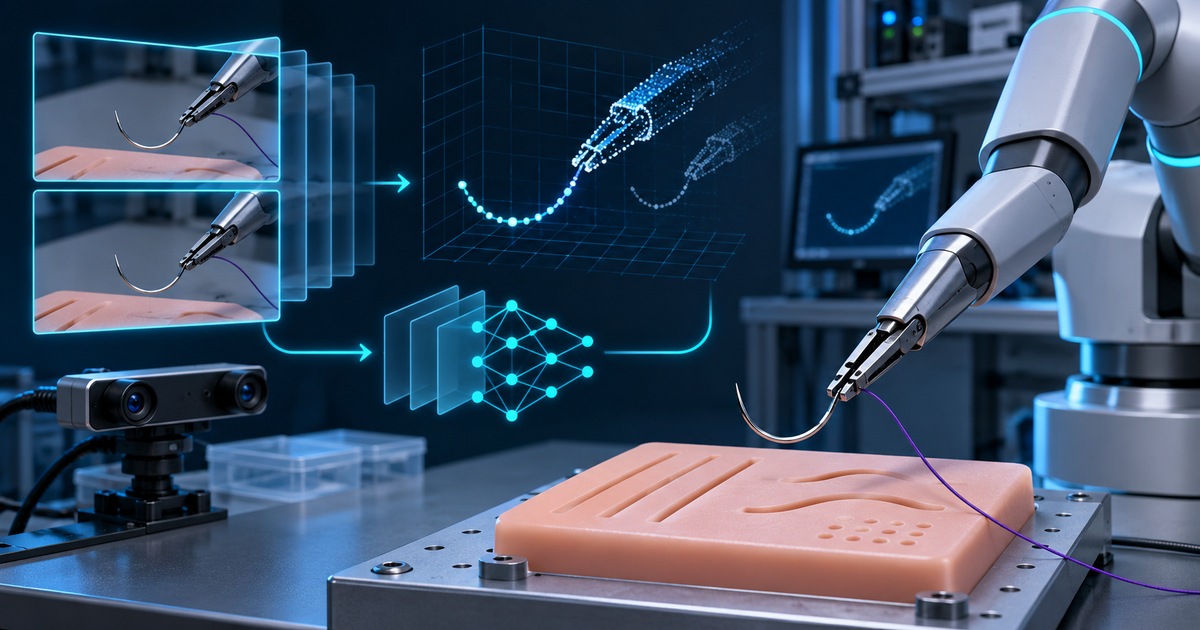
FlowScope is a November 19 preprint on learning a robot policy from 3D motion in stereo video. The authors report an increase in full needle-regrasp success from 2% to 14%. Their evaluation uses one robot platform and suture pads; transfer to tissue remains future work.
The ACT background
The official ACT project describes predicting a sequence of actions at once instead of a single next command. Such action chunks reduce the effective task horizon. This is useful context for understanding a robot policy: observations must become coordinated actions over time, beyond a correct verbal description.
Our editorial interpretation is that evaluation should separate representation quality, control quality and the final outcome. Even improved understanding of a scene does not by itself establish that an entire workflow finishes reliably. A new setup needs a clearly stated success criterion.
A stage and a complete task
Imagine a task with three required phases. Completing the first does not establish success in the others. When reading a robotics publication, identify what each table measures: an intermediate operation, a first transfer or the complete cycle. Comparisons should preserve the denominator and evaluation conditions.
This is a general explanation of metrics. We do not infer a clinical outcome or treatment probability from a robotics benchmark. A useful question for subsequent work is which failures remain and whether the method transfers to another configuration under a comparable protocol.
Stronger follow-up evidence
Independent replication can add information when it specifies inputs, hardware, permitted retries and the final-outcome evaluator. Readers also need to know which elements changed between trials. Otherwise, attributing a result difference to a particular design choice becomes difficult.
SIExpo has not run this robot setup. This article is an original analysis of a bounded research result rather than an announcement of approved autonomous surgical practice. The value lies in a testable training direction, while the limits of application should remain visible alongside the improvement. A careful assessment can acknowledge progress without turning a laboratory measure into a claim about patient care.
Cover: AI editorial illustration, not a documentary photograph.