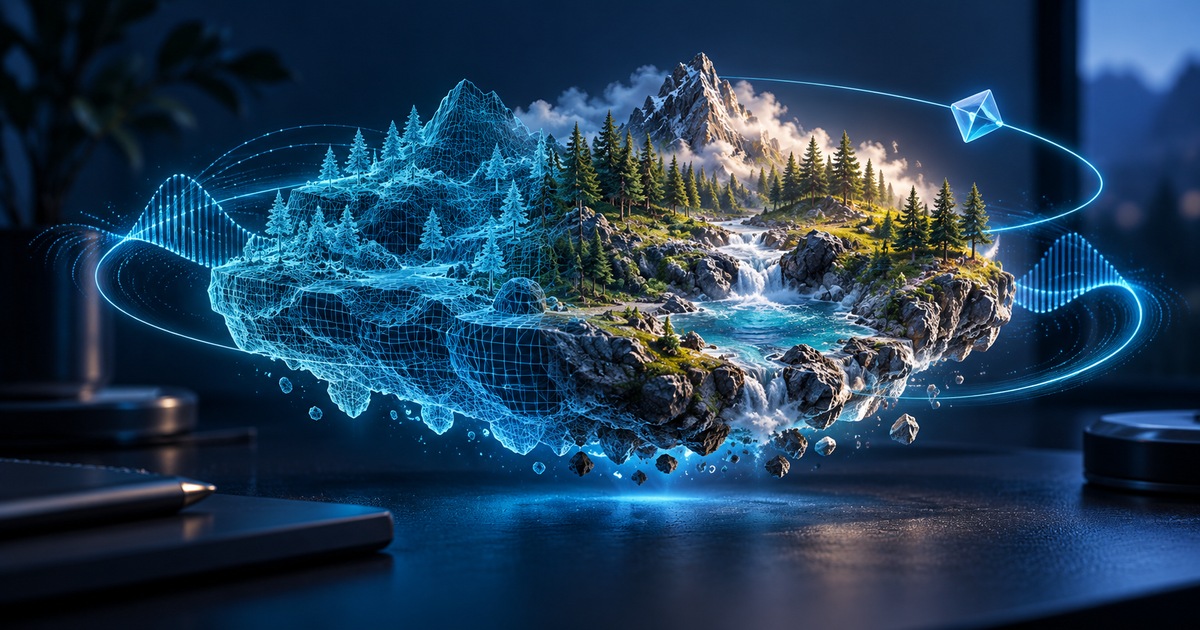
On October 27, Google DeepMind introduced Genie 4, an interactive world model that generates sound alongside its scenes and accepts text changes during a session. The company is starting with a research preview for trusted testers. Access through Project Genie for Google AI Ultra subscribers and for early API partners is described as a next step, rather than general availability at the announcement.
What live editing changes
The demonstrated approach lets a user steer the camera, change weather or add objects while the environment continues unfolding. DeepMind describes contributions from the Gemini family, including Gemini Omni, to appearance and continuity. These are the developer's descriptions and selected demonstrations; SIExpo has not conducted its own product test.
Our editorial interpretation is that controllability matters more here than an isolated impressive frame. A viewer of a finished clip accepts a sequence chosen in advance. An interactive scene creates a fresh expectation after every action: an object should remain where it was, and the sound should correspond to what is visible. Image quality alone cannot answer those questions. A compelling excerpt and a dependable working tool therefore call for different forms of assessment.
Earlier work and current boundaries
The historical Genie 3 announcement from August 2025 already described real-time navigation through generated environments. Interactivity itself is consequently not the distinguishing new element of the fourth generation. The new emphasis is the combination of sound, editing and evolving scene behavior. We infer no numerical improvement over its predecessor, because we have not compared both systems under an identical protocol.
The current product page warns about drifting details and object permanence, inaccurate real-world locations, and difficulties with complex interactions, text and sound. Continuous interaction remains limited to a few minutes. These qualifications mean that a plausible-looking world should not automatically be treated as a measurement model of physical reality.
Where the approach could be useful
Consider a hypothetical film team preparing a scene. It could compare two camera moves and two weather conditions before choosing a visualization direction. This is our assessment example, rather than a reported customer outcome. The team would need to check whether the intended object survives an edit and whether a new change disrupts a previously approved part of the composition. Otherwise, the convenience of making changes could be offset by repeatedly restoring details.
For robot research, the same approach raises stricter questions. Learning an action in a convincing environment does not establish that contact, friction or dimensions match the physical world. Our interpretation is that visual plausibility justifies investigation, while transfer to real control requires separate experiments with measurable criteria. A simulation can be useful for exploring a question without already being validated for deployment decisions.
A prospective user's trial could repeat the same task, revisit an earlier part of the world and inspect consistency after several consecutive edits. Access, actual session restrictions and pricing would also need evaluation once confirmed for the particular service. These are proposed evaluation steps, not experiments we have performed. The verified development today is Genie 4's research preview; its evolution into a predictable production tool remains a subject for subsequent testing.
*AI illustration: a conceptual editorial image, not a documentary photograph or an actual product screen.*
*Editorial verification: 2026-10-28T07:29:45.233660+00:00.*