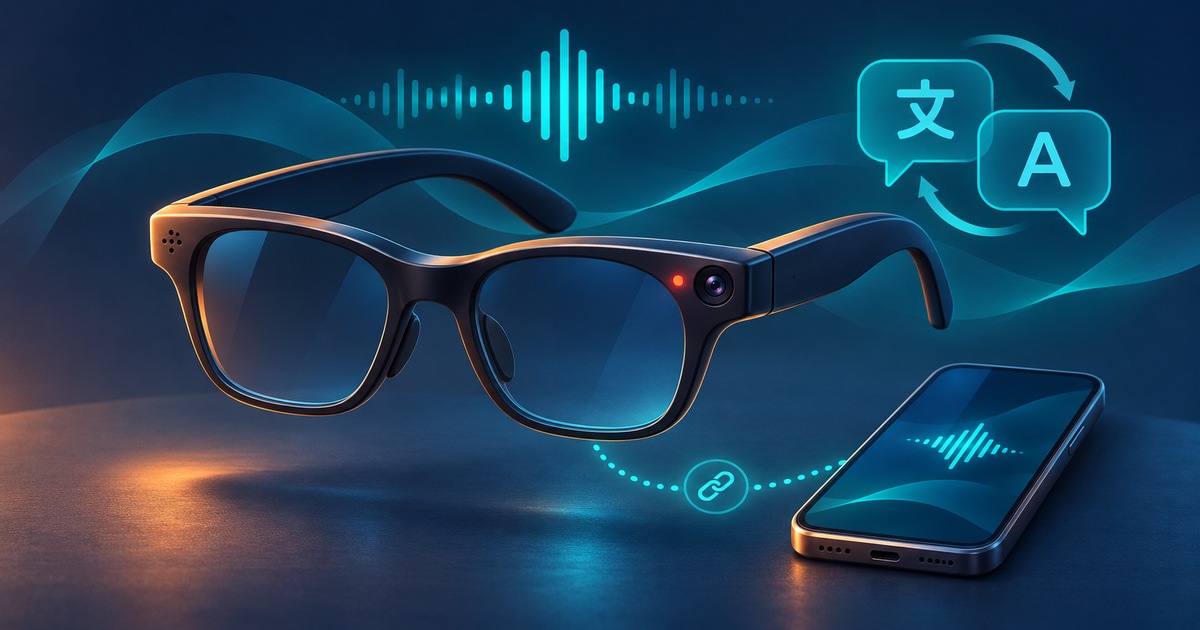
Google and Samsung opened preorders for Intelligent Eyewear on November 12, 2026. Developed with Warby Parker and Gentle Monster, the collections are scheduled to reach general availability on December 10. This is a commercial milestone for glasses with voice-based AI assistance, rather than confirmation of availability in every market.
Price, markets and product scope
Samsung lists U.S. starting prices of $395 for Warby Parker and $449–$489 for Gentle Monster. Both collections launch in the United States, while Gentle Monster is also announced for South Korea. These figures are not verified Bulgarian retail prices. Frame options, lenses and local purchase conditions need separate checking.
Kaldata reports the opening of preorders. Google's own conditions are useful for understanding the technical scope: the device connects to a supported phone and offers Gemini conversations, audio, a camera and app assistance. It should not be confused with glasses that project a computer display in front of the eyes. The absence of that type of display also changes how a wearer can verify an answer.
The phone and services belong in the specification
Google's supported-phone list names particular Pixel, Galaxy and iPhone models with software requirements. Launch access is limited by market, account and language, and some functions are Android-only initially. Owning a phone from one of those brands is consequently not sufficient evidence that every demonstrated capability will work.
A practical purchase assessment should separate hardware compatibility, access to a service and support for an individual function. Successful Bluetooth pairing, for example, does not prove access to a particular app or the desired language. This is a general verification principle for a device connected to cloud services, not the outcome of an SIExpo consumer test.
Samsung describes a camera, open-ear speakers and a microphone array. Its battery claim is up to nine hours under the manufacturer's conditions. A maximum figure is not a promise of nine hours of uninterrupted conversation or video recording. Without a comparable usage scenario, it cannot support an independent conclusion about daily battery life.
Privacy mechanisms address different questions
Google describes separate treatment for Gemini's visual context, conversation history and photos or videos saved to the gallery. Announced protections include a recording indicator and stopping recording when that indicator is covered. The company also describes processing bystanders' faces before Gemini uses camera visuals. These are stated product protections; SIExpo has not tested them.
Our editorial interpretation is that a visible indicator and a retention policy solve different problems. One helps nearby people understand what a device is doing, while the other governs what happens to information afterward. The presence of one mechanism does not verify every other protection. A useful assessment also needs settings that the wearer can understand and operate reliably.
That distinction matters for hands-free products because reducing interaction with a phone can make the processing chain less obvious. A convenient spoken answer may depend on a connected device or external service even when the glasses themselves feel self-contained. The appropriate question is which component handles a particular operation, rather than whether the frame looks like an ordinary pair of glasses.
Assessing the launch in practice
Before purchasing, a user could try a basic conversation, an interrupted connection and the necessary apps using their own supported phone. In a noisy setting, they could assess whether the answer remains intelligible and whether audio exposes information to nearby people. These are suggested test scenarios, not findings of a defect.
The news is the opening of actual preorders with defined launch markets. The convenience proposition remains tied to the combination of frame, phone, account and services. SIExpo does not have a review unit and is not confirming Bulgarian delivery or full Bulgarian-market functionality. Published compatibility conditions should therefore be read alongside demonstrations and starting prices.
The cover is a conceptual AI illustration, not a product photograph.
Editorial verification: 2026-11-14T17:12:57.436197+00:00.