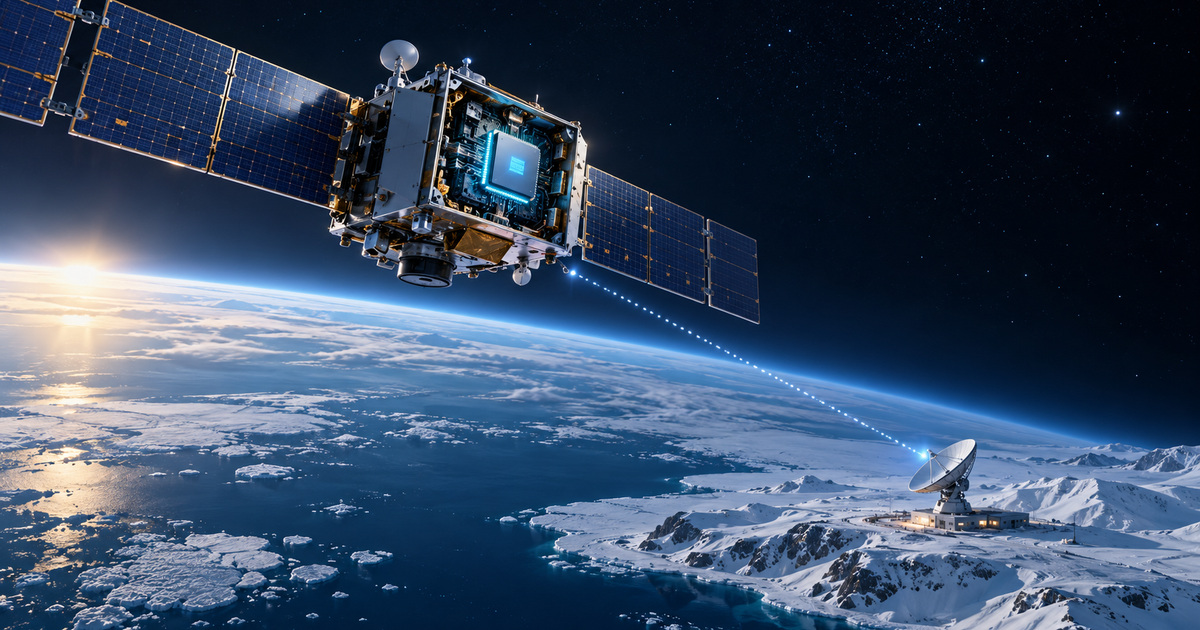
Google said on October 30 that its Project Suncatcher prototype ran a Gemma 4 request in orbit and returned the result to Earth. The task was a short poem. The company describes it as the first response from a data-centre-class TPU in space, a specifically bounded priority claim made by Google.
The achievement is a computing demonstration, rather than an opened cloud service. It does not establish customer pricing or independently measured performance for a finished orbital data centre.
From contact to a completed workload
Google’s earlier October 1 announcement describes the launch of the prototype, developed with Planet, on SpaceX’s Transporter-18 mission. At that stage, contact with the satellite had been confirmed. Establishing communication and successfully running a model are different milestones: one supports control and data exchange, while the other also tests the computing payload.
That launch is historical context, not a new launch this week. The current announcement adds a reported model result. The launch announcement anticipates gathering thermal and radiation data, while the earlier research plan identifies interconnected twin satellites as a goal for 2027.
Why one response does not establish infrastructure
The research project described in November 2025 considers solar-powered constellations connected through optical links. In that earlier analysis, Google treats communications, maintaining closely spaced orbital formations and electronics resilience as separate engineering challenges.
The high-speed optical-link demonstration described there was a laboratory experiment. We do not present it as an operational network between satellites. The distinction matters: an individual accelerator can complete a task without proving that multiple accelerators can exchange data reliably enough for a distributed workload.
Our editorial assessment is that scaling must be judged across the complete chain. It includes delivering a request, hardware availability, finishing the computation and returning the result. An appealing piece of generated text demonstrates an individual completed task; it does not measure every part of that chain over sustained operation.
Reading the next results
A useful future report would state how many tasks were completed, over what period and under which conditions. It would also explain how interruptions, errors and retries were counted. These are editorial evaluation criteria, not requirements we claim have already been met.
Separating single-satellite tests from infrastructure-scale promises is equally important. Neither the poem nor the initial contact automatically establishes an economic advantage over a terrestrial data centre. That conclusion would require comparable measurements and an explicit account of which costs are included.
For example, a comparison based only on successful computing time would answer a narrower question than one that also counted unavailable periods and communication overhead. A reader should be able to identify which question an eventual performance figure answers before treating it as a deployment decision.
The development matters as a transition from a launched experiment to a reported AI workload result. Its immediate value is the opportunity to test real computing hardware in orbit. The larger infrastructure proposition remains a research objective, rather than a service whose operating characteristics have already been demonstrated.
Cover: conceptual AI illustration, not a photograph or an accurate engineering model of the satellite.
Editorial check: 2026-11-01T09:38:54+02:00 (Europe/Sofia).