Researchers presented Image-to-Video Transfer, or I2VT, on November 25. It adapts an existing video editor using individual images and guidance from an image-editing model. A still image is treated as a one-frame video.
The starting point is the key limitation: the video model is already pretrained. “Without new videos” describes the additional adaptation stage, not a system that has never learned video dependencies. The authors evaluate three video editors and extend OpenVE-Bench with new editing tasks in OpenVE++.
Why a single frame helps
The project page describes a frozen image editor guiding training. That teacher is removed for final editing, when the adapted student processes a video clip. The extra training component should therefore be distinguished from the components needed for each use.
The practical question is how an edit holds over time. Changing lighting in one frame is different from keeping that lighting convincing as the camera and subject move. Still-image quality is consequently only one part of evaluating a video result.
Our editorial example is a clip of an object on a table whose lighting needs to change. A reviewer should check not just the new color, but whether shadows, edges and unchanged regions remain coherent between frames. This is not a test performed by SIExpo; it illustrates how to define an acceptance criterion.
Reading the comparison
The project's scores come from specified datasets and evaluation procedures. They are not guarantees for every video genre, duration or resolution. One successful example does not justify promising that every editing task can be performed automatically.
Before adoption, a team can prepare a small set of its own examples describing what must change and what must remain intact. Reviewing results both frame by frame and at normal playback speed is useful. The two approaches expose different problems: a local defect can be less apparent in motion, while flicker can be easier to detect across a sequence.
Applicability and limits
A production workflow also needs human control over the final version. A good instruction does not remove the need to inspect unintended changes outside the requested area. Keeping the original and processing settings allows comparison and makes the transformation easier to reproduce.
I2VT is preliminary research into extending video-editing capabilities with a more economical adaptation process. SIExpo has not independently measured its quality or cost. The contribution is a proposed route for giving an existing editor new abilities through images. Demonstrating usefulness for a particular production remains a separate practical step.
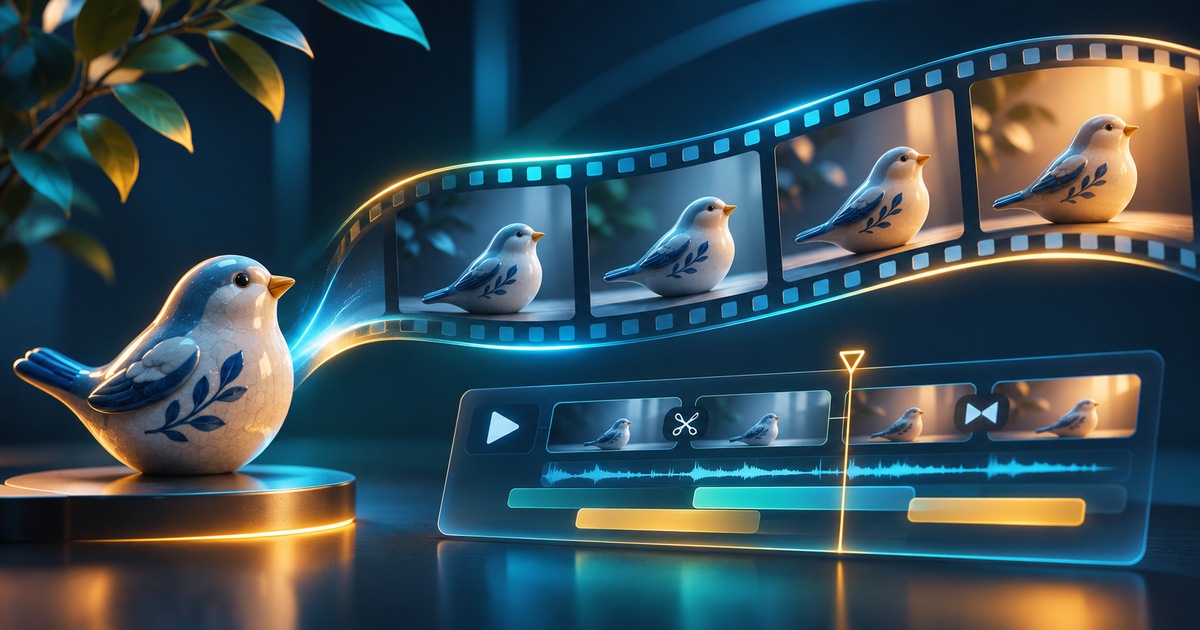
Cover: AI editorial illustration, not a documentary photograph.