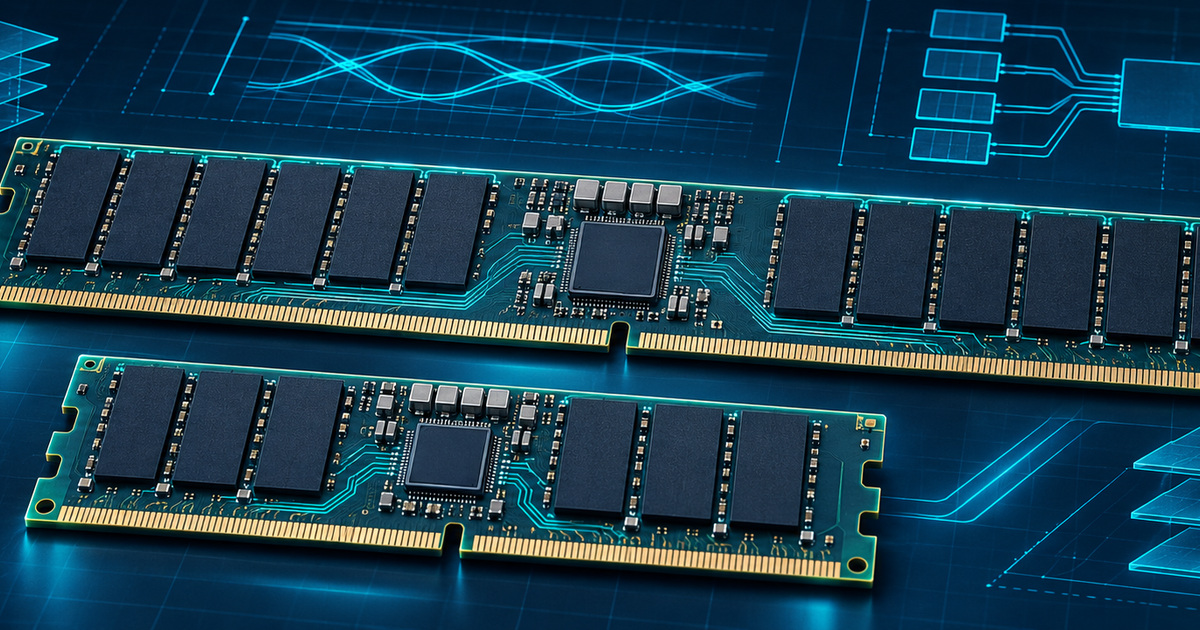
JEDEC outlined a preliminary DDR6 plan in an issuer announcement republished by Design & Reuse on November 19. It includes initial RDIMM rates of 12.8 GT/s, a roadmap to 14.4 GT/s and 96 data lines rather than 64. The features remain under development and may change. This is neither a finalized standard nor a declaration that DDR6 products are generally available.
What the comparison actually measures
Bandwidth does not determine application speed on its own. Extra transfer capacity may help a memory-constrained workload; we do not turn that into a guaranteed percentage improvement for an AI model.
For complementary context, Micron presents DDR5 as a product family with different characteristics and technical resources for individual devices. A generation name starts a selection process; it is not a complete system specification. That DDR5 page does not establish future DDR6 compatibility or availability.
Rate, capacity and latency
These properties are useful to consider separately. Capacity concerns how much data can be held; transfer rate concerns how much can move over time. Waiting for an individual access is another issue. A broad faster-memory label can conceal different trade-offs between them, especially when results from one workload become expectations for another.
In a hypothetical example, one task repeatedly reads a large working set while another makes occasional small requests. They need not respond identically to a memory change. This is an explanatory example, not a measurement of an upcoming DDR6 module. It shows why workload selection belongs in the evaluation rather than being treated as a minor testing detail.
How we would evaluate a future system
Our proposed approach starts with the actual task and its present bottleneck. We would keep the model, data and quality criterion fixed, then compare time to result and system resource consumption. If the working-set size changes, that difference should remain visible. The objective is a useful application result rather than a single impressive transfer figure.
For a product decision, platform support and the particular module would need separate confirmation. A preliminary architectural outline does not certify compatibility with an existing motherboard or processor. DDR6 also should not be confused with GDDR6 or LPDDR6, which name different memory families rather than interchangeable products.
The development matters as a direction for future computing standards. SIExpo has no finished DDR6 product to test and gives no unconfirmed mass-market launch date. What exists now is a design preview whose final characteristics and practical implementations remain to be established.