Researchers from Kyutai, Inria and École des Ponts have presented REKI, a model connecting camera observations and language instructions to robot actions. The preprint was submitted on October 15, 2026; later coverage does not change that research date. The system has 2.4 billion parameters and is pretrained on public data. Its contribution is a compact memory of the recent past, helping control move beyond a decision based only on the current image.
What the robot remembers
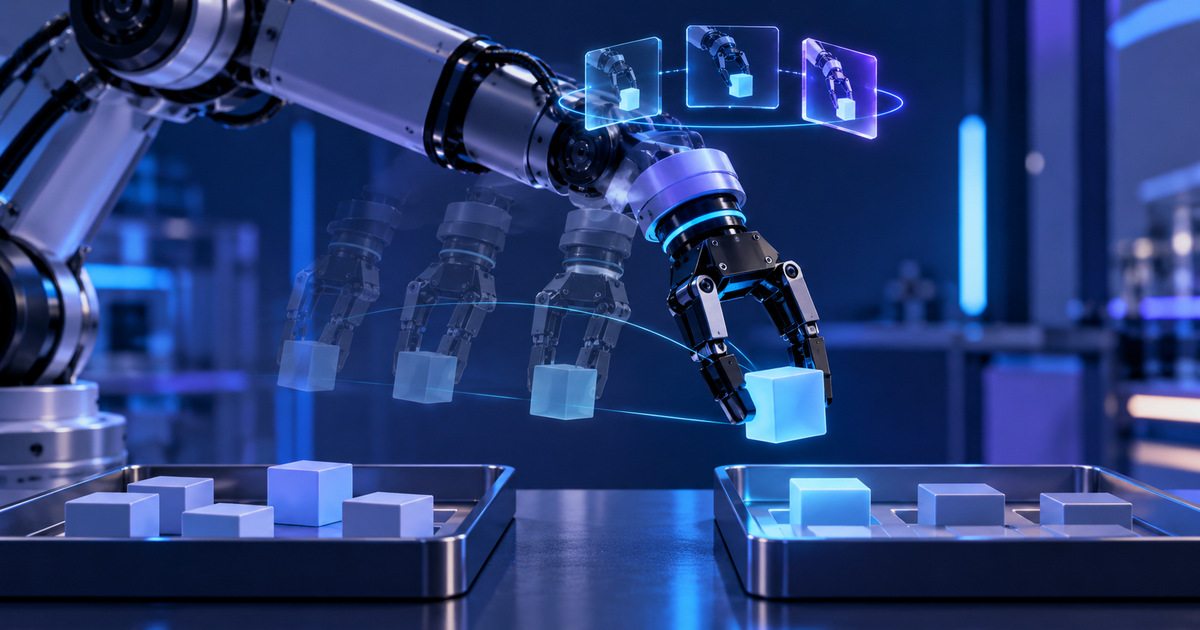
The architecture documentation describes a Qwen3.5-2B vision-language component and a separate action expert with approximately 0.2 billion parameters. The expert predicts a one-second action chunk using flow matching. Memory stores 32 learned register tokens per frame across three frames spaced one second apart. This is a short temporal context, not a conversation archive or a persistent record of a person's preferences.
An intuitive explanation is that a still image does not always establish which way a gripper was already moving. Recent observations can help distinguish states that look similar in isolation. This is our explanation of the control problem, rather than a claim that REKI understands every physical situation. Memory supplies more information; its usefulness still needs to be measured against a particular action and setting.
Reading the reported improvements
The authors report higher success with memory and approximately four times fewer pose oscillations in their tests. These are the research team's results, which SIExpo has not reproduced. They do not establish universal physical safety or turn the system into a finished household assistant. A preprint is a research report, distinct from independent certification of a robot product.
The model card identifies limitations when introducing a new robot-state format or tasks outside the predominantly tabletop demonstrations with parallel-jaw grippers. Our interpretation is that a comparison based only on parameter count misses the integration work. Cameras, control conventions and the meaning of the robot's state must fit the training and evaluation setup. A compact model can still require a carefully prepared deployment.
Code and weights have separate terms
The public model card explicitly distinguishes MIT for code from CC BY-NC-SA 4.0 for weights. A public repository therefore does not provide a blanket commercial permission for the entire stack. Teams assessing REKI for a product need to trace the terms of the selected artifact and its dependencies. This is a distinction in the published conditions, rather than individual legal advice about a proposed deployment.
For a research pilot, we recommend defining the task, acceptable duration and stopping conditions before running trials. Comparing memory on and off should use equivalent starting situations and record human interventions. If cameras, objects and control strategies change at the same time, it becomes difficult to determine how much of a difference comes from memory itself rather than the surrounding setup.
Failed attempts also deserve preservation. A successful demonstration establishes that a sequence is possible, but does not by itself measure its success frequency under all conditions. Practical evaluation additionally needs attempt counts, execution times and reasons for stopping. These are our proposed assessment criteria, not additional experimental results for REKI or claims that its authors failed to keep such records.
The development matters because it offers a research stack with a specifically described short memory. That makes it possible to ask more concrete questions about robot policies: which recent observations do they need, and what does using them cost? An answer for a defined laboratory task remains different from demonstrated operation of an arbitrary robot in an unpredictable environment. That boundary should remain visible when interpreting promising results.
Editorial verification: 2026-10-19T06:33:53.177083+00:00 (UTC). Cover: conceptual AI illustration, not a documentary photograph.