MIT reported a superconducting thin film between two magnetic layers on November 20. The device can store a bit and control signals; the authors demonstrated switching one cell without changing its neighbor. It requires very low temperatures. Miniaturization, arrays and total system energy savings remain subsequent challenges.
Kaldata covered the subject on November 25. We retain the actual research-announcement date: this is a worthwhile uncovered result within the seven-day window, rather than a discovery made today. We have not measured the device or an independent implementation.
Memory must retain information and allow selection
Two distinguishable states are a beginning. Useful memory also needs a way to read a selected bit and change it without unwanted changes elsewhere. Those cells must then connect into a structure that supplies data to the rest of the system.
A library offers an analogy: possessing a book is insufficient without a way to locate it, retrieve it and return it correctly. This illustrates the organizational problem, not the specific MIT electronics.
An isolated successful operation therefore answers a narrower question than a working storage array. Scaling requires checking whether selection and readout remain reliable as the number of cells and connections increases.
A local advantage and the whole installation
Energy required to switch a cell differs from energy required by a working computer. Cooling, control and data movement may add to the total. A component-efficiency statement should not become a data-center saving percentage without further measurement.
Our engineering interpretation is to define the measurement boundary first. What enters the energy account? At what temperature and workload? How long does the system wait compared with actively working? Without those conditions, two accurate numbers can describe incomparable operating regimes.
This also affects comparison with existing technology. The relevant alternative is a system delivering the same useful result under stated constraints. Comparing one favorable operation with the full cost of another architecture would obscure rather than establish an advantage.
A classical bit and a quantum bit are different
A cold environment does not automatically make every memory quantum. Storing two classical states and maintaining a quantum state are different tasks. A device can assist supporting electronics without performing quantum computation itself.
Likewise, a possible future AI application does not mean a language model was trained or served using the new cell. Integration, reliability, manufacturing and software stand between a laboratory component and that system. Each stage requires separate verification.
The next persuasive demonstration would be an operating array with a clearly described size, access behavior, endurance and total energy account. These are criteria for evaluating future progress, not results we attribute to the current work.
The significance is specific: a component demonstrated by its researchers for cryogenic electronics and a clearer integration direction. A slogan about magnets replacing electricity would hide control and refrigeration requirements. Those conditions remain part of the story.
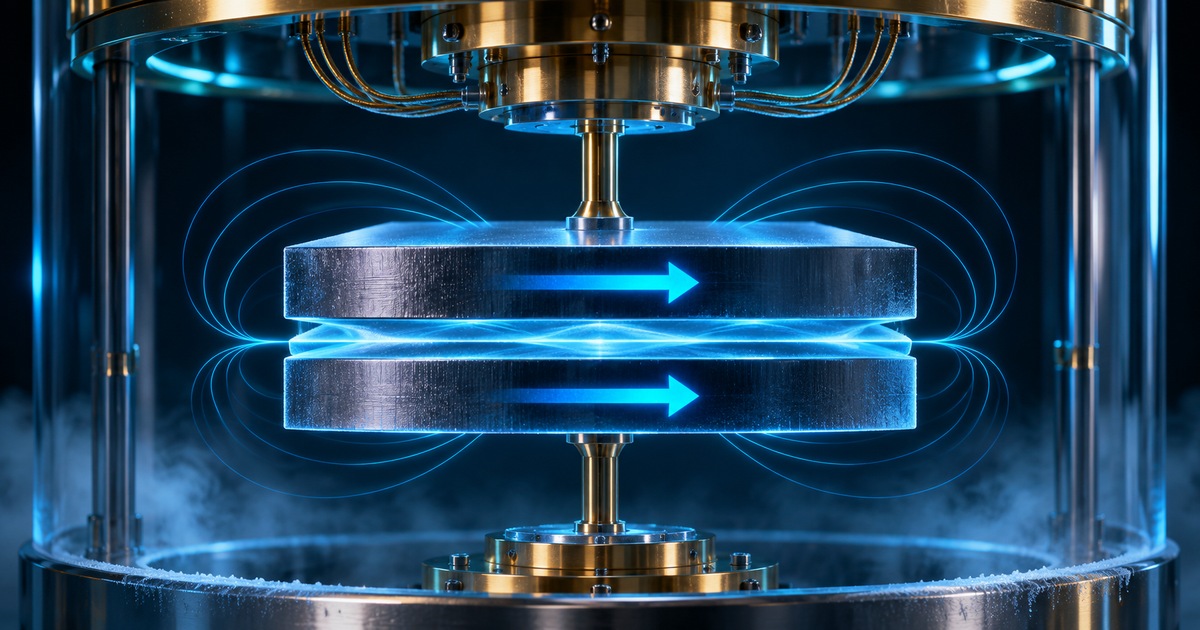
Cover: AI editorial illustration of a layered component, not a microscope image.