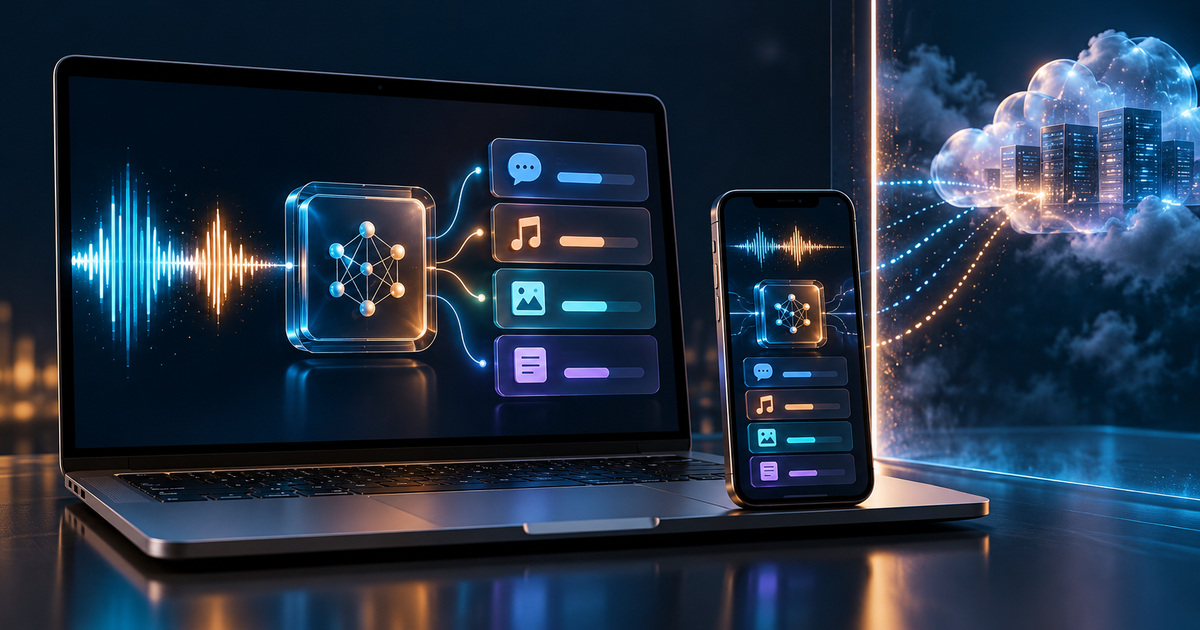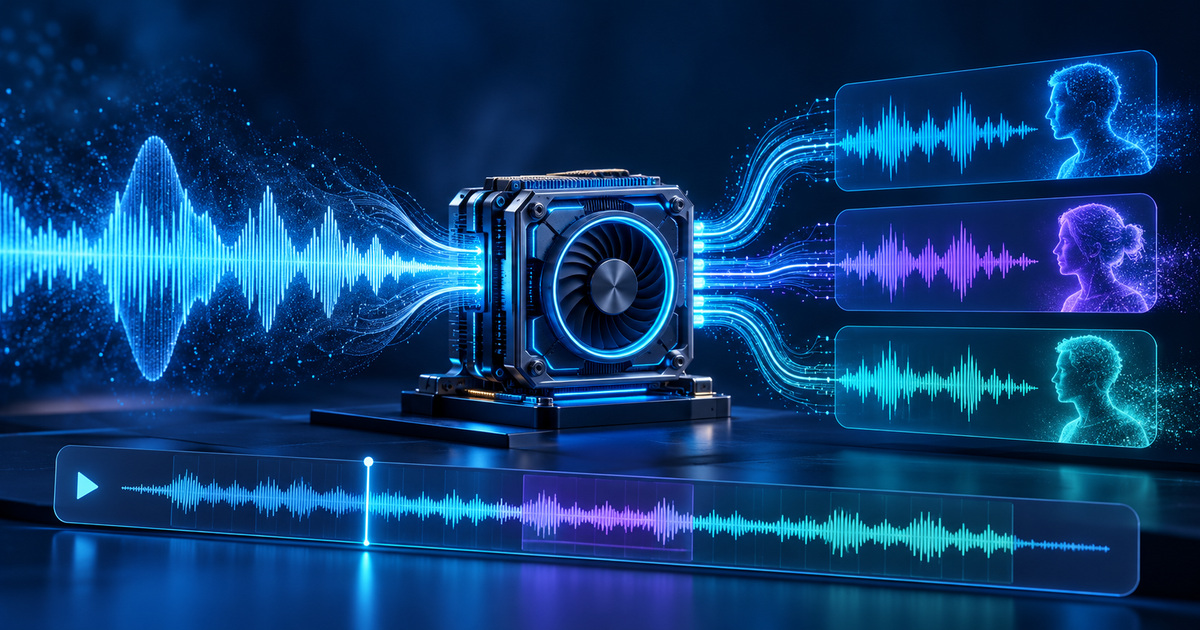
On October 28, NVIDIA introduced Nemotron 3.5 Transcribe and Granary v2. According to the announcement, the model transcribes 40 languages, translates 31 to or from English and attributes speakers in 13. It supports recordings up to an hour and up to eight speakers. Granary v2 supplies adaptation data and tooling.
A recording is not a live conversation
The official model card identifies an offline system. Internal audio chunking does not make it a streaming transcription service. The card specifies 34 billion total parameters including the audio encoder, about 4.3 billion active, an H100 80 GB BF16 reference configuration and OpenMDW-1.1 licensing. The fastest published measurements use NIM optimisations not yet included in the open implementation.
These distinctions change how a product should be evaluated. An archive can be processed after recordings finish, whereas a conversational application needs results before the speaker completes an entire recording. Short processing time for a finished file does not establish how an interface with continuous input will behave. This is our engineering and editorial interpretation, rather than a measurement we performed on the model.
Versions and accuracy are not interchangeable
At verification, the card lists BF16, FP8 and NVFP4 variants despite the blog's remaining “coming soon” wording. The separate NVFP4 card requires Blackwell and warns that its tables describe BF16. It reports an average transcription error rate 3.6% higher in relative terms for NVFP4, not a 3.6-percentage-point difference.
A team should therefore avoid combining the lowest error from one configuration with the highest speed from another and presenting that combination as a measured product. For a particular workload, both results need to refer to the same version, hardware and serving implementation.
From text to a useful result
Consider an illustrative interview archive requiring accurate original text, translation and speaker attribution. A misspelled name, an incorrectly attributed speaker and an inaccurate translation are different failures. Successful transcription in a language is insufficient grounds to promise every other function for that language automatically.
Our assessment is that the task must be defined before selecting a metric. Search across an archive may prioritise finding the relevant passage; publishing an interview requires checking individual remarks and editorial review. SIExpo has not processed audio with this model or independently confirmed the company's comparisons. The development is one model supporting several audio tasks with distinct limitations, rather than a promise of uniform accuracy everywhere.
*AI illustration: conceptual recording processing, not a real user session.*
*Editorial verification: 29.10.2026, 19:17:12 +0200 (Europe/Sofia).*