NVIDIA published a practical walkthrough for a pick-and-place simulation using SimReady assets on November 13, 2026. This is a new example of using the library whose launch SIExpo has already covered, rather than a second announcement of that library. The following is an original analysis of documentation; we have not executed the scene.
Three different levels of readiness
The walkthrough uses Isaac Sim 6.2 and combines a robot arm, gripper and beverage can. Its important boundary is between prepared asset properties and a successfully executed task. Mass, contacts and joints supply a necessary foundation, but scene composition and control code remain separate work.
SimReady Foundation organizes requirements through profiles and features. Validation should therefore be read within the scope of a particular profile. Checking authored physics or joints does not automatically establish that every composition behaves correctly, still less that it transfers directly to physical hardware.
In our reading, the first level is the file: which object it describes and which properties it contains. The second is composition: correct connections, coordinates and contacts among the participants. The third is behavior: whether the control sequence achieves its goal and how it handles deviations. Combining those levels makes diagnosis harder.
A specific mismatch in the links
NVIDIA's text names a Robotiq 2F-140 gripper. Its link instead opens a pinned Robotiq_2F_85.usda file in Robotiq's official dataset. These are different designations; we do not treat them as interchangeable or present the example as an exact recipe independently verified here.
The linked arm asset points to a versioned UR17G package from Teradyne Robotics. The packages have their own provenance and license labels. Availability through a shared platform does not automatically create one common license for every component. The pages reviewed here establish file traceability, not evidence that SIExpo tested a particular assembly.
What follows for developers
Our practical recommendation is to fix the exact assets and revisions before comparing behavior. When an instruction and a linked file disagree, the choice should be resolved rather than silently adapting dimensions or limits on an assumption.
A useful test record would separate scene checks from task outcomes. An arm loading correctly does not establish a stable grasp; one successful lift does not establish repeatable release at the target. With AI-generated code, developers also need to inspect what is actually controlled and how failure is reported. These are proposed criteria, not tests performed by SIExpo.
Reproducibility requires more than keeping a screenshot. A scene revision, component identities and the settings relevant to the observed result provide a stronger basis for later comparison. If the scene changes, earlier success should remain evidence for that earlier configuration rather than automatically carrying forward.
The new walkthrough is valuable as a concrete bridge between an asset catalog and a working simulation task. Its most useful lesson is to preserve traceability at every step. A validated asset, a functioning scene and a reliable task can then remain separate, testable statements rather than collapsing into one claim of readiness.
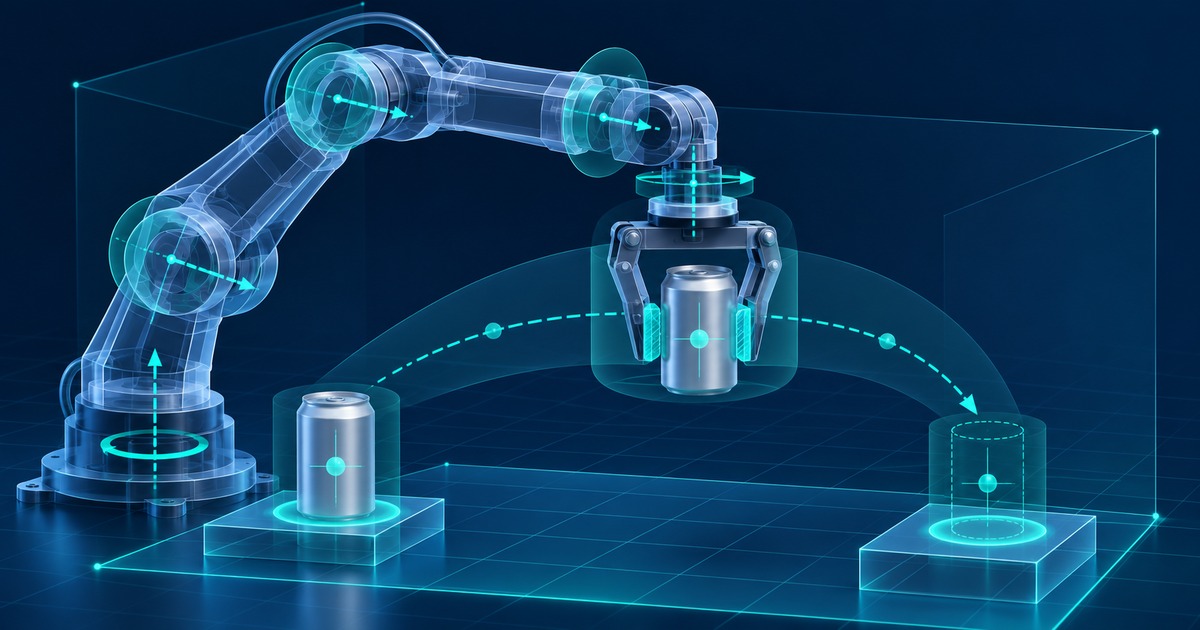
The cover is an AI illustration of the principle, not a captured execution of the example.
Editorial verification: 2026-11-14T07:32:28.965785+00:00.