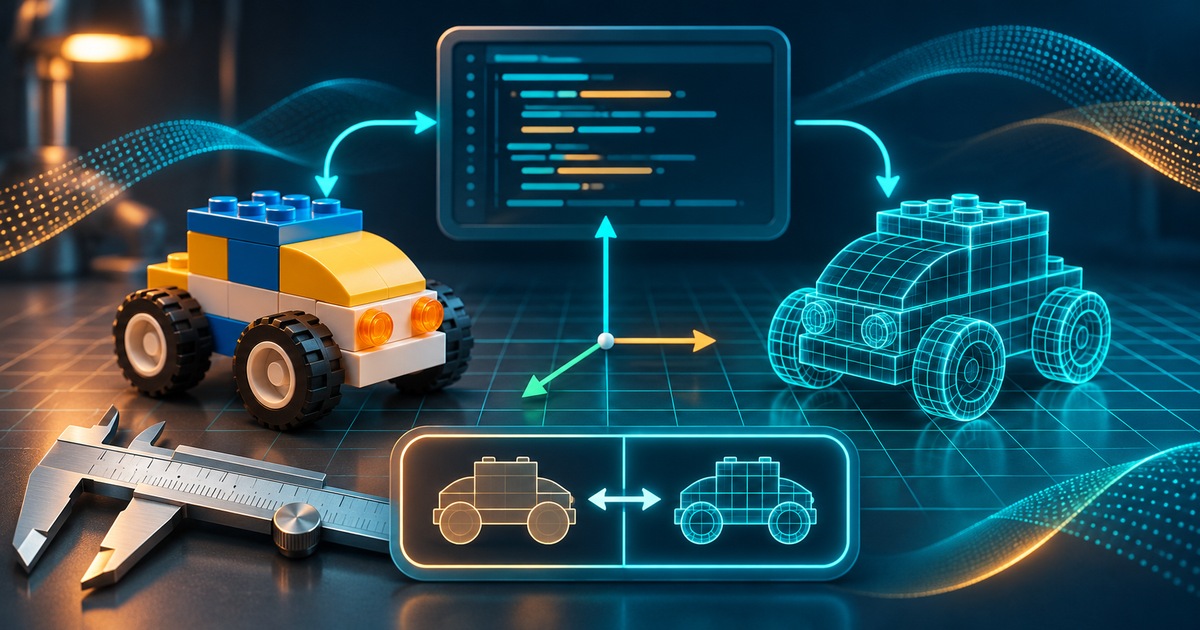
Researchers presented Real2SimLab on November 25 as a common platform for transferring real observations into simulation. The task is for an AI system to produce an executable program that reproduces what was observed. The authors report support for 47 coding agents and five other methods across six benchmarks.
The platform runs the submitted program and uses the original scorer for the relevant benchmark. That distinction matters: a shared report format does not mean that different tests measure the same capability. The new preprint and open project provide comparison infrastructure, not proof that real-to-simulation transfer has been solved.
From recording to a checkable artifact
The official repository describes recorded runs, freezing the delivered artifact and replaying it offline. This separates an agent's development activity from the behavior of the simulator it produces. Keeping those stages distinct is useful when methods have different tools and development budgets.
Imagine a recording of an object sliding across a surface. A reconstruction might look convincing from one camera, but evaluation still needs to specify what is being compared. Appearance, trajectory and behavior under changed initial conditions are different questions. This is our explanatory example, not an experiment we reproduced.
A common interface is valuable because it makes conditions easier to trace. It does not remove the need to read each task's definition. Reconstructing an observed movement should not automatically be described as predicting every future interaction.
When a comparison is fair
Our practical interpretation is to record the method version, its inputs and its available attempt budget. If one agent receives more time or different information, the result must be read in that context. Otherwise a ranking can mix model capability with the quality of its surrounding workflow.
The repository also describes separating training data from evaluation. A statement that filtering was performed is not an independent audit of overlap. A team reproducing the work should examine the actual data versions and exclusion rules rather than treat a general description as sufficient.
Relevance to robotics
Simulation is useful for examining hypotheses before acting with physical equipment. That is precisely why simulator error must remain visible: a better simulated score is not, by itself, evidence of safe physical operation. Transfer to a robot requires separate acceptance criteria and checks on the real system.
Real2SimLab could make research comparisons more organized and reproducible. SIExpo has not run the platform or scored an agent with it. The news is the released infrastructure and its verification approach. Its practical value will depend on preserving the conditions and meaning of each individual test in the resulting reports.
Cover: AI editorial illustration, not a documentary photograph.