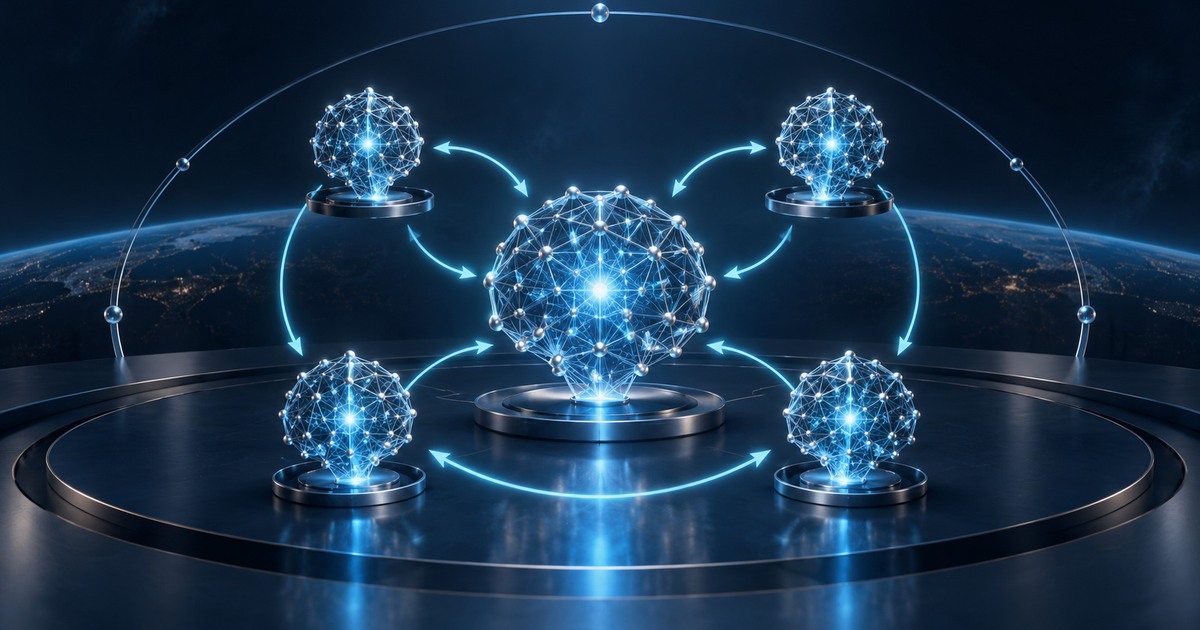
On October 12, 2026, Sakana AI introduced MASS, or Multi-Agent Self-Supervision. The approach uses one shared model as executor, organizer, and evaluator. Experience from a virtual team's work becomes material for subsequent training. This is a research method, not an announcement of a finished system with demonstrated general intelligence.
What has been published
The paper was submitted to arXiv on October 8. Its authors are from Sakana AI and UC Berkeley. The abstract describes two cycles using Qwen3.6-27B and combines evolutionary workflow search with training on self-generated trajectories. An arXiv preprint does not itself establish that independent peer review has been completed.
Editorially, two changes should be distinguished. One concerns how several roles divide a task. The other concerns changes to model parameters after learning from selected examples. A better plan within a conversation does not automatically mean that the model has been retrained.
The inner and outer loops
The authors' detailed account describes an inner search with fixed weights and an outer training stage using selected executions. After two updates, they report 1.2–1.6 times the base model's score per output token across four research benchmark sets. On Terminal-Bench 2.0 and SWE-bench Verified, the same measure is 0.96 and 0.94 of the base respectively.
These ratios describe a particular measure, not a universal multiplier for intelligence. Score per token combines an assessment of work with the amount of generated text. Shorter execution and better execution can affect that ratio differently. The comparison does not measure every resource used to prepare data and train the model.
The code is not a complete reproduction package
The public repository's README describes separate search, collection, selection, and training stages. It also identifies missing components: its MLR-Bench configuration covers an earlier small subset, and adapters for several other evaluations are not included. Available code and all reported experiments should therefore not be portrayed as identical packages.
A separate NOTICE states that no public open-source licence has been assigned to MASS-specific code. Model weights, task datasets, and generated artifacts are not distributed with the repository. This describes the published conditions rather than offering our legal conclusion about every possible use.
That clarity matters to researchers seeking to check a result. They need to know what can be inspected and which data, settings, and tools remain absent. Reproducibility requires a traceable package; a GitHub link does not replace that examination.
What LoRA means in this context
MASS's detailed description identifies LoRA for training. The original 2021 LoRA paper explains adaptation through trainable low-rank matrices while base weights remain frozen. This provides technical context for distinguishing prompt changes from parameter training. We do not infer a specific MASS cost or hardware requirement from that background paper.
A hypothetical team could prepare data, select a method, and check a report. If its execution is used for training, the model receives an example of the process rather than only its final answer. This is our explanatory illustration, not an invented additional experiment attributed to the authors.
Self-evaluation remains something to examine
Our main editorial question is how genuine progress is recognized when the same underlying model proposes work and evaluates it. Agreement between roles is not logically equivalent to independent verification. Different roles can share the same mistaken premise, making an external way of detecting it important.
The promising element is the concrete link between organizing work and subsequent learning. The limitations are equally concrete: a preprint, author-reported results, uneven transfer, and an incomplete public package for all evaluations. Independent reproduction on well-described tasks would be a useful next step, rather than turning one benchmark ratio into a promise of universal self-improvement.