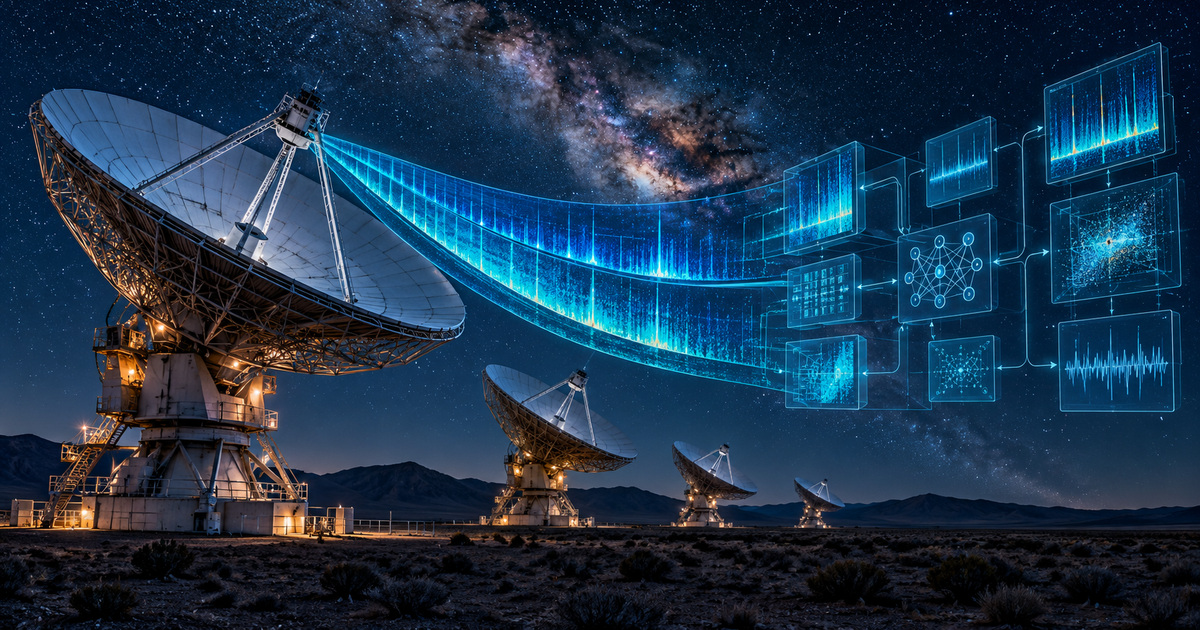
On October 30, NVIDIA described agent-directed control and analysis at the Allen Telescope Array through Holoscan, used by the SETI Institute and Breakthrough Listen. It reports 2.4 Tb/s and a Crab Nebula pulsar demonstration. This is a company account, not an independently verified record or extraterrestrial discovery.
The instrument behind the story
The SETI Institute describes the array as 42 six-metre antennas at Hat Creek, California, operating at roughly 1–14 GHz. Interferometry combines radio signals, while beamforming enables targeted observations. Alongside searches for technological signatures, the observatory studies ordinary astrophysical phenomena. A pulsar is one such natural source.
CyberEther presents its component as a graph of signal-processing blocks. The project describes live ingestion over 100 GbE, correlation and baseline visualisation at the array. Its general interface supports changes to a running graph. This clarifies what an agent can control: a specific processing chain, rather than an undefined “intelligence of the telescope”.
Holoscan documentation places the platform between sensors and accelerated processing. It provides modular operators for input, preprocessing, model inference and visualisation. That general architectural context does not independently establish the reported speed of this particular astronomical system.
Reading the technical achievement
Our editorial interpretation is that the value lies in connecting observation, computation and control. A textual request must become inspectable operations: what is observed, how the stream is processed and which result returns to the researcher. An attractive spectrogram does not by itself answer those questions.
The connection figures also have different scopes. CyberEther’s 100 GbE description and NVIDIA’s 2.4 Tb/s figure should not be merged into one measurement: the pages do not establish that they concern the same interface, configuration or test. We therefore calculate no acceleration factor between them.
What a convincing evaluation would establish
We suggest the following evaluation approach without claiming SIExpo has performed it. A research team could preserve the same recorded radio stream and compare a predefined processing workflow with agent-directed operation. Relevant measurements would include dropped packets, calibration stability, time to a reproducible result and human corrections. Conditions would need to match for the comparison to be meaningful.
For a live instrument, we would distinguish read access from permission to change an observation. A record of executed commands and a way to restore the previous configuration would help investigate disputed results. These are editorial criteria for a reliable experiment, not claims about safeguards already deployed at the array.
A useful report would also separate failures of the language interface from failures of the signal-processing pipeline. Otherwise an apparently smooth interaction could conceal missing data, while an awkward interaction could still produce a scientifically valid result. The operator needs evidence about both parts of the system.
Finally, recognising a familiar natural signal is a useful processing check. It does not replace the separate scientific task of establishing the origin of an unfamiliar signal. The development matters as an example of agents connected to real scientific instruments; speculation about other civilisations remains a different question.
*Cover: AI illustration; a conceptual scene, not a documentary photograph of the observatory.*
*Editorial verification: 30.10.2026, 19:35:25 +0200 (Europe/Sofia).*