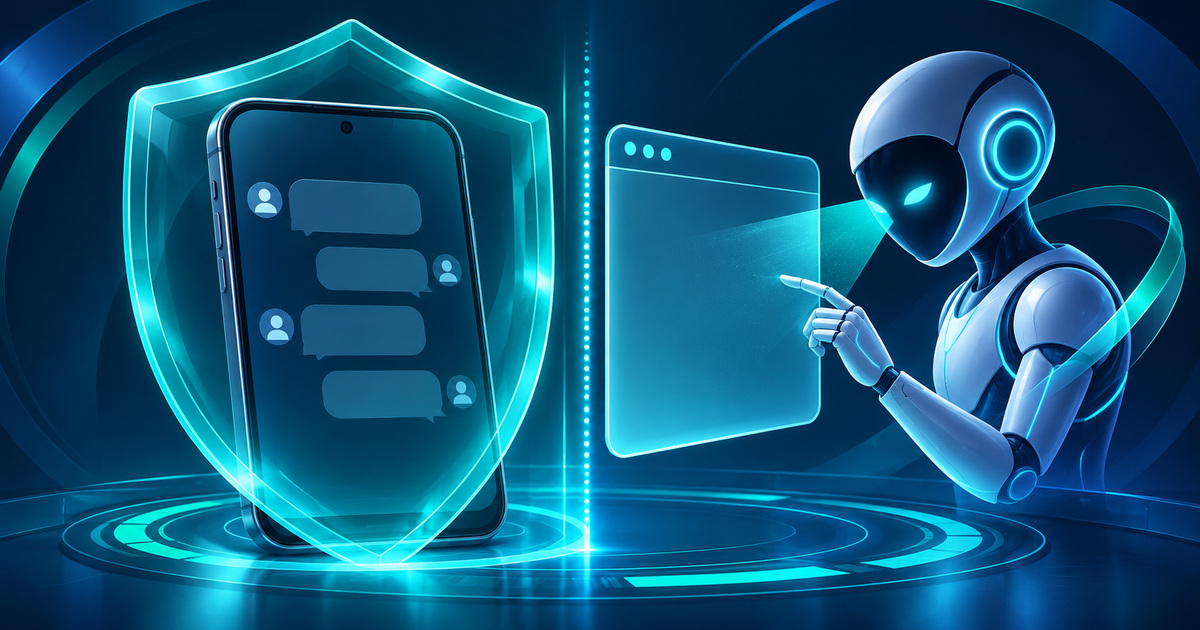
Signal announced measures on November 20 against screen-content capture by AI agents embedded in operating systems. The app restricts screenshots on iOS 27 and in Android environments where it can detect such an attempt. Its developers explicitly describe the remedy as incomplete and say they currently cannot implement comparable protections on macOS.
A message after delivery
The announcement does not establish a break in Signal's encryption. It concerns information after receipt: the participant can see it, while a system assistant may have a separate route to it. Signal identifies filesystem access as an example that screenshot blocking does not address. Users can disable protection, potentially exposing information belonging to their contacts as well.
Our editorial interpretation is that privacy has several boundaries. Transport, display and subsequent processing are different operations. A protected communication channel does not automatically determine which other software can use content on the endpoint. That distinction matters well beyond messaging applications and should remain visible when describing what a product protects.
Implications for agent applications
Consider a proposed design example: a workplace assistant summarizes information from several business applications. Before adding another source, its developers could document screen access, notifications and local files separately. A broad permission for the assistant to be helpful does not explain where its scope ends. This is an engineering illustration, rather than a test we performed or an account of a specific incident.
A useful acceptance exercise would use fictional conversations in a separate profile. It could compare what the assistant can see under different settings and record the application version, operating system and access mechanism. A successful result should be reported as a result for that scenario, without becoming a guarantee for every device or subsequent release.
Keeping the choice understandable
Users need to understand what changes when they turn protection off. Administrators need to decide who may make that change and how its effects on other participants' data are explained. Developers need to limit their promises to controls the platform actually lets them enforce. These responsibilities overlap, but none can be replaced by a reassuring encryption label alone.
Signal's announcement is both a concrete product measure and an account of limited control over the surrounding environment. SIExpo has not independently reproduced every platform combination discussed. When assessing an AI assistant, the useful question extends beyond whether communication is encrypted: it includes who can read, retain and forward the information after delivery.