On 15 October, Axonex AI announced TOMO and Rice Robotics Hong Kong's participation in FLAIR's embodied-AI hub. Introducing a robot does not establish an educational benefit.
The company describes TOMO as a wheeled humanoid with an expressive face, chest display and two-finger grippers, intended for reading, STEM and programming activities. These are manufacturer-described functions, not SIExpo device tests or findings from a comparative student study.
What the new hub contributes
A separate HKPC release describes the Embodied AI International Applications Hub as an environment for training, adaptation and validation. Its initial phase names seven technology partners and eight scenario partners, covering manufacturing, logistics, services and inspection. The planned cycle connects task definition, training, testing, evaluation and revalidation. This describes how work will be organized, rather than proving reliability already achieved across all sectors.
Both sources are participant announcements. HKPC's text was distributed through Media OutReach and carried by Malay Mail; that does not make it an independent journalistic assessment. We use it for the hub's structure, not as outside confirmation of every TOMO capability.
An educational robot needs several kinds of evaluation
Our editorial interpretation separates three questions. Can the machine perform the physical task in the specified environment? Can a participant understand and use the interaction? Is there a measurable educational outcome? Success on one question does not automatically answer the other two.
In an illustrative demonstration, a robot moves a book and explains its motion sequence. This may successfully demonstrate control. To call it a useful programming lesson, however, an evaluator needs to establish what the learner understood and can apply. Applause or conversation duration does not measure that skill.
The distinction between a prepared demonstration and a changing environment also matters. A table could have a different height, an object could be displaced or an instruction could be ambiguous. These are examples of conditions we would include in an evaluation; we do not claim TOMO passed or failed such tests.
Useful evidence after the introduction
For an actual pilot, we would look for task descriptions, supervision requirements, stopping conditions and records of human intervention. Knowing when an operator helped is essential. If assistance is omitted from the account, a smooth demonstration may create an inaccurate impression of autonomy.
For classroom use, we would also separate the teacher's work from the robot's contribution. Preparing material, correcting wrong answers and recovering from technical problems form part of a lesson's practical cost. A machine may have value as a learning platform, but that needs assessment against a defined teaching objective.
The Hong Kong announcement concerns an introduced product and a framework for validation. The next substantive development would be published test results with clear conditions and limitations. SIExpo has not tested TOMO. We do not attribute proven learning gains, widespread deployment or teacher-replacement capability to the present announcement.
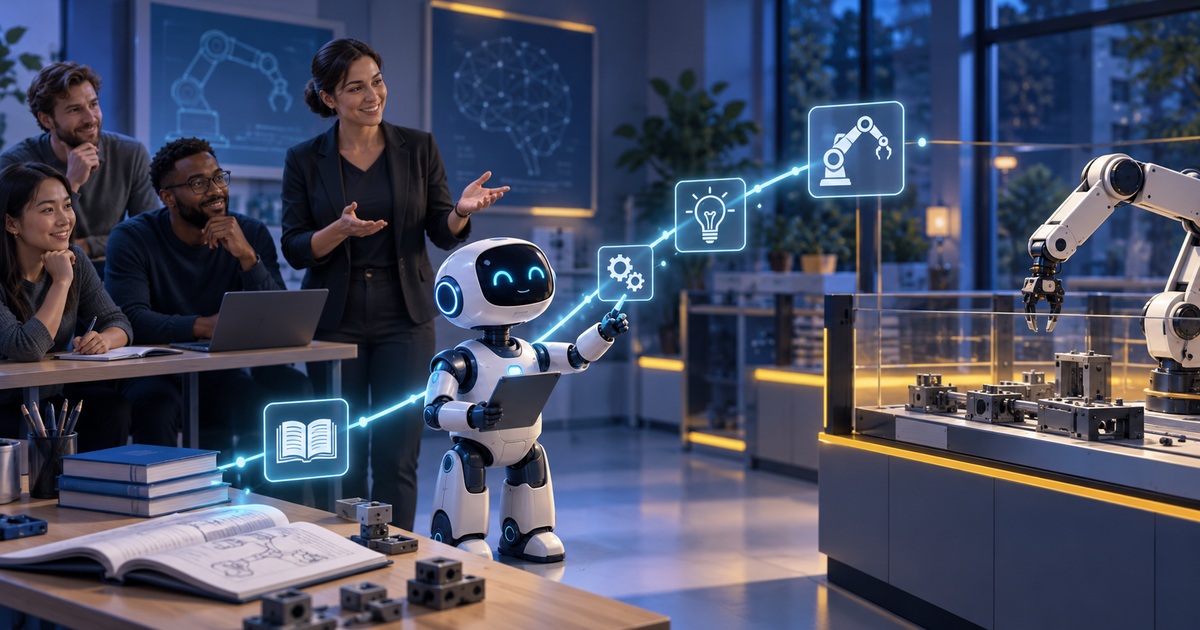
Cover: a conceptual AI illustration of educational robotics, not TOMO's actual product design or a real demonstration.
Editorial verification: 2026-10-15T16:12:02.996741+00:00 (UTC). Cover: AI illustration, not a documentary photograph.