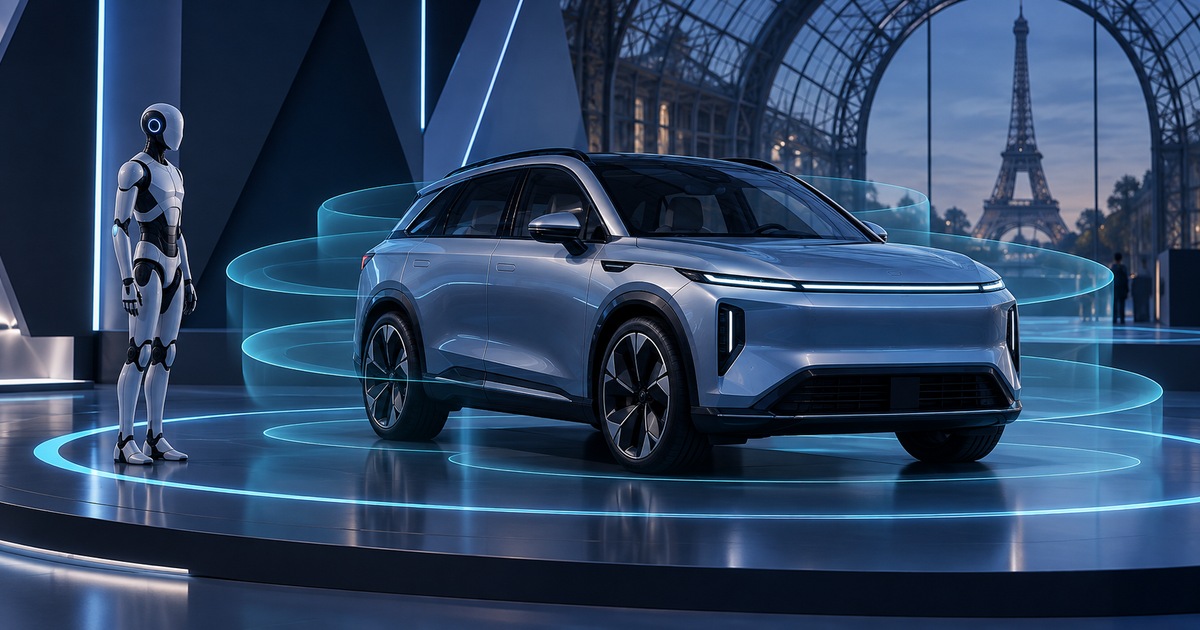
On 12 October 2026, China's XPENG presented the G9L for Europe at the Paris Motor Show. It announced public test rides with NGP powered by VLA 2.0 and opportunities for technology collaboration. This is a specific presentation and demonstration program; we do not equate it with permission for unrestricted autonomous driving on European roads. Event announcement.
A connection to European manufacturing
The presentation has a background beyond the exhibition stage. On 7 October, XPENG reported a G9L production trial at Magna in Graz, Austria. This is a manufacturing-preparation milestone, distinct from evidence of mass deliveries of the new model. For the AI sector, the significant connection is between a software proposition and a physical manufacturing and service environment.
CnEVPost independently reports the European launch and a starting price of €74,990 in France. The European electric version has six or seven seats, unlike the five-seat Chinese version. The publication notes that the earlier production-trial announcement did not specify when mass production or deliveries would begin. This adds concrete product context without turning the exhibition into a promise of immediate delivery.
In its earlier Chinese presentation, the company described VLA 2.0 and a proprietary Turing chip sharing a technology foundation with the IRON robot. This is the company's physical-AI framing. A common hardware element does not establish identical tasks, software or reliability between a vehicle and a humanoid robot. The applications still require their own evidence.
What VLA means
Vision-language-action connects visual information, language and actions. RT-2, published in July 2023, provides useful research context: it represents robot actions as tokens and trains them alongside vision-language tasks. We cite that work to explain the category. We do not claim XPENG uses RT-2, or that results from its robotics experiments establish the behavior of NGP in a car.
Our editorial conclusion is that a model choosing an action must be evaluated against the consequences of that action. In a chat, an incorrect description can be corrected in a later answer. In a physical environment, response time, sensor state and control boundaries become part of the task. The quality of a language explanation is therefore insufficient as a measure of the quality of a control system operating around people and objects.
Demonstration and everyday use
A public test ride lets a visitor observe behavior under particular conditions. It does not by itself cover every condition of future use. For an evaluation, we would want a description of the route, function limits, driver interventions and the way an inability to continue is communicated. These are questions for future verification, not deficiencies we have established in the product being shown.
A hypothetical example illustrates why environment matters: a temporary change in traffic arrangements can differ from a familiar road layout. An evaluation should examine how uncertainty is recognized and predictable control preserved. Successfully completing one section does not describe the frequency of rare cases or the response when part of the available information is lost. The evidence needs to describe both performance and the conditions surrounding it.
Moving between markets
In our reading, the European announcement also concerns transferring a system between environments. An engineering team should check local signs, user instructions, support arrangements and the specifically available functions. Translating the interface is only one part of that job. The person in the vehicle needs to understand when a feature operates and which responsibilities remain with them throughout its use.
Local manufacturing does not replace software validation either. Hardware versions, model versions and settings can change at different times. For traceability, we would want observed behavior tied to a precise system version. That would allow a future update to be compared with its predecessor, rather than grouping every demonstration under one continuing marketing name regardless of changes to the underlying system.
The Paris presentation is a significant meeting of AI models, an automotive product and a new market. It supplies a verifiable date and product milestone. The next substantive check should examine what customers can actually access and how it behaves within its stated boundaries. Until then, test rides remain demonstrations, and the broader physical-AI ambition extends beyond the evidence for any individual feature.
Sources checked: 2026-10-12T16:32:59+00:00. Cover: AI illustration, not a documentary photograph.