ABB announced the integration of AI Robot Trainer into Fashion Inductor on October 15, targeting item induction in fashion logistics. The development connects vision-model training to the operation of a particular robot cell. The manufacturer claims up to 75% less engineering and commissioning effort. That is a stated reduction in a defined process, not a general promise of a 75% reduction in warehouse costs.
Different garments bring different difficulties
The product page specifies up to 1,300 items per hour per cell and picking-accuracy targets above 99.5%. These are vendor specifications, not SIExpo measurements. It also describes pretrained fashion vision models and adaptation to new products and packaging. Changing incoming items provides the practical reason for subsequent training rather than treating deployment as a one-time event.
Readers should distinguish peak rate, accuracy, and end-to-end throughput. A successful grasp does not establish that the entire route to the next machine finished correctly. An incorrect placement or human intervention can change the actual flow. This is an editorial explanation of the measures, not a report of a defect found in ABB’s system or a claim about a particular customer installation.
Where the digital twin fits
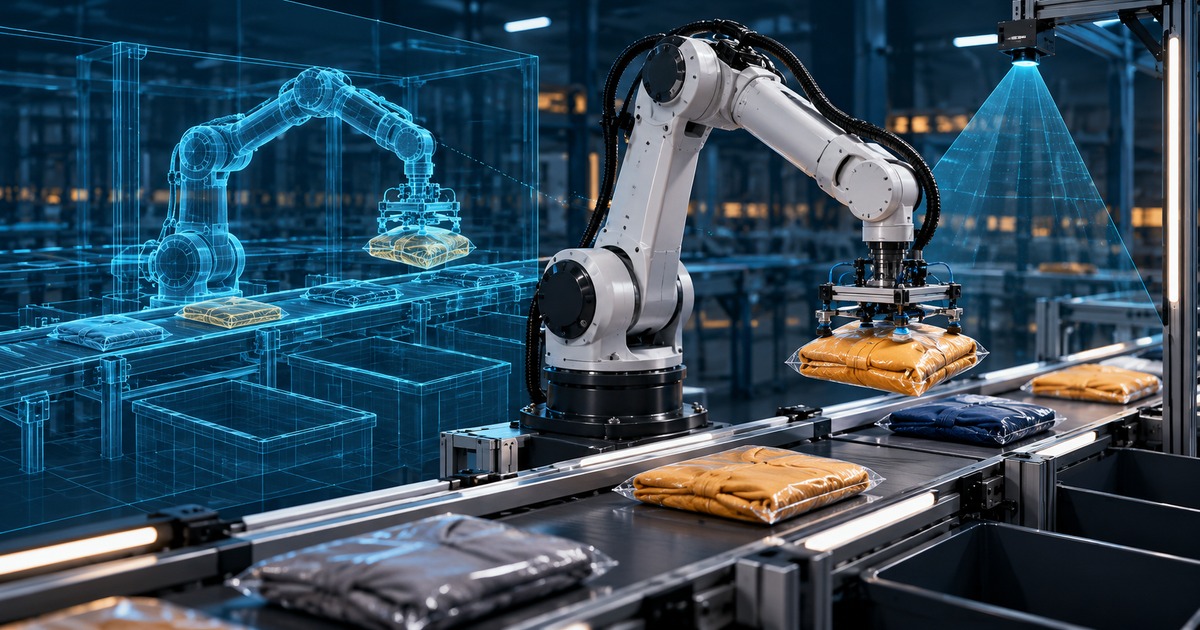
The announcement connects the twin to Application Controller Platform, Automatic Path Planning, AI Robot Trainer, and RobotStudio. OmniCore remains the production execution layer. RobotStudio’s own page supplies additional context: offline programming, a virtual controller, motion analysis, and layout validation are tools distinct from training the vision model.
One practical benefit of that separation would be examining a change before introducing it on the physical line. Simulation, training, and accepting a new version are nevertheless different activities. Correspondence with the real objects, lighting, and gripper must remain testable. This is our engineering interpretation of the architecture, not a test SIExpo has conducted or a guaranteed outcome for a prospective buyer.
How to assess continuous updates
Our proposed acceptance test would include ordinary items and a predefined set of difficult cases. Preserving results from the previous version would allow a comparison under the same conditions. An improved average could otherwise conceal a decline in a rare but important category. The test should reflect the assortment the cell actually needs to handle.
Maintenance effort is a separate measure: who prepares data, who approves changes, and how the previous version is restored. This does not make updating undesirable. It means that a promise of faster adaptation should be evaluated alongside the work needed to verify it and clear responsibility for the final result. Neither a model update nor a simulation alone answers all those questions.
ABB describes expansion of the approach to additional applications through the first quarter of 2027. That remains a plan. The current development is the specific Fashion Inductor integration. For a potential customer, the most useful next answer would be an evaluation on its own assortment, with agreed criteria for errors, interventions, and completed inductions rather than transferring headline figures directly into a business case.
Editorial verification: 2026-10-18T16:11:34.881843+00:00 (UTC). Cover: conceptual AI illustration, not a documentary photograph.