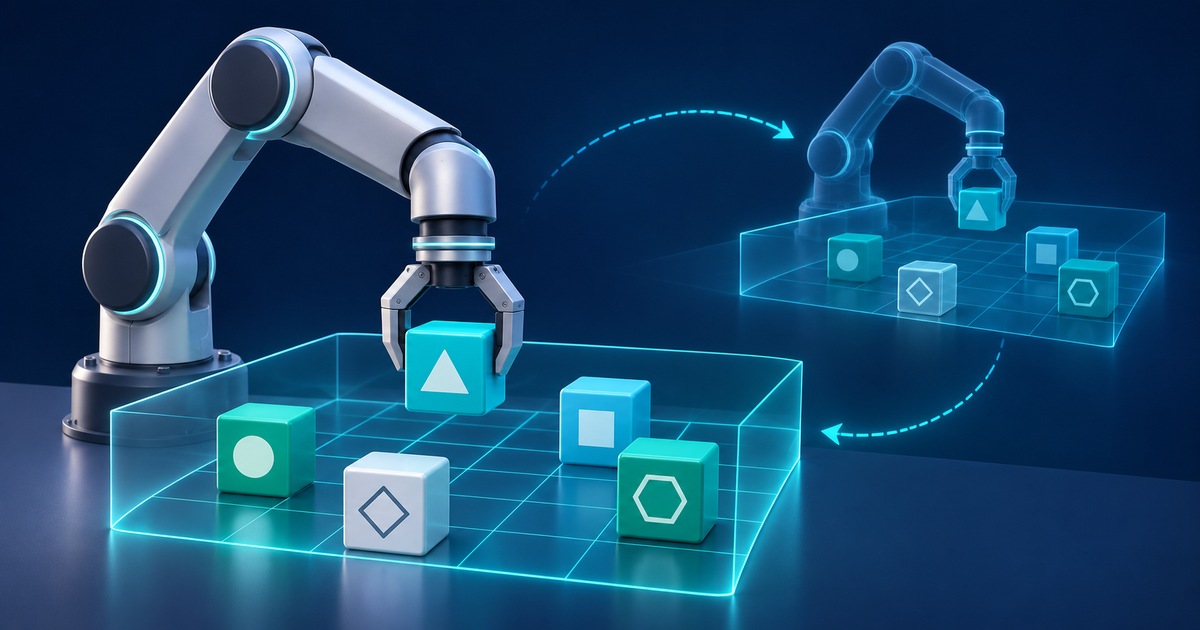
Ai2 introduced ToyBlocks on November 6 as a controlled environment for studying robot learning. The framework places a robot arm and tabletop blocks in simulation, generates demonstrations and supports repeatable evaluation. It is the first example of the FoundationWorlds approach: bounded worlds in which researchers can more clearly trace why a system succeeds or fails. This is research infrastructure rather than evidence of universal robotic dexterity.
Why a small world can be useful
A complex demonstration often combines perception, planning and movement. When something goes wrong, the overall result does not identify the failing layer. Our editorial interpretation is that a controlled environment is useful precisely when it lets researchers change one variable while keeping the remaining conditions traceable.
An unsuccessful arrangement, for example, could begin with a misidentified block face, an unsuitable action sequence or inaccurate movement. All three may produce the same visible outcome. A useful experiment distinguishes them because they call for different changes to data or models. This is our illustrative example, not an additional measured result from Ai2. The distinction prevents one broad failure label from hiding several different engineering problems.
What has been released
The repository describes an open framework based on IsaacSim and IsaacLab, generated recordings in LeRobot format and infrastructure for training ManiFlow. It supports closed-loop evaluation on fresh scenes or preserved initial states. A reference component can replace one layer of a hierarchical policy to help isolate the source of failure.
The main code uses Apache 2.0, while the repository separately identifies licensing for submodules and downloaded assets. A team therefore needs to check the complete collection it uses before incorporating it into a project. Public core code does not imply identical conditions for every dependency or dataset, and reproducibility includes knowing which assets were actually loaded.
Success is more than a final image
The metrics documentation distinguishes success_once, when the goal is reached at least once, from success_at_end, when it holds at the final step. Results are recorded by step and episode, and collision settings affect scoring. These distinctions provide more context than one percentage for successful stacking.
For an in-house experiment, we would preserve the initial state, task, policy version and termination rule. If blocks are briefly arranged correctly before the structure collapses, initial and final success answer different questions. The metric should follow the actual objective. Choosing the more favorable one after inspecting the results would make the comparison harder to interpret.
The same applies when comparing two models. If one is evaluated on easier scenes or under different collision rules, a difference cannot confidently be attributed to the model itself. Published settings are part of the result rather than an administrative detail. A repeatable configuration makes it possible to investigate a surprising improvement or regression later.
Starting with a reproducible setup
The separate installation guide describes dependencies, assets and environment verification. A practical first stage is establishing that the baseline example works with the expected resources and configuration. Researchers can then alter the training distribution and assess its effect on a separate task set. We have not installed or run the framework for this editorial review.
Preserving failed episodes is also valuable. They allow the next change to target a particular gap instead of simply increasing the total demonstration count. The relationship between task, observations and result should remain traceable after data is generated again. Otherwise a model improvement may become difficult to connect to the change intended to produce it.
Where the evidence ends
A result in simulation does not establish readiness to operate around people. A real gripper, friction, sensor noise and different geometry require separate assessment. The restricted scene is useful because it makes some causal relationships clearer; it does not remove the distinction between simulation and physical deployment.
ToyBlocks provides tools for more testable research. Their value will appear in experiments that can be repeated and whose failures can be explained. That is a more specific form of progress than another impressive clip without enough information about how it was produced, or whether the result survives a controlled change in conditions.
Editorial verification: 2026-11-06 19:32 (Europe/Sofia).