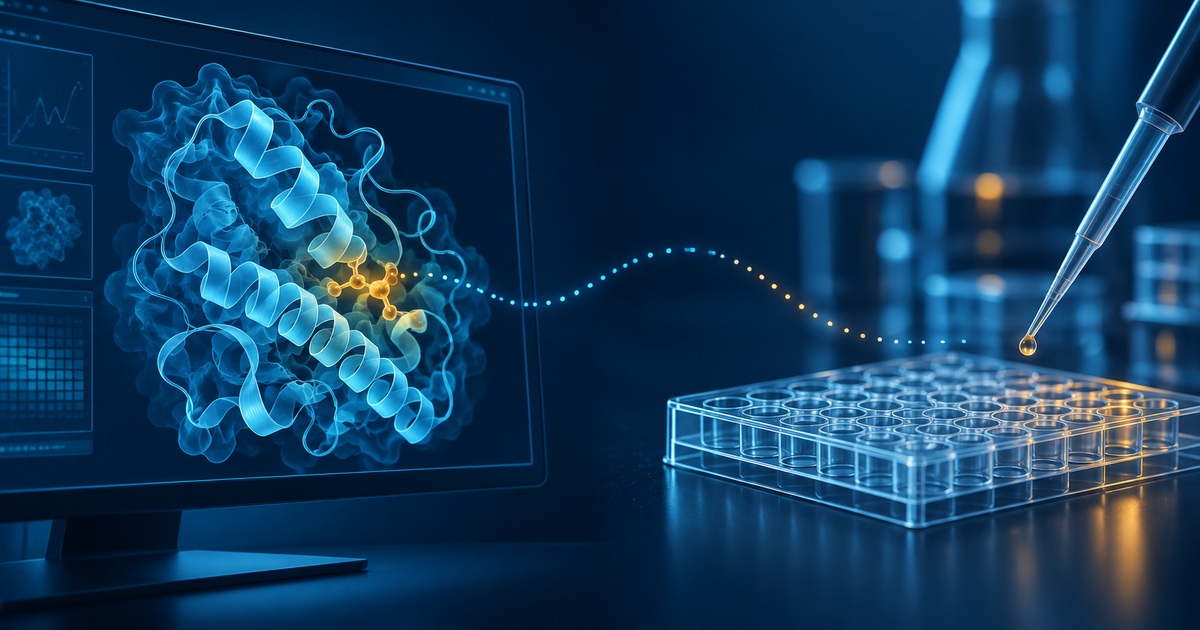
Google DeepMind published an Antigravity workflow for antimicrobial peptide discovery on 15 October 2026. It describes a candidate identified through data and computational analysis that is still undergoing laboratory validation. This is not a newly approved antibiotic, an established treatment or a published clinical outcome.
Why the research question matters
The World Health Organization describes antimicrobial resistance as microorganisms no longer responding to the relevant medicines. It also identifies a shortage of new solutions in the research pipeline. This context explains interest in finding candidates, but does not validate the quality of Google's particular hypothesis. The importance of a problem and the evidence for a proposed answer are separate matters.
In the demonstration, Antigravity helps connect information and structural observations under a researcher's direction. Google also introduces a shared three-dimensional visual context for examining molecular structures. The announcement describes a scientific workflow: making it easier to assemble an analysis does not remove the need to test its result beyond the software environment.
From a promising hypothesis to measurement
Our editorial interpretation is that AI's value here should be judged by how well it prepares the next verifiable question. A plausible structural similarity may help prioritize a candidate. It does not, by itself, establish activity, safety or practical usability. Combining those different outcomes under the word discovery can give readers a stronger promise than the evidence supports.
Imagine a researcher receiving a list of candidate molecules. A useful account would preserve where each hypothesis came from, how priorities were assigned and which evidence is missing. Another team could then examine the reasoning and challenge the selection. A compelling visualization makes a structure easier to inspect, but is not an independent experimental test of the proposed effect.
People also define the boundary of the question
For such an assistant, we would distinguish retrieving a database record, making a prediction and drawing an interpretation. An automatically annotated database entry should not silently become a human-confirmed biological function when an agent summarizes it. A proposed accountable workflow would keep those evidence types visibly separate. This is our interpretation of good reporting, rather than a description of an independently tested deployment.
Negative results matter as well. Failure to confirm a candidate in the laboratory would not automatically invalidate every part of the workflow. It would, however, require updating the particular claim. Evaluating practical usefulness would include what the system learns from such outcomes and how its next selection changes, rather than simply counting the suggestions it produces.
At present, the news concerns a more connected research tool and a candidate for further examination. We do not have independently verified laboratory outcomes for that candidate. SIExpo explains the method and the limits of available information without turning it into treatment advice or predicting when a product might reach patients. The decisive evidence must come from the relevant experimental work, and later stages would require their own assessments.
Editorially checked: 2026-10-16T07:59:41.852540+00:00 (UTC). Cover: conceptual AI illustration, not a documentary photograph.