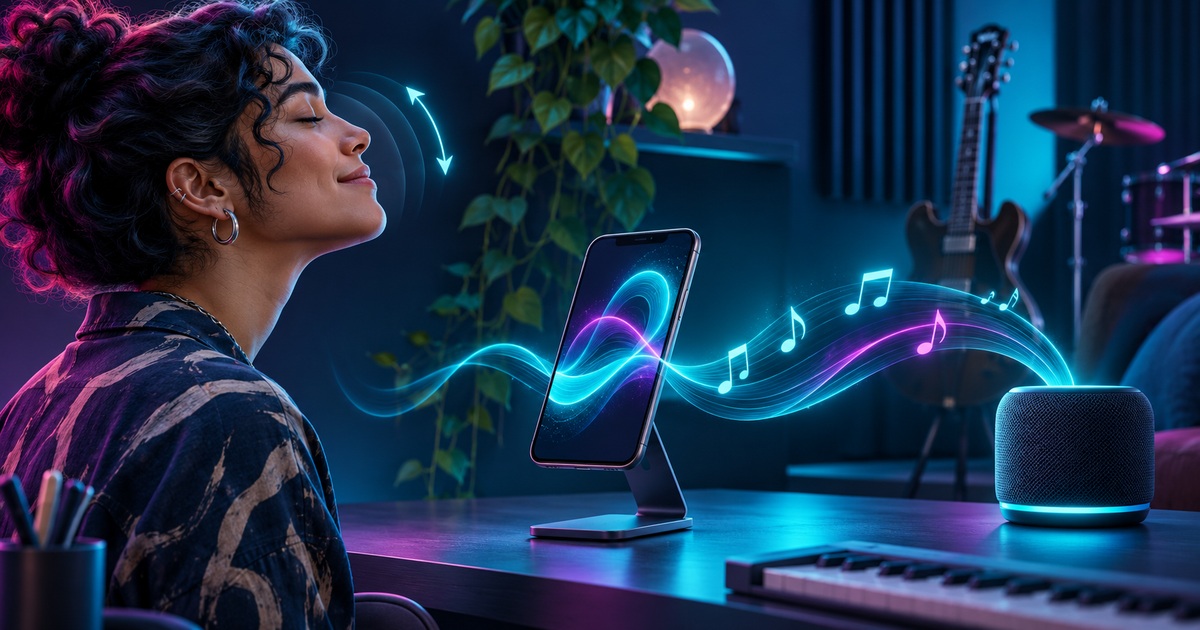
DJemma is a prototype for making music without touching a screen, presented by its creators on November 23. Head and facial movements control playing, while a local Gemma model proposes changes to the accompaniment. The authors describe a phone demonstration in airplane mode.
The interesting engineering choice is the separation of timing. Camera input and musical interaction run in a fast loop, while the model makes less frequent decisions about the backing arrangement. The authors report roughly a second per AI decision, which would become disruptive if every note had to wait for it.
The person remains the performer
The described system uses Gemma 4 E2B through LiteRT-LM, with MediaPipe tracking the face. Model proposals come from a bounded musical command vocabulary and are validated by the app. This gives AI a specific supporting role rather than making every interaction an unrestricted generated instruction.
For the user, expressive performance and accompaniment suggestions have different delay costs. A late note can break the rhythm. A slightly delayed instrument suggestion can leave the current arrangement playing until it is ready. This is our architectural analysis, not a performance measurement of the application.
What the code establishes
The linked public repository contains Android integration for a local model and explicitly notes that actual performance depends on the device. Its visible README describes a starter chat integration. That text alone does not establish that every new user can reproduce the complete demonstrated music interface without additional steps. We have not compiled or run the application.
This boundary does not invalidate the demonstration, but changes what readiness means. A published repository, a successful build and comfortable use by a particular person are three different checks. Installation instructions are not an accessibility trial.
The next test involves the intended users
Potential use by people who find touch or speech difficult motivates the project. Establishing real benefit requires examining fatigue, movement range, calibration and accidental commands. The absence of an internet permission also does not automatically settle image retention or the behavior of future versions.
A useful trial would offer low-effort undo, pause and restoration of a previous setting. It should measure whether the person retains control, rather than only whether the model produces pleasant accompaniment. These are criteria for future evaluation, not clinical outcomes established by this project.
DJemma demonstrates a clear role for on-device AI: support a user's choices without making fast interaction wait. Accessibility outcomes and everyday readiness remain separate conclusions that the available evidence does not yet confirm.
Cover: AI editorial illustration, not a photograph of a trial participant.