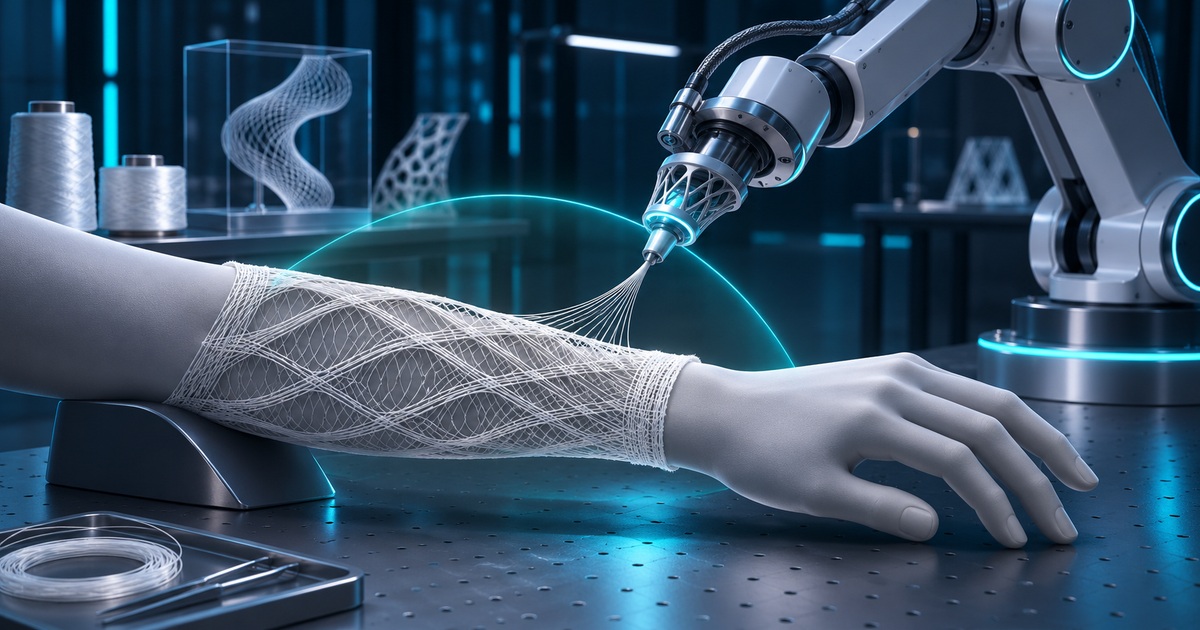
MIT Media Lab published a November 24 account of InSituWear, an experimental method for forming textiles directly around the human body. A robotic arm draws fine polymer filaments, while its path and material tension shape the resulting structure. The Critical Matter team demonstrates a sleeve and a responsive glove.
This is a new presentation of the project, but it includes a video labelled CHI 2025. We therefore do not describe the underlying technology as invented this week. Kaldata brought it to Bulgarian readers on November 25. The sources establish robotic fabrication, not a generally autonomous AI tailor capable of learning any garment task.
Responsive material is a separate capability
The official project page distinguishes motion planning from fiber behavior. Its computational pipeline includes body geometry, safety boundaries, toolpaths and collision checking. Additives and conductive elements can make the resulting material respond to heat and touch. That is different from understanding an unrestricted spoken request and independently designing any garment.
The distinction matters in practice. A material can react physically without a language model. A robot can follow a precisely computed path without understanding an unexpected human movement. Combining those two capabilities in a demonstration does not automatically establish a third: safe adaptation in arbitrary circumstances.
Working close to a person changes the test
A wrong path around a mannequin may damage a sample. The same deviation around a person could affect skin or restrict a limb. An assessment therefore needs to consider temperature, separation, stopping behavior and how the textile can be released. This is our engineering interpretation of the problem, not a conclusion from an independent test of the prototype.
A useful future trial would examine different arm sizes and small unexpected movements under a defined interruption procedure. The garment itself raises additional questions: repeated wearing, cleaning, durability and comfort. A demonstrated specimen cannot automatically answer those questions for everyday use or for every material that might be supplied to the tool.
What makes the approach interesting
Conventional garment design typically moves from a pattern to fabrication and then fitting. Here, shaping and fitting meet in the same physical process. That makes the project relevant to personalized wearables and research into the interaction between robotic motion and material behavior. It does not establish that industrial sewing has been replaced.
The next persuasive evidence would concern repeatability: consistent quality across users, measurable process control and a clear accounting of failures. The presentation demonstrates a promising research direction. Readiness should remain tied to the specific prototypes and the conditions in which they were produced.
Cover: AI conceptual illustration using a mannequin, not a photograph of the actual prototype.