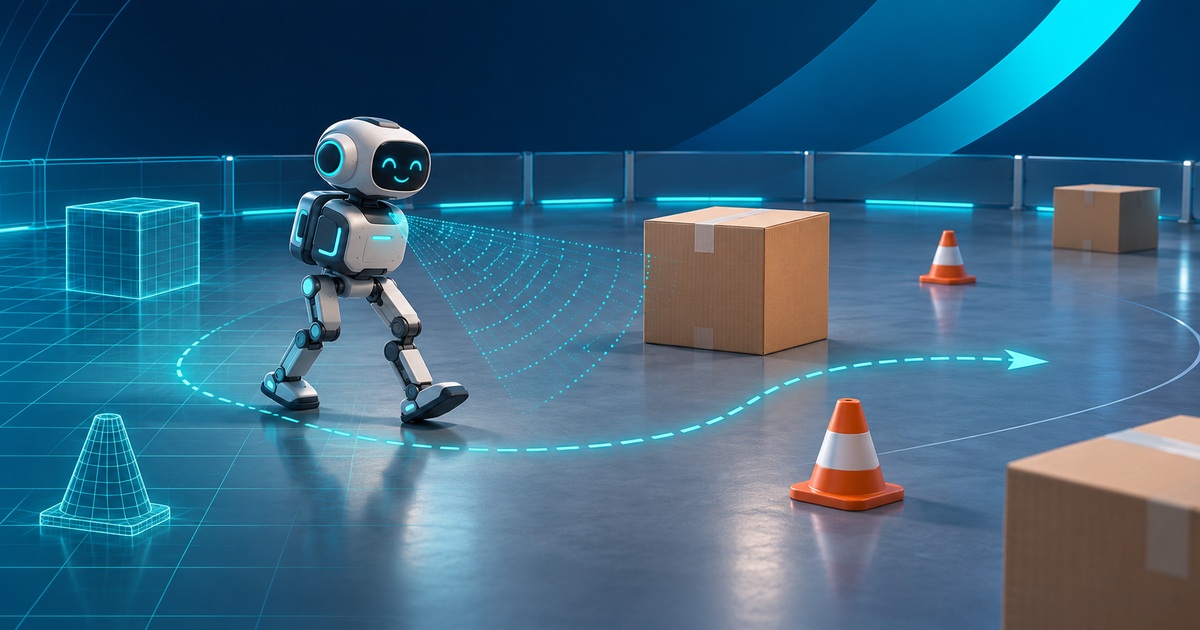
On November 24, NVIDIA published a new Microduck workflow: teaching the small biped to avoid obstacles while retaining its existing walking policy. This is distinct from the earlier walking-training demonstration already covered by SIExpo.
A navigation controller reads time-of-flight distance measurements and adjusts the requested direction and velocity. The walking policy translates those commands into joint actions. In the demonstrated interface a person still supplies direction through a gamepad. Avoiding a nearby obstacle does not mean independently planning an unrestricted journey.
Two controllers make different decisions
Separating the task helps analysis. A wrong steering decision may originate in distance sensing or navigation commands. A loss of balance during an otherwise sensible maneuver points toward the lower-level control problem. This is a useful diagnostic distinction, not proof that the modules remain independent under every load.
The example updates navigation commands at 50 Hz, while the described ToF model supplies an 8-by-8 measurement grid at 15 Hz. The controller therefore does not receive a completely new sensor observation at every update. Those different rates matter when interpreting response time: issuing commands more frequently does not create fresher measurements.
Simulation needs imperfect inputs too
The environment uses Isaac Lab and Newton with varied obstacle arrangements. For physical deployment, the documentation calls for the corresponding walking policy and a configured sensor. We do not present the workflow as automatically transferable to unrelated hardware.
Our practical reading is that the first comparison should be between what the controller expects and what the physical sensor sees. Mounting position, delay and missing observations can change the input without changing the neural-network file. Successfully loading a model checks its format, not these physical assumptions.
A useful evaluation would use new layouts that do not repeat training. It should record goal completion, contacts, falls and human interventions. If interrupted attempts disappear from the statistics, the demonstration will look more reliable than operation actually is. These are suggested evaluation criteria, not findings from a robot test we performed.
The contribution has a defined boundary
The publication provides an engineering route from training through export to limited hardware trials. Its specific contribution is local obstacle avoidance layered onto established walking. It does not establish safe operation among people, stair navigation or general environmental understanding.
For prospective builders, that bounded scope is useful. It lets them ask which new behavior is being learned and which existing behavior remains an assumption. Progress is easier to assess when a successful training run, a working deployment interface and reliable physical behavior are treated as separate outcomes.
Cover: AI editorial illustration, not a photograph of a particular Microduck.