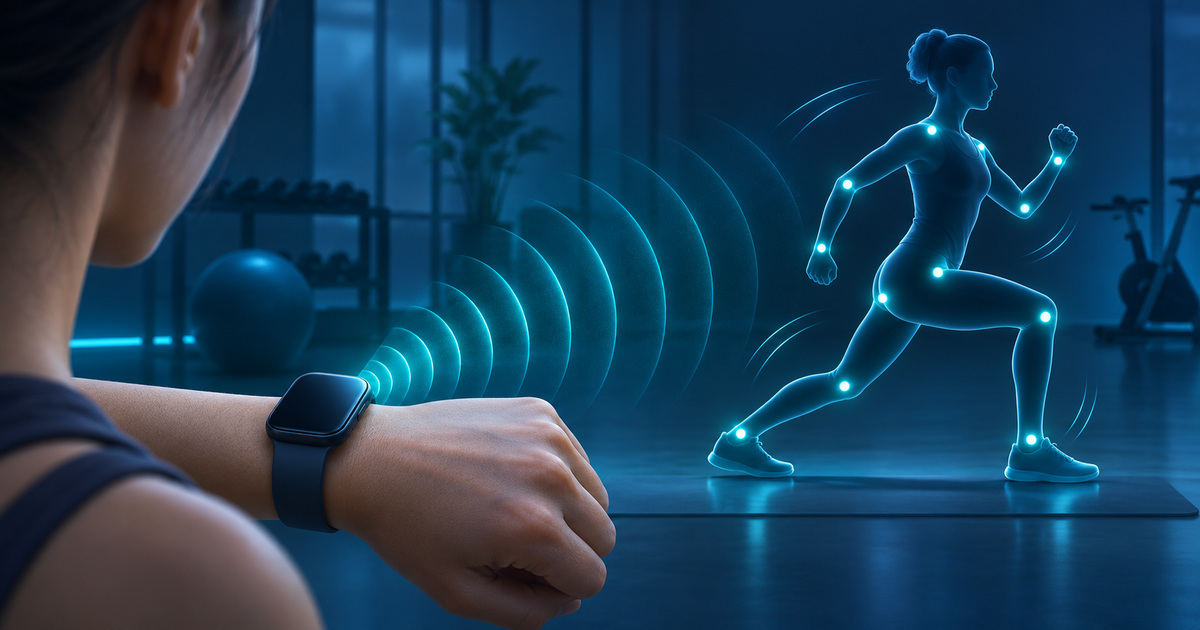
Cornell researchers are exploring how a smartwatch can estimate body movement using acoustic reflections and a machine-learning model. The university's November 11 report presents EchoMotion: a speaker emits a signal, a microphone receives returning reflections, and a model estimates twelve body joints. This is a research project rather than an announcement of a widely available consumer-watch feature.
The chronology matters. The authors' project page describes a September 2026 IMWUT paper, followed by an October presentation in Shanghai. The new public university account appeared in November. It should therefore not be presented as a paper newly published on November 15 or as an independent replication. Both checked accounts describe work by the same research team.
The author abstract separates a prototype study with ten participants from a commercial-watch evaluation involving fifteen different participants. For the latter, it reports a mean per-joint position error, or MPJPE, of 5.99 centimetres. A separate, more naturalistic evaluation with ten participants reports 6.41 centimetres. These are aggregate results under particular protocols, not a guarantee for every joint, movement or future user.
Cornell also discusses the importance of personal calibration and the surrounding environment: reflections from other people in a hallway can make tracking harder. We do not combine results from different settings into a single universal accuracy claim. Neither the mean position error nor the number of estimated joints independently establishes suitability for judging athletic technique or clinical rehabilitation. Those remain possible application directions requiring their own validation.
The technical interest lies in indirect observation. A watch does not see the body in the manner of an external camera; the model learns relationships between returning sound and pose. That suggests a useful editorial question: what happens when movements produce similar acoustic evidence but require different interpretations? Future assessments could usefully report results by movement, body characteristics, clothing and environment. Those are SIExpo's suggested checks, not additional experimental findings.
For practical use, an average error is only a starting point. An application also needs to communicate uncertainty, identify an unsuitable environment and handle interruptions. During exercise, confidently incorrect feedback could be less useful than an explicit warning that the measurement is unreliable. The interface and the treatment of unsuccessful cases therefore deserve evaluation alongside the model's central accuracy measure. A system should not silently convert an uncertain estimate into an authoritative instruction.
The approach offers an interesting possibility for less conspicuous sensing equipment. However, the absence of a camera does not automatically establish complete privacy. A future product would still need to explain where signals are processed, what information is retained and how the user controls those data. EchoMotion merits attention as a demonstration of acoustic perception supported by AI, while its small participant groups and environmental sensitivity remain material limits on claims of universal readiness. The appropriate next question is how consistently the method works beyond the conditions already reported, rather than when every watch will receive it.
Editorial verification: 2026-11-15T17:59:15.509180+00:00.