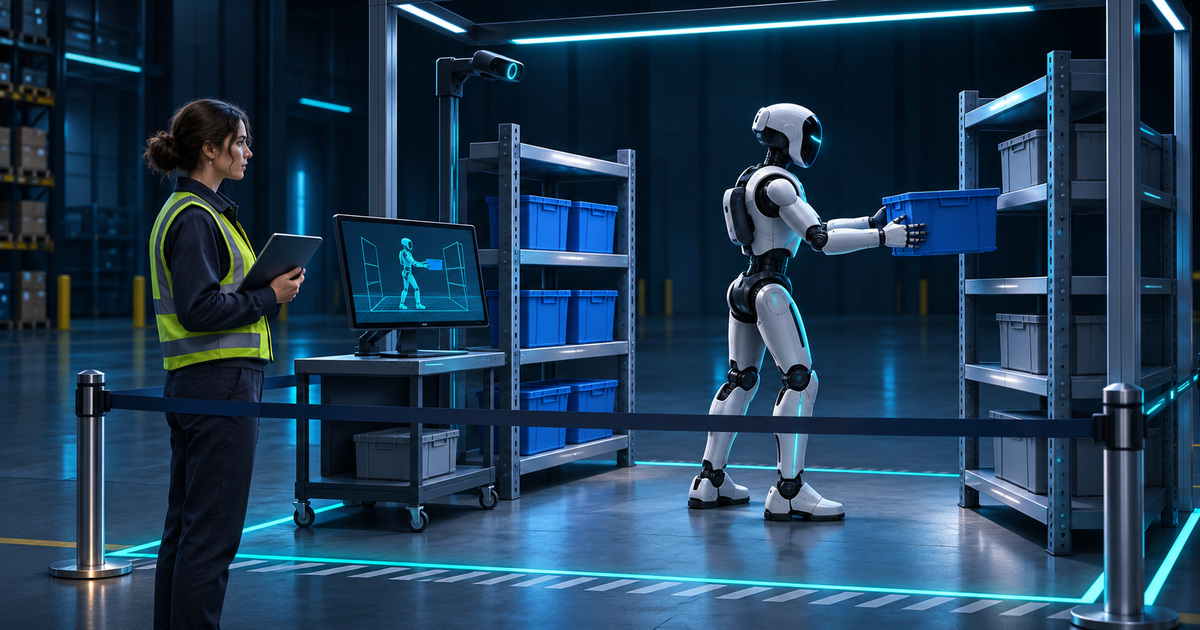
GXO and Apptronik announced an Apollo letter of intent on November 12. The Robotics-as-a-Service framework envisages 2027 trials, a conditional possibility of up to 1,000 robots over four years, and initial commercial deployment in North America in late 2027. This is a participant plan, not a delivered fleet. Workflows are to be assessed against productivity, safety and technical requirements. SIExpo has no independent performance measurement.
Separating those stages enables a testable assessment. Intent identifies a direction; a trial should establish a result under described conditions; accepting a service requires criteria for actual operation. Skipping the intermediate check would substitute expectation for evidence. Readers can usefully ask each subsequent report to identify which of those questions it answers.
The collaboration has an earlier starting point. Apptronik's June 20, 2024 publication described laboratory evaluation before deployment to a US distribution centre once the technology was ready. That earlier description listed swappable batteries and a 55-pound payload, approximately 25 kilograms. These are characteristics from the historical announcement, not a fresh independent measurement of the current configuration. The new development is the next contractual and operational-testing step.
Robotics-as-a-Service raises practical questions beyond the label. An organisation may be contracting for a service rather than buying a machine, but that does not by itself specify responsibility for downtime, maintenance arrangements or future pricing. The announcement does not disclose enough commercial terms to calculate a return on investment. Comparing the service with human labour or other automation would require additional evidence, rather than the largest number of robots mentioned in a plan.
SIExpo's editorial interpretation is that evaluation should follow the complete work cycle. A useful measure would include completed tasks alongside interruptions, intervention time and recovery after an error. A robot's ability to lift a suitable load does not alone establish that it selects the correct tote, hands it reliably to the next system and operates consistently across shifts. These are proposed assessment criteria, not problems we have established in Apollo.
Shared-space operation also deserves explicit examination. Before expansion, an operator would need to assess pedestrian access, stop procedures, recovery following an exceptional event and responsibility for software changes. A good result in one operation does not automatically establish readiness for every other warehouse workflow. Treating each use case as a separate acceptance decision makes the promise of a general-purpose machine easier to test against operational evidence.
Readers can look for consistency between a goal, a measurement and an acceptance decision. A concrete protocol can explain what result would justify the next step. Publicly tracking those criteria is more useful than an impressive demonstration video: it allows an assessment of whether an ambition is becoming a repeatable service and where important unknowns remain.
Editorial verification: 2026-11-15T17:59:15.509180+00:00.