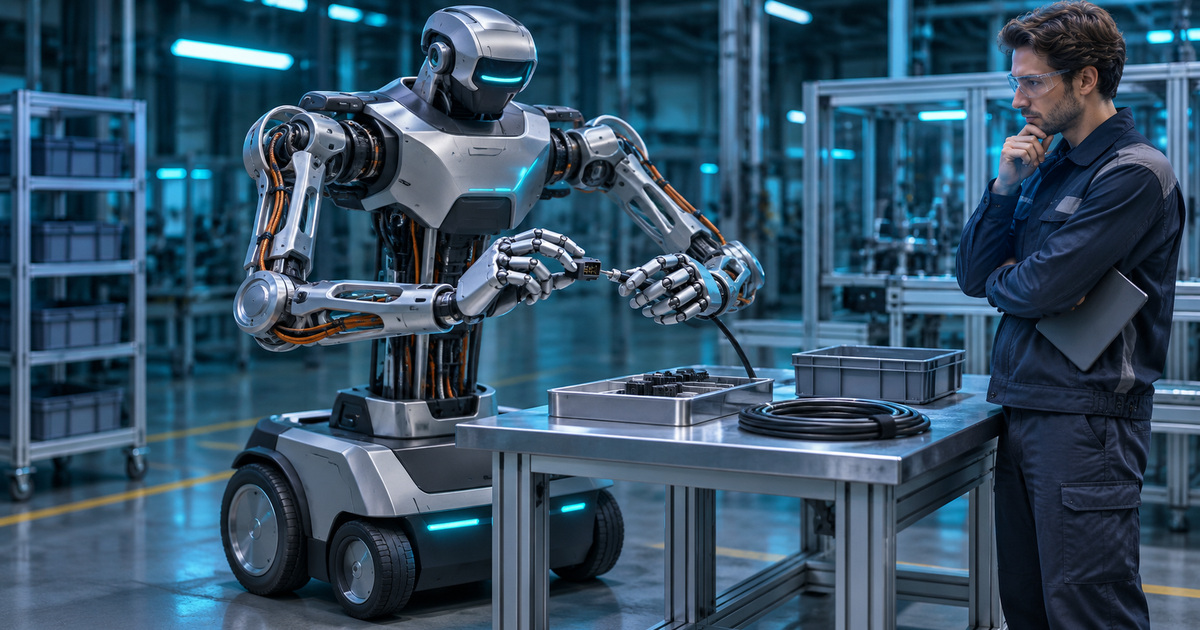
On November 6, Switzerland's Embodied AI announced AIR for Humanoid Europe in Munich: a wheeled factory robot with tendon-driven arms.
The manufacturer plans CE marking for 2027. SIExpo has not tested safety or autonomy.
The deployment approach
The official website combines teleoperation, imitation learning and human intervention when needed. It distinguishes AIR from two-arm industrial cells for complex manipulation. Its described customer process starts with a site assessment, proceeds to a pilot with measurable criteria and only then moves to rollout.
Cable-handling results are company data for a two-arm cell, rather than independent AIR evaluation.
Why the wheels are interesting
Our editorial interpretation is that industrial usefulness can be assessed by completed work rather than resemblance to human walking. For a particular production task, relevant questions include where the machine must go, what it must manipulate and how it will recover from an unexpected situation. Wheels are part of the proposed design; that choice alone does not establish suitability for every factory.
Consider an illustrative cable-connector insertion task. Measuring only successful insertions would omit preparation time, incorrectly presented parts and operator interventions. A more useful pilot would define success in advance and measure the full cycle. This example is our editorial evaluation method, rather than a description of an observed AIR trial.
What a pilot still needs to establish
In practice, a customer would need criteria for acceptable interruptions, clear responsibility when intervention is required and an assessment of interaction with the particular people and equipment involved. A promise of progressive learning does not determine when a system can operate independently. That decision should follow evidence from the task and the applicable requirements.
The development adds another European approach to physical AI, combining hardware, learning and an operator in one process. The announcement alone does not establish readiness for unattended deployment at scale. We checked the company release and official website on November 7, 2026; we did not attend the demonstration or test the machine.