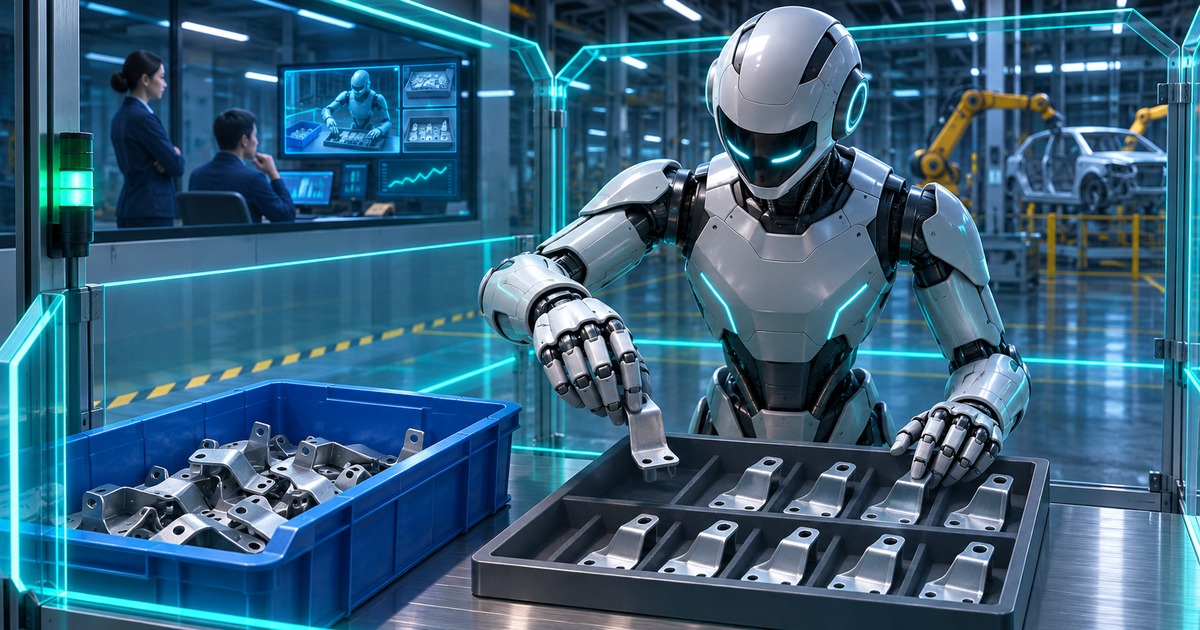
Google DeepMind introduced Gemini Robotics 2.5 on November 10, 2026. The company reports evaluation across more than 200 tasks and an Apptronik Apollo 2 pilot at Mercedes-Benz facilities in Hungary and Germany. It claims a 96% success rate for automotive parts kitting. Access is rolling out to robotics partners; this is not a generally available household robot.
Planning and movement have different roles
The official product overview distinguishes embodied reasoning, which understands physical situations and plans, from a vision-language-action model that converts visual and language input into motor control. A separate On-Device family also exists. Its presence does not establish that every Robotics 2.5 deployment runs locally on any robot.
DeepMind also announces ASIMOV-Jailbreak for testing disguised unsafe instructions. This is a benchmark, not a safety certificate; SIExpo has not reproduced the results.
Reading a 96 percent success rate
Our editorial interpretation is that a factory pilot provides more useful evidence than a demonstration involving one carefully selected object. Nevertheless, success needs a denominator: how many operations, which variations, how many human interventions, and how retries are counted. One aggregate percentage cannot answer all of those questions.
Consider an illustrative order-kitting task. A robot might pick the correct component but place it in the wrong sequence. It might preserve the sequence but require a person whenever packaging changes. Those are different forms of incomplete work. This example is not an additional defect that we have established in the Mercedes-Benz pilot.
For evaluation, we would record the completed kit separately from individual grasp quality. An operator could then determine whether greater dexterity delivers a useful production outcome. Recovery time after a failed attempt also belongs in the working cycle, even when an attractive demonstration video contains only successful movements.
The comparison should preserve the same definition of a completed job for both systems. Otherwise, a faster attempt and a correctly completed task can accidentally become interchangeable entries in a dashboard. The practical question is how reliably the whole operation finishes under stated conditions, rather than how fluent a single movement looks.
Dexterity and safety need separate measurements
Handling a flexible object and stopping correctly near a person are different capabilities. Improving the first does not automatically establish the second. A real pilot needs explicit movement boundaries, a responsible operator, and predetermined conditions for interruption.
A useful test could vary lighting, object placement, and permitted objects within a controlled environment. A separate series should examine ambiguous instructions and safe refusal. These are proposed evaluation criteria, not additional promised features or experiments performed by SIExpo.
The path from a plan to an action matters as well. A persuasive language explanation for a movement is not evidence that the physical movement occurred correctly. Observations from the environment are required. After an interruption or a change of task, an old plan should not remain authoritative simply because it was clearly expressed.
The announcement describes progress claimed by a specific developer on reported tasks and partner deployments. The useful next step is reproducible operation under the adopting organization's own conditions. Those results should establish the acceptable application, rather than a broad impression that one robot can now handle everything.
Sources: Google DeepMind — Gemini Robotics 2.5 announcement, Google DeepMind — robotics model roles and deployment families. The cover is a conceptual AI illustration, not a documentary photograph.
Editorial verification: 2026-11-11T07:14:46.966546+00:00.