Google Research announced the public launch of Deep Review on 14 October 2026. The system is intended to provide detailed feedback on complex documents and develops the earlier Paper Assistant Tool, or PAT. The announcement is a new access milestone, rather than evidence that automated checking replaces a scientific editor or domain expert.
What sits behind a combined report
The PAT preprint describes logical document segmentation, allocation of a computational budget, specialist checking and synthesis of criticisms. Individual reviewers receive the complete document as context. The authors explicitly discuss fabricated criticisms: generating more comments can increase the work needed to verify them instead of automatically improving quality.
ICML's retrospective describes approximately 4,500 papers processed during its January pilot and 869 survey responses. Feedback was separated from official peer review and unavailable to reviewers. This is a historical report by organizers and partners, rather than an independent measurement of today's public version.
A criticism begins a check
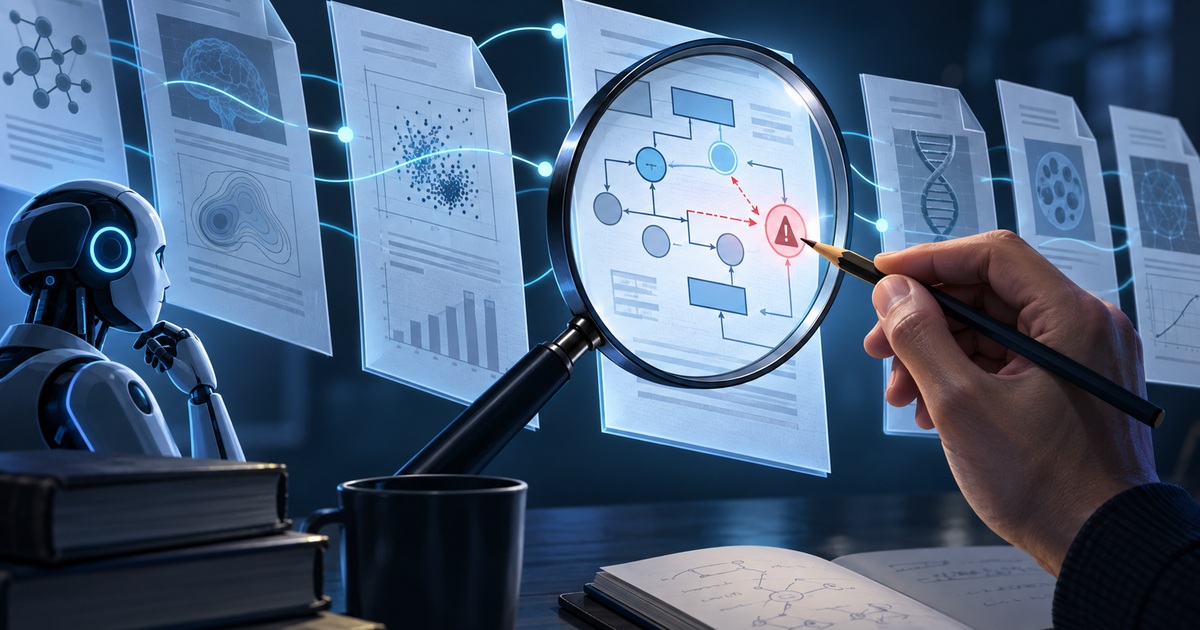
Our example is a technical document in which a variable changes meaning between the methods and results. An automated assistant might flag an inconsistency. The author must then establish whether there is a real logical error, unclear editing or a misunderstanding of the notation. Those outcomes call for different corrections.
We would retain each important criticism with its location, explanation and final disposition. A rejected criticism is also useful evidence when the reason for rejection is clear. The number of suggestions alone does not show how many were correct, important or responsible for a better document. This is our methodological recommendation.
Data conditions are a separate issue
Google states one-year retention and no training on uploads. We have not audited that policy.
An unpublished manuscript also needs authorization before it is shared. Authorship, coauthor consent and institutional rules are not displaced by a convenient interface. Before real use, a team needs to establish which versions it may provide and how comments will be handled. We have not uploaded third-party or confidential documents.
How we would assess usefulness
For a limited pilot, we suggest an owned or authorized text with previously established problems. Some could be logical errors, others missing qualifications, alongside entirely correct passages that should not be changed. The test should include false accusations of error, because those consume expert time too.
After revisions, we would check the complete argument again. A corrected sentence can leave another section inconsistent. A useful endpoint is therefore a traceable version with resolved criticisms, rather than merely receiving an AI report. We do not present this proposed procedure as an experiment conducted by SIExpo.
The development matters as an attempt to increase capacity for technical verification. Practical value will depend on the accuracy of particular criticisms, time spent handling them and retained human responsibility. In science, assistance to an author and a decision to accept a paper remain different activities.
Editorial verification: 2026-10-15T06:15:13.472260+00:00 (UTC). Cover: AI illustration, not a documentary photograph.