Ai2 introduced HiRO-ACEv2 on 14 October 2026 as an update to its climate emulator. The system produces detailed precipitation, wind and pressure fields compared with X-SHiELD. This is research news about simulations and available models, rather than an operational forecast for a particular city's next few days.
Two stages address different tasks
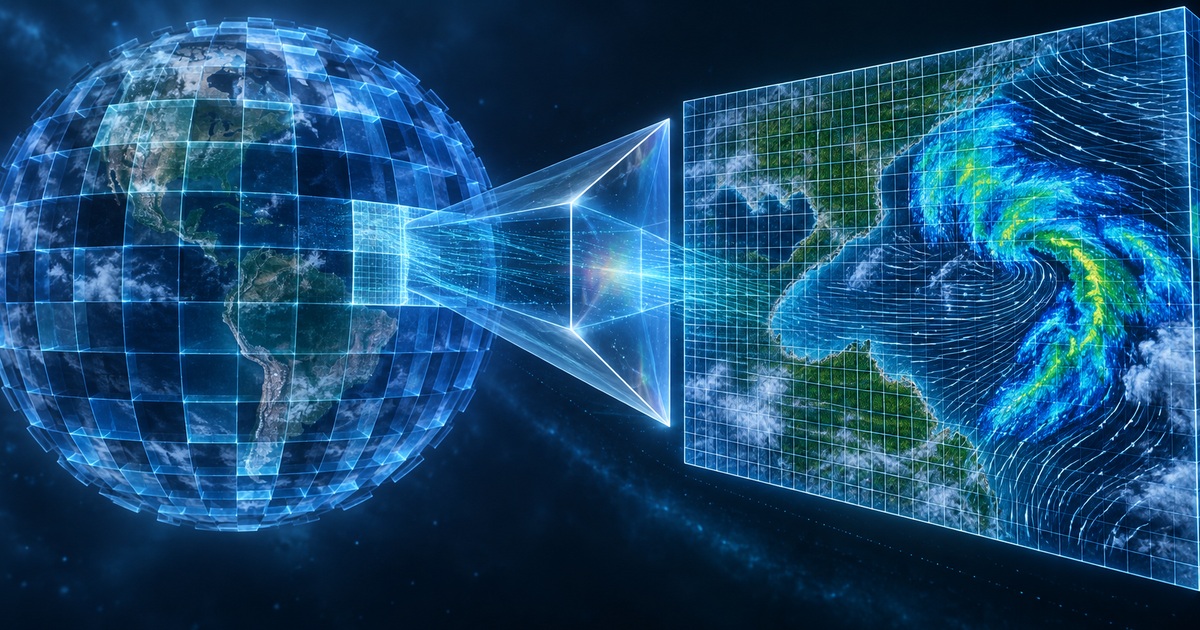
The 13 October preprint describes an emulator on a coarse 100 km grid and a separate diffusion model that adds regional detail at 3 km. The authors report inference computation costing over 300 times less than the traditional high-resolution model. This is a research comparison against a specified reference process, not a promise for every computer or dataset.
The model card explicitly warns that the system is unsuitable for weather forecasting. Its training follows X-SHiELD rather than observations for current operational prediction. Generalization to climates outside the training conditions is not expected, and geographical coverage and regional patch assembly have limitations. These are substantial boundaries on use, rather than minor footnotes.
A finer picture is not a new observation
Our editorial interpretation is that resolution describes spatial detail. It does not establish the accuracy of each point by itself. If inputs and physical assumptions do not match the question being asked, an attractive local image can create excessive confidence. The analysis should identify what is simulated and what it is compared against.
In a hypothetical example, a researcher wants to compare distributions of strong winds. A useful result is a sufficiently described collection of simulation cases and a comparison method. One striking spiral on a map does not establish how frequently the system reproduces the required class of events. This is our illustration of evaluation, without reproducing the model ourselves.
Rare events need a separate check
Average behavior can be suitable while the rarest cases remain problematic. We would inspect common values, distribution tails and joint behavior of the fields separately. Wind, precipitation and pressure should be assessed against the research question, rather than visual plausibility alone.
For an authorized pilot, we would preserve model version, initial conditions, region and random settings. We would then check whether a repeated execution can be explained and compared. When investigating sensitivity to one assumption, the others should remain specified. We have not conducted that experiment or produced a new measurement.
From a research tool to practical use
An available model enables other teams to investigate specific questions but does not remove the need for specialist knowledge. Real decisions require attention to permitted scope, data representativeness and independent checking. Moving to a different future climate does not follow automatically from a good result under the conditions on which a system was trained.
HiRO-ACEv2 illustrates AI reducing the cost of a particular scientific computation. Its significance is in more opportunities for exploration and comparison within retained limits. SIExpo treats the published materials as evidence of the authors' method and results, without turning a simulation map into a documentary photograph or a promise about future weather.
Editorial verification: 2026-10-15T06:15:13.472260+00:00 (UTC). Cover: AI illustration, not a documentary photograph.