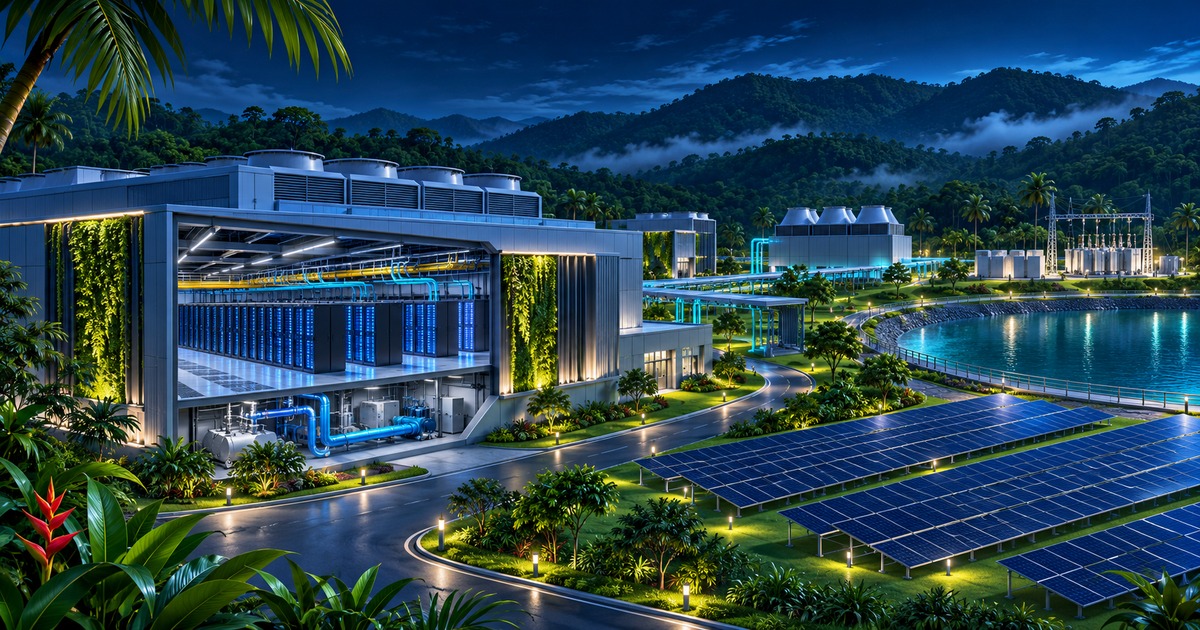
Google announced a $15 billion Malaysian investment plan for 2027–2028 on November 4. It identifies an operating campus at Elmina Business Park and additional planned facilities in Selangor and Negeri Sembilan. The country's cloud region is still described as upcoming. The plan also includes adding more than 1 GW of clean-energy capacity to the national grid. These are Google's announced intentions and status descriptions, not independent confirmation that the entire plan has been completed.
The development matters to the AI sector because it places computing alongside electricity, cooling and local infrastructure. Our editorial reading is that the investment figure alone cannot tell an application team when a particular service will be usable. An investment decision, a completed campus and an available cloud feature are separate milestones needing separate checks.
A data center and a cloud region
Compute Engine documentation describes regions and zones as logical abstractions over physical resources. Distributing work between zones and regions addresses different failure boundaries. Some resources are zonal, others regional or global. An operating building therefore does not automatically establish every capability, location option and service condition available to an external customer.
For an illustrative team planning an AI assistant for regional users, the first task would be to establish the interfaces and resources actually available at launch. Our recommendation is to check required models, network dependencies, quotas and recovery arrangements. A press announcement should not replace that technical review or become a promise about the team's own delivery deadline.
Availability is product-specific
The public Cloud locations page explains that regional portfolios evolve and some services differ in functionality by location. It describes an initial set of products and additional services following launch. That is a general product framework, rather than certification that every AI capability is already ready in the future Malaysian region.
In a pilot, we would trace the whole request: where input arrives, where processing happens and where results are retained. Calling another service can introduce a separate dependency even when the main resource is close to users. This is an engineering recommendation for reviewing an architecture, not a latency measurement of the new infrastructure or a legal conclusion about particular data.
The same review should identify what happens when the preferred resource is unavailable. A fallback may preserve application availability while changing cost or processing location. A team should understand that behavior before relying on it. This is a proposed deployment check, not an announced feature of Google's Malaysian plan.
Efficiency and total consumption
Google's efficiency page explains PUE as the ratio of total data-center energy to energy used by IT equipment. A figure closer to one indicates lower relative overhead. It does not, on its own, reveal absolute consumption or the useful work completed by a particular AI application. Comparisons therefore need a clearly defined measurement boundary.
A similar distinction helps when reading plans for additional generation capacity. Power describes capacity, while energy consumed over a period is a different quantity. Added capacity alone does not establish which source serves every request during every hour. We are not calculating a carbon footprint or certifying a completed environmental commitment in this article.
Which evidence would show progress
To follow the plan, we would distinguish construction milestones, actual service availability and resource reports. Each answers a different question. Announced investment is not an accounting record of money already spent, and projected effects are not measured outcomes.
The established event is Google's new large-scale Malaysian commitment and the stages it describes. For a reader making a technology decision, the practical value lies in tracking when that commitment becomes a specific available service. Neither the future campuses nor the upcoming cloud region should be declared fully ready solely because of the headline investment figure.