The LeRobot team introduced version 0.7.0 on November 5, changing two connected stages: preparing robot policies and using them on a physical machine. The announcement emphasizes interactive instructions, streamed access to large datasets and training larger models. For developers, the important question is how these pieces form a repeatable workflow, rather than simply how many model names appear on a feature list.
Instructions can change during operation
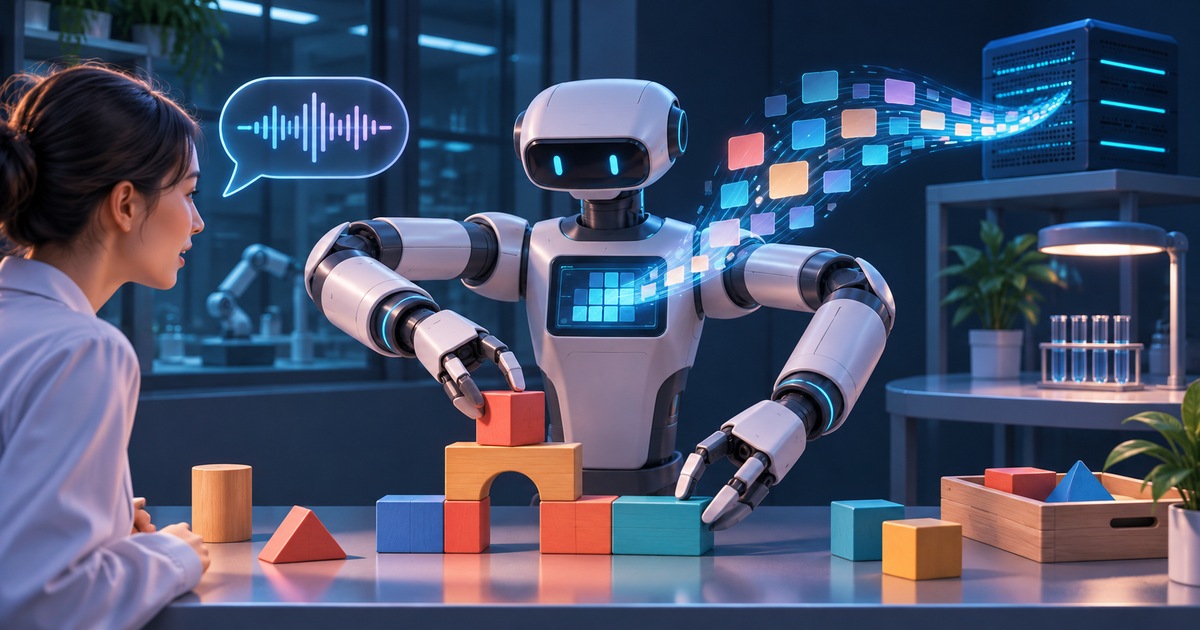
The deployment documentation describes interactive sessions with commands for subtasks, visual questions and selection of subsequent subtasks. Questions and automatic planning require a text-generating policy or an external planner. A new terminal command therefore does not turn every existing policy into a conversational robot. Capabilities depend on the specific model and its integration, which must be checked before interpreting a demonstration as a generally available feature.
Our example evaluation would involve arranging several objects on a table. Start with a bounded task, then change just one instruction. The question is whether the action reflects the new goal and whether the recording shows when that goal was accepted. A spoken or written answer does not by itself prove that the movement is correct. This is a proposed test, not an experiment we have performed with the release.
The complete dataset need not be copied first
The training-streaming guide describes reading necessary Parquet data and MP4 byte ranges without downloading the entire dataset beforehand. Distribution operates on whole episodes with defined frame coverage. Local indexes and startup preparation still have costs; streaming does not mean zero memory, network traffic or waiting. The documentation also distinguishes this training input path from streaming encoding during recording, which solves a different problem.
Our practical interpretation is that a disk-capacity problem becomes an end-to-end measurement task. If a GPU is waiting for data, adding compute will not necessarily help. We would compare time to the first batch, memory use and reading stalls on the same small dataset. That would help establish whether the bottleneck is decoding, connectivity or training itself. Keeping the test constant makes a later configuration change easier to assess.
The model can live on another machine
The separate remote-inference guide splits the GPU policy server from the computer attached to the robot. Cameras, motors and a buffer of upcoming actions remain local. While the next sequence is computed, the robot can follow actions it has already received. The guide distinguishes policies tested on hardware from those supported only at the interface-contract level; those categories should not be treated as equivalent evidence of readiness.
This separation provides a useful choice with a concrete trade-off. Continuing an older trajectory preserves motion, while a newer observation may call for a different action. In a laboratory deployment, we would test a delayed connection, an exhausted buffer and a changed scene. Predetermined stopping criteria and operator observation would be part of that evaluation. These are our recommendations, rather than a claim that the framework supplies a universal safeguard for every robot.
Reading the release as a system
LeRobot 0.7 offers tools for building and assessing a complete system. We have not reproduced its published speedups or robot demonstrations. A useful starting point is one known policy, one bounded scenario and a preserved record of data, instructions and actions. Each subsequent change can then be assessed against the behavior of the full workflow, rather than an isolated promise about a faster component.