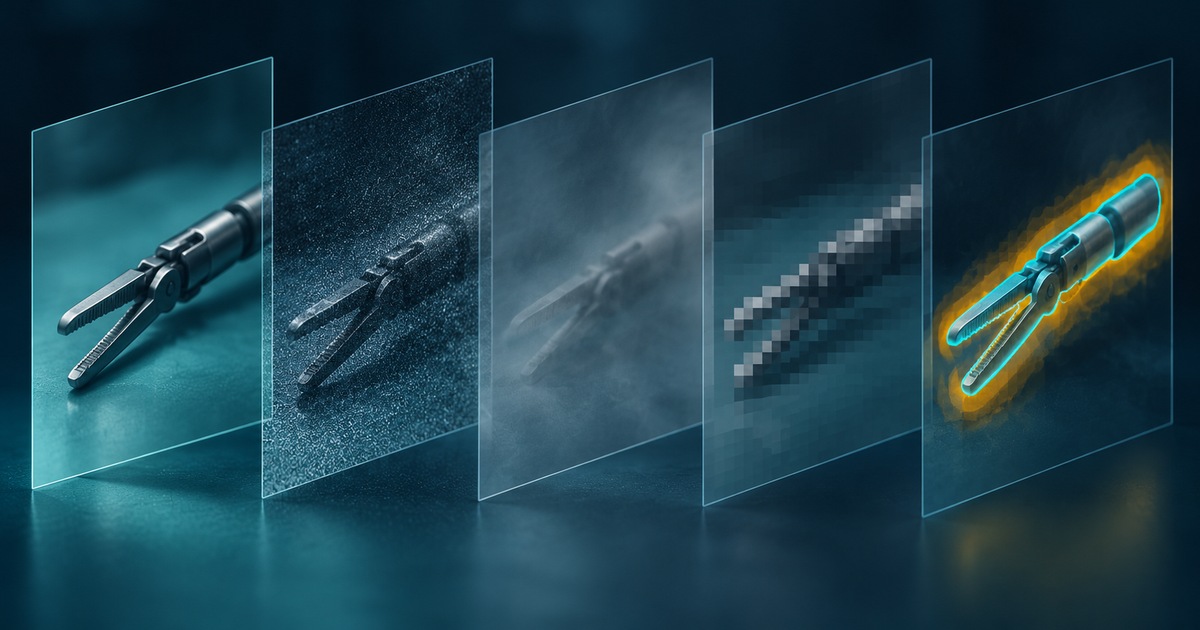
A Chengdu study in Frontiers in Robotics and AI, published October 23, 2026, evaluates LiteST-TTA on EndoVis2017 under twelve synthetic degradations. Selective adaptation helps under severe dimming; on held-out videos, the unchanged model is better in ten of twelve conditions. There is no clinical trial.
What adaptation during use means
A familiar deployment approach trains a model in advance and then keeps its parameters fixed. Test-time adaptation explores a different option: limited updating as new inputs arrive. The central question is whether an image change warrants intervention or whether the model already handles it adequately without adjustment.
Earlier work on Tent describes minimizing prediction entropy, estimating normalization statistics and modifying transformation parameters. In this setting, the model has test data and its own parameters without receiving a new correct answer for every input. That explains why confidence matters to the approach, but increased confidence is not a logical demonstration of increased accuracy.
This distinction is easy to miss when adaptation is presented as continuous improvement. A system can become more certain about an incorrect interpretation. A meaningful evaluation therefore needs an external reference rather than treating the model's confidence score as the final measure of success.
What task EndoVis2017 represents
The dataset's official description identifies stereo images from a da Vinci Xi robot during procedures on a porcine model. Its training videos contain manually labeled instrument components: shaft, articulated wrist and claspers. The original challenge includes separating instruments from background, identifying parts and distinguishing instrument types.
That is the provenance of the data, rather than evidence that the new method has been used to treat patients. The historical challenge protocol and the new study's particular experimental organization must also be distinguished. Sharing a dataset name does not automatically mean that every published number uses identical frames, splits and metrics. The original protocol overlaps model-selection and evaluation data; a separate video-level check reduces, but does not eliminate, that limitation.
The distinction matters for reproducibility. A reader comparing two results needs to know what was used to select a model and what was reserved for its final evaluation. Otherwise, an apparently straightforward comparison can conceal a difference in the experimental question being answered.
Why one average can mislead
Our editorial interpretation is that this topic requires evaluation by situation. Strong agreement between a predicted region and a manually labeled region demonstrates performance on a particular segmentation task. It does not establish understanding of the complete scene, safe instrument motion or a beneficial medical outcome. These are separate levels of evidence.
A useful comparison would retain separate rows for visual changes and their severity levels, alongside the unchanged model. A large recovery under dim lighting would then not obscure conditions in which updating makes the result worse. A working system would also need scrutiny of processing time and stability over a long sequence of frames.
A sensible next research question is how to identify when adaptation is needed without using an unknown correct answer as an operational guide. Another is whether improvement survives a different video source. These are proposed criteria for future assessment, not experiments we have conducted or recommendations for clinical use. The publication's value lies in its specific, bounded benefit and its visible warning that continually changing a model is not always the right response.
*AI illustration: a conceptual editorial image, not a documentary photograph or an actual product screen.*
*Editorial verification: 2026-10-25T17:51:23.544949+00:00.*