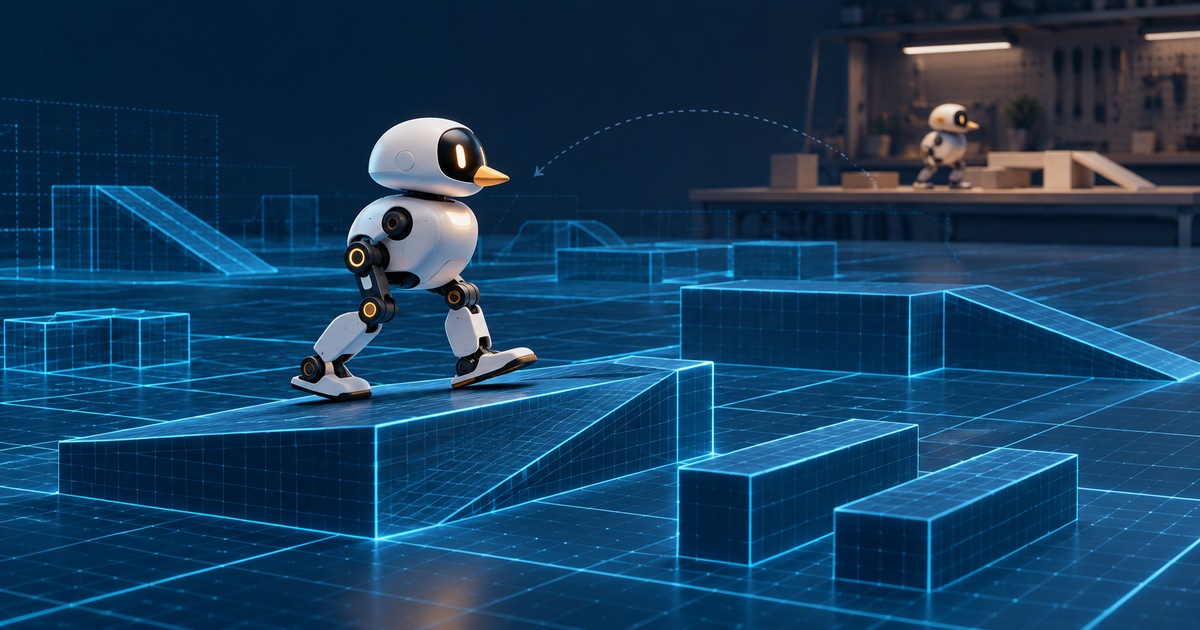
NVIDIA's October 23, 2026 guide connects agent-assisted preparation, cloud training in Isaac Lab and local Microduck evaluation in Isaac Sim. Its 4,096-environment experiment uses RTX PRO 6000 Blackwell, rather than RTX Spark alone.
The agent prepares a task; a policy controls movement
The work illustrates two different meanings of AI for robotics. One is an assistant turning an intention into a plan and preparing resources. The other is a control policy choosing movements from the robot's observations. Successfully creating a virtual course does not establish that a policy can already traverse it reliably.
The consequential issue is the traceable connection between the task, environment and evaluation. If an obstacle is built at the wrong scale, subsequent learning may optimize behavior for the wrong task. If the observations omit necessary information, additional attempts do not automatically repair that omission. These are engineering questions to ask of the workflow, rather than shortcomings we have measured in the demonstration.
Preparing a transfer to physical hardware
The accompanying Hugging Face tutorial describes evaluation and ONNX export for Microduck's onboard runtime. It stresses preservation of observation ordering, normalization and action scaling. Training varies parameters including friction, delay and mechanical backlash to represent part of the simulation-to-hardware gap.
That is not evidence that every physical situation has been covered. Even a correctly loaded model can receive observations whose meanings differ from those used in training. A numerical value is insufficient if it represents a normalized signal in one place and a quantity in different units elsewhere. The input-and-output contract is part of the behavior of the complete system.
This makes the export boundary especially important. A file being generated successfully and a robot interpreting that file correctly are different checks. A reproducible handoff would preserve the observation specification and control configuration alongside the policy, making a later mismatch easier to investigate.
What the physics engine contributes
Newton's official description presents an open GPU physics environment built on NVIDIA Warp with extensible solvers. It supports Isaac Sim and Isaac Lab, with MuJoCo Warp among its key solving components. Those are capabilities of the computational tool, rather than certification that every scene built with it represents physical reality faithfully.
Our suggested practical evaluation starts by preserving one unchanged comparison course and preparing a separate unfamiliar arrangement. For each policy, record completed traversals, falls, collisions and locations where progress stops. Then alter one parameter, such as friction, while holding the remaining conditions fixed.
This is a proposed test plan, not an execution of the published code by SIExpo. Separating training situations from evaluation situations would help reveal whether a system handles only a familiar course or tolerates a specific change. The physical walking footage demonstrates a locomotion policy; it does not by itself establish reliable completion of the entire virtual obstacle course. The new material supplies a route for experiments whose results still need verification at every transition between agent, simulation and robot.
*AI illustration: a conceptual editorial image, not a documentary photograph or an actual product screen.*
*Editorial verification: 2026-10-25T17:51:23.544949+00:00.*