On 12 October 2026, Microsoft announced Maia 300 and plans to expand Maia infrastructure from 2027. It says Maia 200 already serves production workloads, including Copilot. For the new generation, the company expects 40% more tokens per megawatt than leading GPU systems. This is a company comparison, not an independently established result for every model. Official announcement.
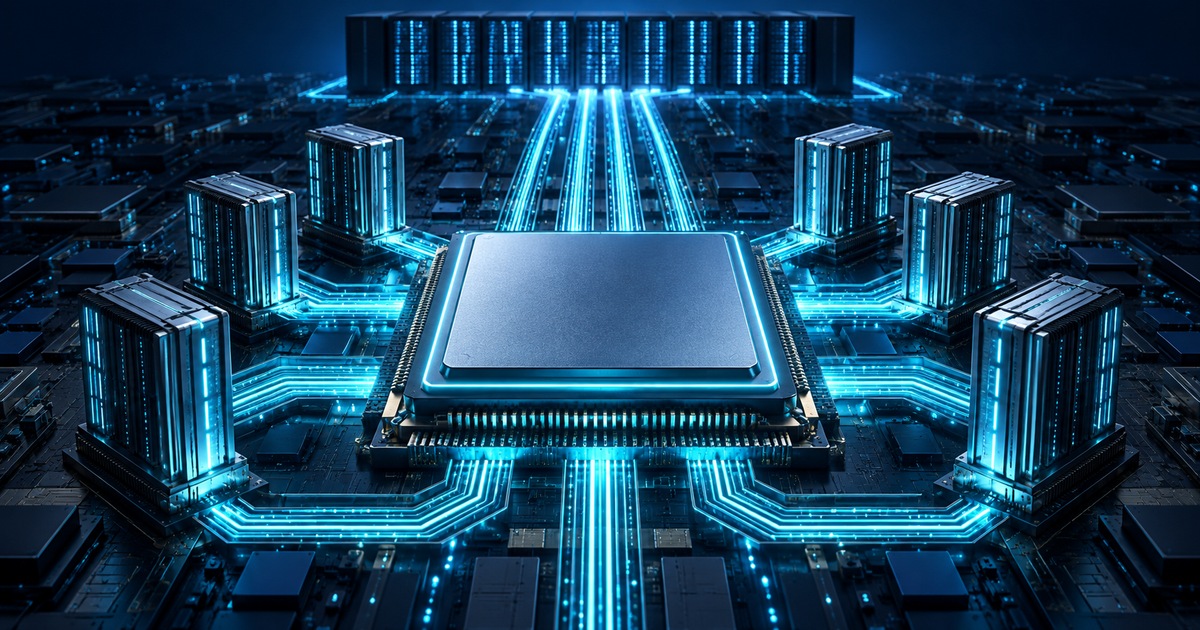
In its separate architecture explanation, Microsoft describes eight HBM4 stacks, 288 GB of memory and 18 TB/s of bandwidth per accelerator. A rack contains 96 accelerators within 167 kW. The chiplet design separates compute, memory control and input/output functions, while software manages data placement and movement. These are design specifications published by the manufacturer.
Why memory matters to this announcement
The vLLM Paged Attention documentation offers useful technical context. It describes storing attention keys and values in blocks and explains how access to those data participates in computation. This illustrates one way inference is organized; it does not establish that Maia runs this particular implementation.
Our editorial conclusion is that a large number of operations per second is insufficient to evaluate a service. A long conversation or analysis of substantial material also requires managing the request's context. If important data do not reach the compute resources in time, theoretical capacity does not automatically become a fast answer. Memory capacity and the rate at which memory can be accessed therefore answer different questions when assessing an inference system.
Consider a hypothetical document-review service. A short query and many simultaneous long conversations may encounter different constraints. For an evaluation, we would hold the documents, model, output length and latency target constant. Otherwise, an improvement might come from changing the task or acceptable quality rather than from the system being compared. This describes a method for a future test, not a result SIExpo has measured on the new accelerator.
A rack is a separate unit of measurement
Infrastructure teams need to distinguish an accelerator's specification from the characteristics of an entire rack. The overall power budget includes more equipment than the compute chips alone. Comparing a component's power figure with an installation's power figure therefore does not by itself reveal service efficiency. The measurement boundary must be defined first, along with the equipment and operating conditions included inside it.
The same distinction applies to performance. Serving more concurrent requests and returning an individual answer faster are different improvements. An interactive assistant may be dominated by latency requirements, whereas overnight batch processing may prioritize the number of documents successfully processed. One headline performance figure cannot make that choice for the team that understands its users and the commitments it has made to them.
Reading the GPU comparison
The announced metric is meaningful as a stated manufacturer target. For an independent evaluation, we would request the model list, numerical precision, input context, concurrent session count and acceptable response time. We would also check whether power consumption was measured across equivalent parts of the systems. Without that framework, a percentage should not be turned into a universal winner across hardware families or application types.
For developers, service availability is also a different issue from a chip announcement. A team planning a new product must confirm the actual interfaces, available regions and restrictions for its specific deployment. Promised future infrastructure is not capacity against which an unconditional customer commitment can already be made today. Procurement timelines, service access and hardware specifications all need to be considered together.
The news outlines Microsoft's direction: designing a system around workloads from its own AI services. Its practical significance will emerge through deployment and comparable measurements. Until then, the distinction is clear: a previous generation reportedly in production, a new architecture with published specifications, and a future expansion timetable. Each statement carries different weight in a technical decision, and none removes the need to validate the behavior of a real application.
Sources checked: 2026-10-12T16:32:59+00:00. Cover: AI illustration, not a documentary photograph.