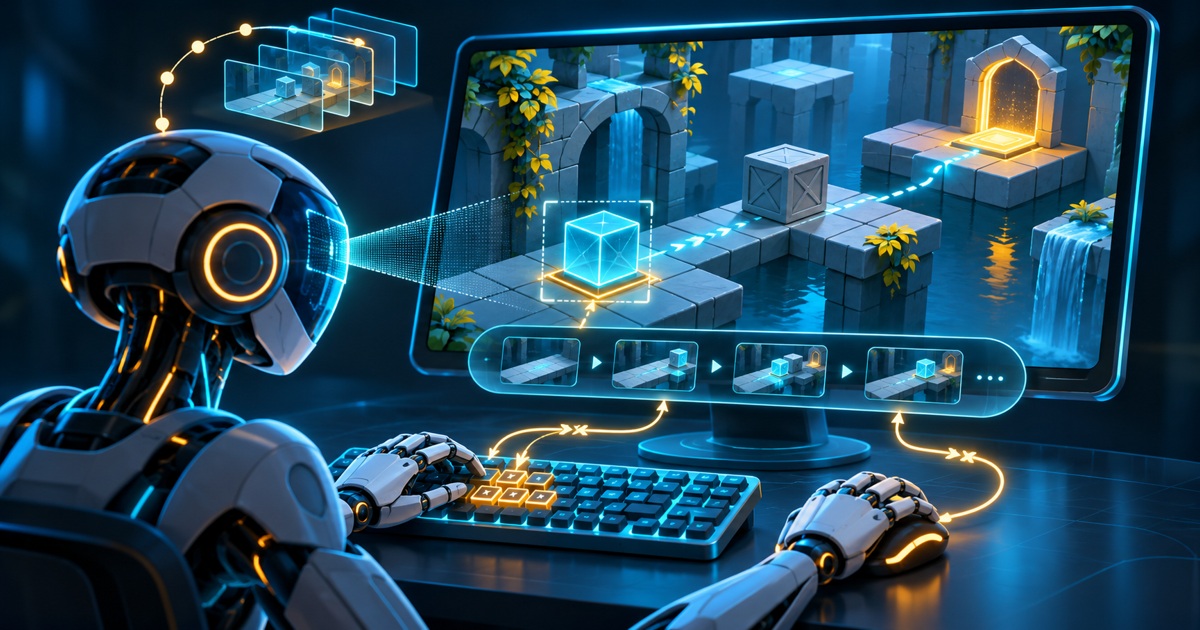
miHoYo’s Honkai AI R&D team published the Gamer preprint on November 13. It describes an agent framework that observes screens and acts through keyboard and mouse controls over extended game tasks. The work connects perception, memory and decision-making rather than treating every action as an isolated answer.
This is valuable uncovered research from recent days, not a launch this morning. The authors combine training on interactions with subsequent training for long tasks. They report capabilities across 2D and 3D environments. These are results in their experimental setup, not an independent SIExpo replication.
Duration changes the problem
The editorial significance can be illustrated simply. A short task may require one correct command. Across a long sequence, an agent must distinguish completed work from planned work, preserve useful facts and return to the goal after a diversion. A convincing description of the next step is not the same as completing it.
Games make such sequences observable and repeatable. Their value as a research environment does not make them a complete test of general autonomy. Familiar visual conventions, action patterns and task structures can help an agent in ways that do not transfer to unfamiliar software.
The environment does not wait
The paper addresses real-time serving as an important system concern. Our interpretation is that latency is more than user inconvenience: an observation can become stale while the agent decides. A logically appropriate command may then refer to a situation that has already changed.
A useful evaluation would separate misunderstood images, poor plans, inaccurate actions and delayed actions. Collapsing them into one success percentage makes it harder to identify what needs repair. This is our analytical criterion, not an additional results table from the paper.
Memory introduces another trade-off. Retaining everything can increase computation; excessive summarization can discard a fact needed later. Tests should include goals requiring an earlier observation, and separate cases where an old memory is no longer valid. Both matter for sustained interaction.
Transfer claims deserve similarly explicit boundaries. A keyboard-controlled simulation can be reset after failure. A production application may contain private data, financial commitments or destructive controls. Success in the former does not establish acceptable behavior in the latter, even when both use a screen. These are deployment considerations, not failures we observed in Gamer.
SIExpo has not installed a playing agent, operated another person’s account or tested transfer to a physical robot. The news is the research framework for sustained interaction through a familiar interface. Broad claims about real-world autonomy require real-world evaluations with their actual costs, permissions and irreversible consequences.
Editorial verification: 2026-11-17T07:54:00.882419+00:00.