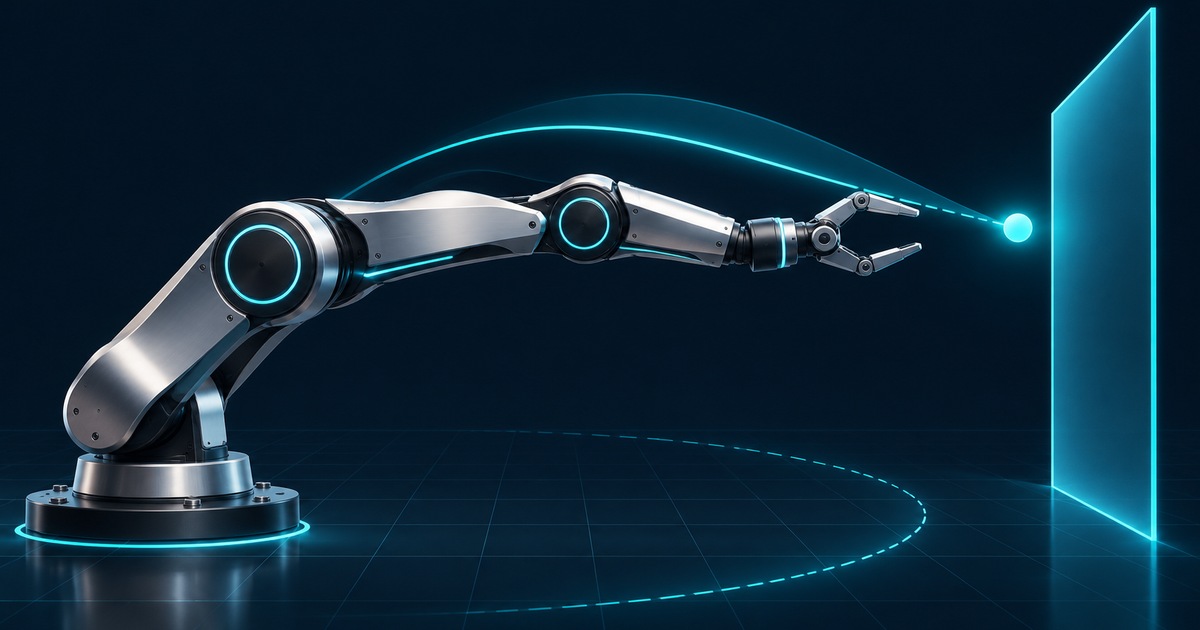
Version 1.4.0 of mink was published on November 1 with a new mechanism for elastic constraints. The Python library provides inverse kinematics based on MuJoCo: a desired movement of a robot frame is translated into a corresponding movement of its joints. The addition lets a selected task remain exact when possible and yield in a controlled way when a conflict requires it.
The authors describe an exact L1 penalty approach. The package now requires Python 3.11 or newer. This is a published update to a robotics tool, rather than a new standalone AI model or proof of a physical robot’s safety. SIExpo has not run the library on its own hardware.
### Why a target can become infeasible
Consider a robot arm asked to hold an object at a specified position and orientation. If the target moves beyond its reachable space, every desired condition can no longer be satisfied simultaneously. In this example, the system must distinguish a preferred pose from boundaries that must remain intact. It is an explanation of the problem, not a report about a particular deployed robot.
The mink tutorial distinguishes tasks, exact equalities and limits. An ordinary task can compete with other objectives; a hard equality can make the optimisation problem infeasible. Elastic provides an intermediate choice: a desired condition remains exact up to a penalty threshold, while individual components can yield. Limits and ordinary hard constraints do not automatically become elastic.
The practical implication is that developers must decide in advance what is a preference and what is mandatory. If a particular operation must stop when its target becomes unreachable, getting closer to the target may be an inappropriate response. If the application permits an orientation change, it might prefer that compromise to completely interrupting tracking. This decision belongs to the application, rather than to the visual appeal of a demonstration.
### Existing configurations need review
The release notes also identify changes to the RelativeFrameTask convention and CollisionAvoidanceLimit behaviour. An old scenario should therefore not be assumed equivalent merely because it starts without an error after upgrading. For an established system, the useful question is whether identical inputs still produce the intended behaviour, including at the edge of the working area.
PyPI confirms the package’s availability and scope: kinematic tasks, joint and velocity limits, and avoidance of specified collisions in the model. That is not certification of an entire installation. The model, geometry, actuators and physical environment remain separate parts of a complete system.
Our editorial recommendation is to compare an upgrade with the previous configuration in simulation, using expectations written in advance for both reachable and unreachable targets. The evaluation should record when a condition yields and whether that is acceptable for the application. Cases that produce no solution should also remain visible rather than being omitted from a successful demonstration.
The addition is relevant to AI-driven robotics because a higher-level system can request a goal without resolving all its mechanical consequences. A movement layer still has to turn that request into a feasible command. This is an architectural explanation, not a claim that mink 1.4 supplies a complete autonomous controller. Its new contribution is a clearer mathematical choice when tasks conflict; that choice still needs validation for the specific robot.
Editorial verification: 2026-11-02T09:49:31.133144+00:00 (UTC; Europe/Sofia is UTC+02:00).