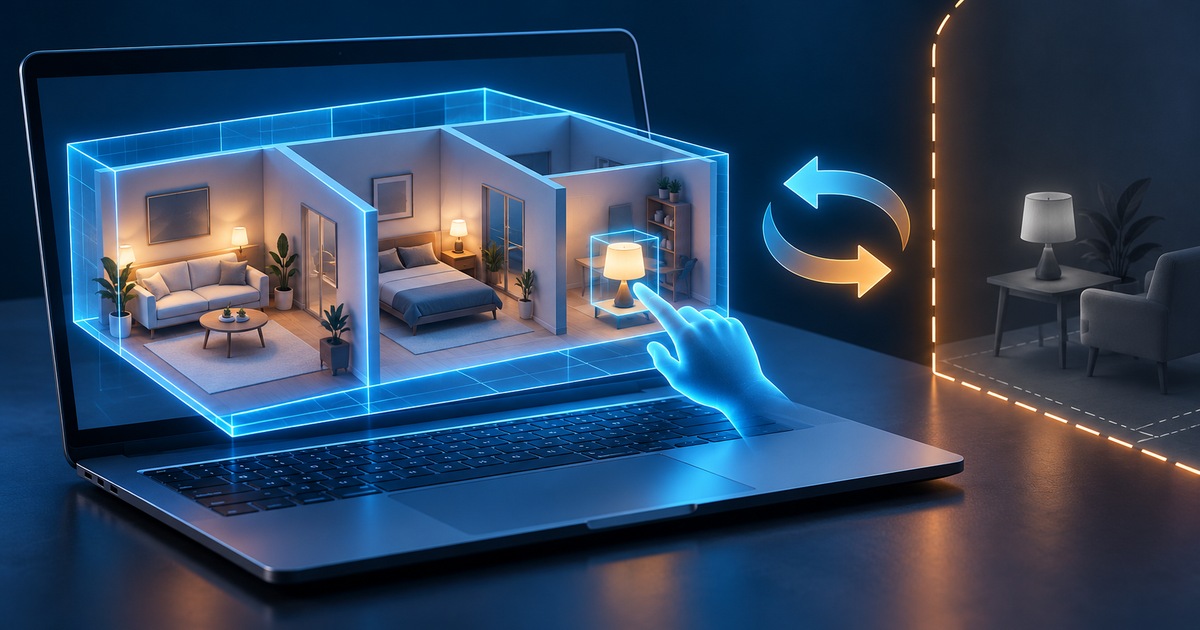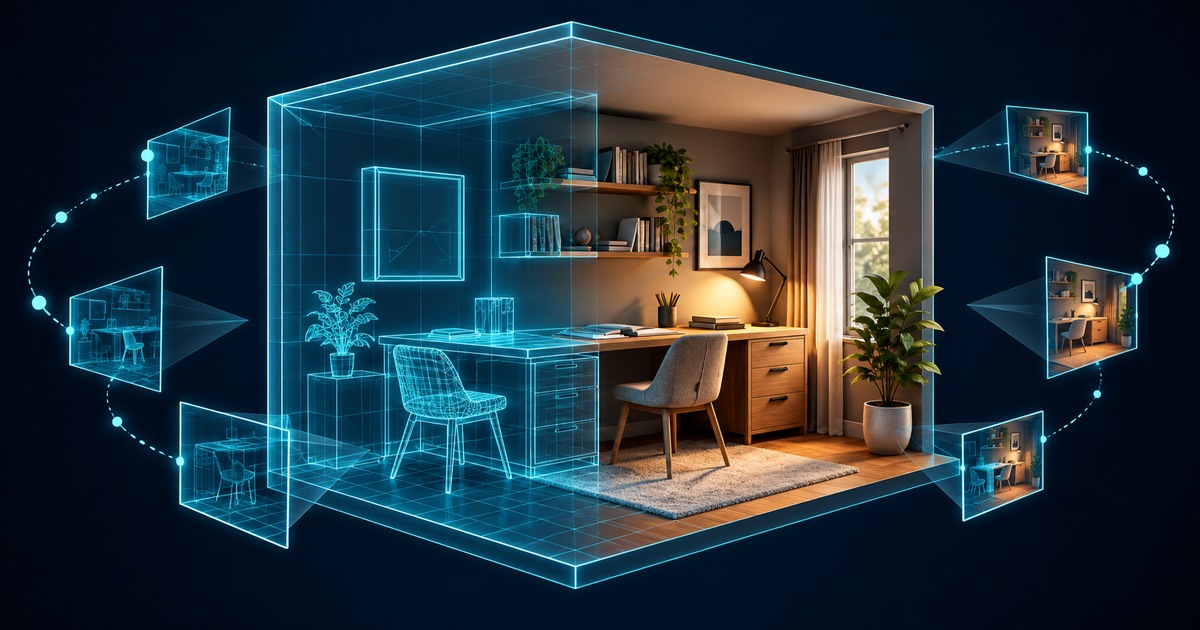
Mundo proposes turning images of a particular place into an environment for exploration and simulation. The team's October 23 public presentation describes a combination of simplified 3D state, a scene program, physics simulation and a video model. It is a research approach to world modelling, rather than an established system for reliably controlling real robots.
The project page shows navigation and interactions in reconstructed rooms, including a hotel-floor example. These remain demonstrations supplied by the authors. SIExpo has not executed the system or verified that behaviour learned with it transfers to physical hardware.
Three different kinds of fidelity
Our editorial interpretation is that a system of this kind needs several separate evaluations. First, the room layout might correspond to the input images. Second, objects might move according to the specified simulation. Third, the generated video might look convincing. Success at one level cannot automatically establish success at the others.
For example, an attractive animation of an opening drawer would not be sufficient evidence for planning how a physical hand should grasp its handle. We would request separate checks of position, clearance and object state. That is a proposed engineering requirement, not an assertion that the team made a particular measured mistake in its demonstration.
The same distinction applies to hidden areas. If the observations do not show the space behind furniture, a plausible reconstruction might help visualisation, but we would not treat it as measured free space. In an owned pilot, we would mark observed and inferred regions separately so that a reviewer could see the difference.
Limitations are part of the announcement
The authors explicitly identify slow processing, difficulties with small-object interactions and the absence of a long-horizon memory mechanism. These qualifications limit any interpretation of Mundo as a finished interactive robotic world. We found no basis for promising real-time operation or persistent fidelity following prolonged changes.
Its practical interest lies in separating the scene, the actions and the visual result. For developers, that separation could be useful if it helps locate the cause of a failure. However, the benefit needs checking against the actual artifacts of a particular run, rather than being inferred solely from a final video clip.
How we would organise a bounded pilot
We would start with one room and a predefined route. Some photographs would be used for construction and others reserved for checking. We would then change only one object and compare whether that change persists when the camera returns. The evaluation would therefore have a specific question and an observable failure condition.
For interaction, we would choose a large stationary object before examining small moving parts. We would retain the input images, scene description, simulation parameters and resulting output. Without those records, it becomes difficult to establish whether the difference between two clips comes from the input, the movement or the generative rendering.
We would also distinguish a failed reconstruction from a visually plausible but physically unverified result. Both outcomes matter, but they require different responses: collecting another view, revising the scene or declining to use the simulation for a proposed physical decision. A single attractive video should not conceal that distinction.
This is not a recommendation for immediate production deployment. Mundo is an interesting example of connecting spatial representation with generative video. The useful question after the demonstration is which parts of its world can be checked repeatedly and which remain plausible imagery. That answer determines whether the system is suitable for visual exploration, a simulation experiment or further robotics development.
*Cover: conceptual AI illustration, not a documentary photograph.*
*Sources checked: 2026-10-24T06:09:06.891206+00:00.*