On November 6, 2026, NVIDIA published an overview of research using its open wireless tools Aerial and Sionna. It presents them as foundations for future AI-native 6G networks. The examples include real 5G testbeds and simulations; the publication does not mean these capabilities are already a deployed commercial 6G service.
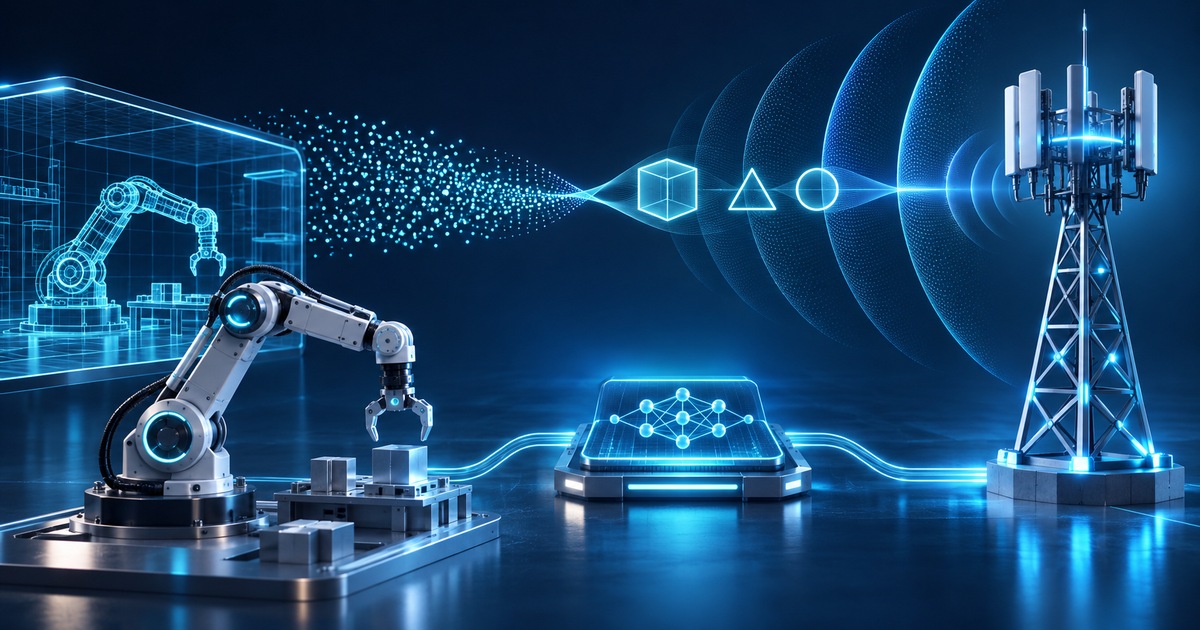
A robot transmits what matters for its task
A September study from King’s College London and Toshiba Europe describes a PiPER arm, an RGB-D camera and a Jetson AGX Orin connected over 5G OpenAirInterface. Instead of periodically transmitting raw images, the authors test representations using spatial bounding boxes and scene graphs. They report up to 52.6% shorter task completion time against their baseline configuration. This comes from a particular laboratory system, rather than a universal figure for every robot.
The engineering idea is straightforward: when an action depends on several objects’ positions, a full image is not the only possible message. The editorial question is how the system detects that it has omitted an important detail. Transmitting less data helps only when the information necessary for a safe decision is preserved.
AI also changes how a radio signal is received
On November 2, SoftBank published a separate report on a Transformer-based neural receiver. Its experiment uses a commercial smartphone, one spatial uplink layer and controlled interference inside a shield room. At one setting, the authors measure 47.9 versus 29.9 Mbit/s at the physical layer, a 60.5% increase. The neural path leads at all 15 tested interference settings. These numbers do not measure an ordinary subscriber’s speed on a city network.
Research from ETH Zurich and NVIDIA examines another condition: training for a specific deployment site. Its authors compare three receiver architectures on a real 5G NR testbed, including single- and dual-layer transmissions. They report benefits from local fine-tuning for the more adaptable models, with effectiveness across measurement campaigns more than six months apart. This provides research context for adapting to an environment, not a new measurement performed by SIExpo.
Faster simulation before investment in a network
On November 4, Catalonia’s CTTC described integrating GPU implementations of 3GPP radio-channel models into ns-3 5G-LENA. The work uses CUDA and WebGPU. The team reports checking statistical fidelity and comparing network behavior with a CPU baseline. It targets demanding scenarios with many cells, users and large antenna arrays. Preserving model behavior matters: a fast simulation based on different physical assumptions would not be an equivalent replacement.
The open Sionna repository also provides concrete access to research tools. It separates the library into radio-propagation, physical-layer and system-simulation components, and specifies an Apache-2.0 license. Access to code supports inspection, but does not remove the need for suitable data, equipment and independent checks of results.
What the results mean
Our editorial interpretation is that AI is being applied at different points in the communications chain: selecting what to transmit, recovering a signal and preparing an experiment. The results should not be combined into one overall speedup claim. Each has its own baseline, hardware and operating conditions.
For a team evaluating this technology, a useful starting point is reproducing one narrow scenario. The next step is checking behavior when conditions change or connectivity fails. A robot’s task completion time, a receiver’s physical-layer throughput and a simulator’s execution time are different measurements. Improving one does not establish the same gain in the others.
The relationship to 6G is therefore a research direction. These testbeds let developers explore building blocks before broader deployment decisions. Their value is strongest when configuration details and limitations remain attached to the headline result, allowing another team to decide whether the experiment resembles its own problem.