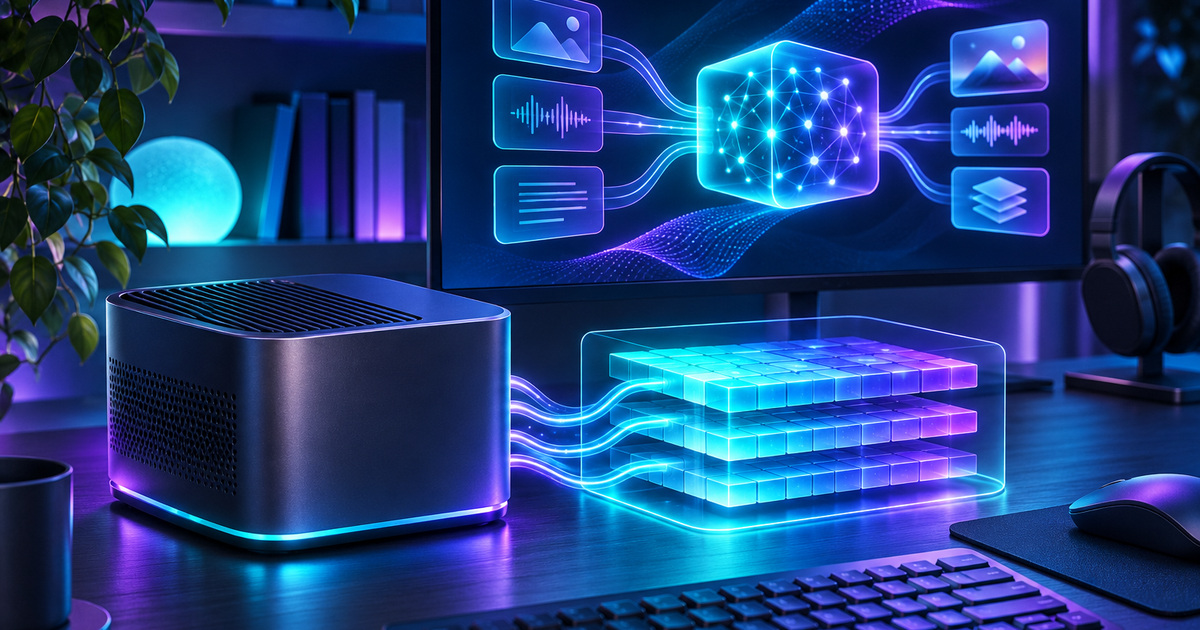
NVIDIA announced on November 18 that RTX Spark compact desktops from ASUS, Dell and MSI are available. The stated configuration ceiling is up to 128 GB of unified memory. NVIDIA positions the systems for local models, creative software and agents running on a dedicated Windows machine. This is an availability announcement for particular partner products; it does not establish that every configuration is sold in every country.
What actually fits in memory
The official product page describes a Windows on Arm platform combining a Grace CPU with Blackwell RTX graphics. That combination makes application, library and dependency checks important. The presence of Windows does not establish compatibility with every older plug-in, driver or Python package.
Unified memory is shared by different parts of the system. The useful question is how much remains for the workload after the operating system, application, model weights and temporary buffers. As a purely arithmetic example, 100 billion parameters at an ideal four bits per parameter require 50 billion bytes for weights alone. This editorial calculation excludes metadata, context and cache, and predicts no particular speed.
Product documentation lists a 20-core Grace CPU, a Blackwell RTX GPU with 6,144 CUDA cores and 10 Gb Ethernet for the desktops. These are platform specifications, not measured performance for a particular model or proof of compatibility with every package.
A separate machine for long tasks
Our practical reading is that a dedicated computer can separate sustained jobs from everyday laptop work. Continuous availability still depends on power, cooling, sleep settings, disk space and recovery after interruption. An agent demonstration does not test those operating conditions on the owner's behalf.
Local processing also needs to be traced step by step. A model may run on the device while a search provider, extension or fallback cloud model sends part of a task elsewhere. For a sensitive project folder, first map the actual data route. This is a proposed configuration review, not a finding of data leakage in RTX Spark.
Turning a hardware claim into a test
We suggest an acceptance scenario with the same model, exact quantization, fixed document and real sequence of tools. Record time to first response, total time to a verified outcome and peak memory. Repeat after sustained operation and with the main working application open at the same time.
Separate feasibility from convenience. A model that loads successfully can still respond too slowly for an interactive workflow, while a smaller model may finish a narrower job faster. The relevant comparison is the complete task, including checking and correcting its output, rather than a memory figure in isolation.
The announcement therefore presents a measurable question: can the particular machine complete your workload at an acceptable speed and predictable cost? SIExpo has not benchmarked these computers and does not present advertised capacity limits as guaranteed workload results.