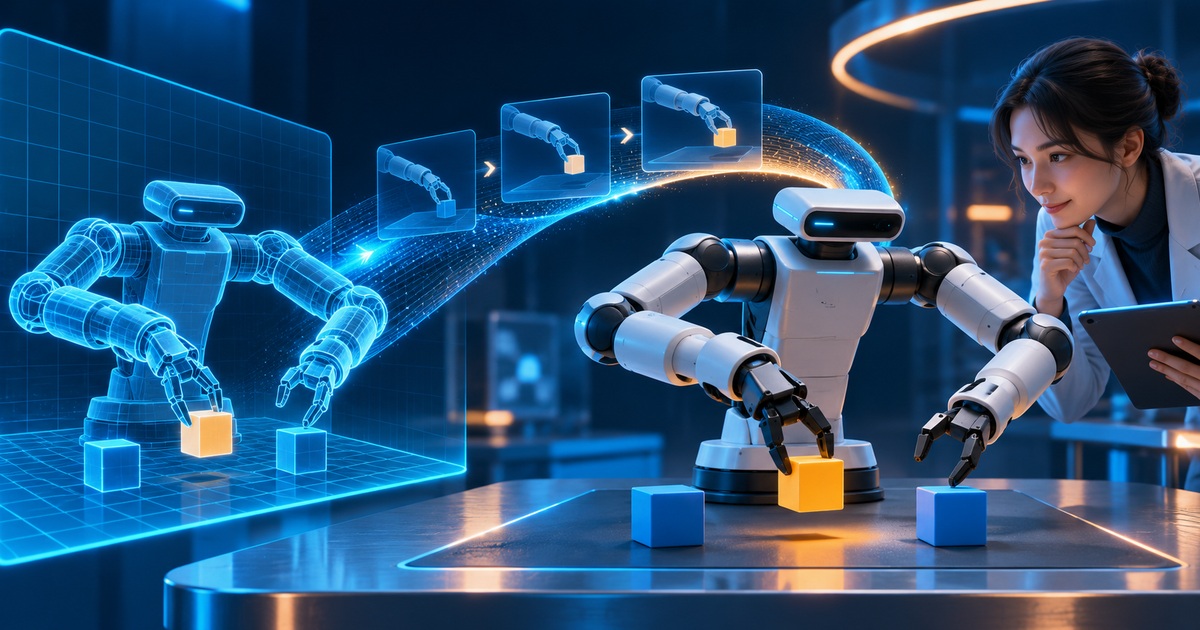
PEAR is a public research environment for post-training reasoning models to use robots. Its preprint was submitted on November 13. This original analysis examines the checked methods and limitations rather than presenting the work as a product launched today.
The authors report that a 27-billion-parameter model trained with reinforcement learning in simulation achieved 60% success across 30 trials on a real dual-arm robot. The base model succeeded in none of those trials. This is a bounded laboratory result, not a general reliability figure for arbitrary physical tasks.
How the workflow is organized
The public repository describes PEAR as infrastructure built on veRL, with asynchronous training and simulation environments. The model observes the scene and arm state, reasons, and produces the next movement target. The code is marked Apache 2.0. Our verification was static reading of documentation, without installation or control of a physical robot.
The repository separates training, evaluation and deployment. It identifies MuJoCo and Isaac Sim, while the model server and robot station are distinct components. That distinction is useful: starting a server does not establish readiness for physical execution.
What the real-trial protocol contributes
The full paper describes block-alignment and object-lifting tasks. Trials have limits on the number of rounds and reasoning. Those conditions belong to the meaning of the percentage; it cannot simply be transferred beyond them.
Our editorial assessment is that robot evaluation must specify what counts as success and what retries are acceptable. An illustrative object-moving task might finish at the correct location after an action that would be unacceptable near a person. That is a proposed evaluation question, not a reported PEAR incident.
The authors themselves identify a limited task and simulator set, along with slow execution caused by extended reasoning before movements. The result should therefore be read both as evidence of transfer and as a description of remaining boundaries.
What would strengthen a follow-up
A useful next test could introduce previously selected unfamiliar objects, repeat tasks under different layouts and separately report safe stopping. Completion time should remain visible rather than judging only whether the task eventually finishes. We have not conducted those trials.
Keeping the model and surrounding execution components distinct would also improve comparisons. If the control software or permitted retries change between tests, the final score reflects more than model capability. Recording those choices allows another team to understand what was actually compared.
PEAR matters as an accessible basis for testing a specific research idea: can simulated experience improve a general reasoning model’s use of a real robot? The reported findings provide a positive signal within the described scope. Expanding that scope requires new measurements, rather than a broader retelling of the same 30 trials.