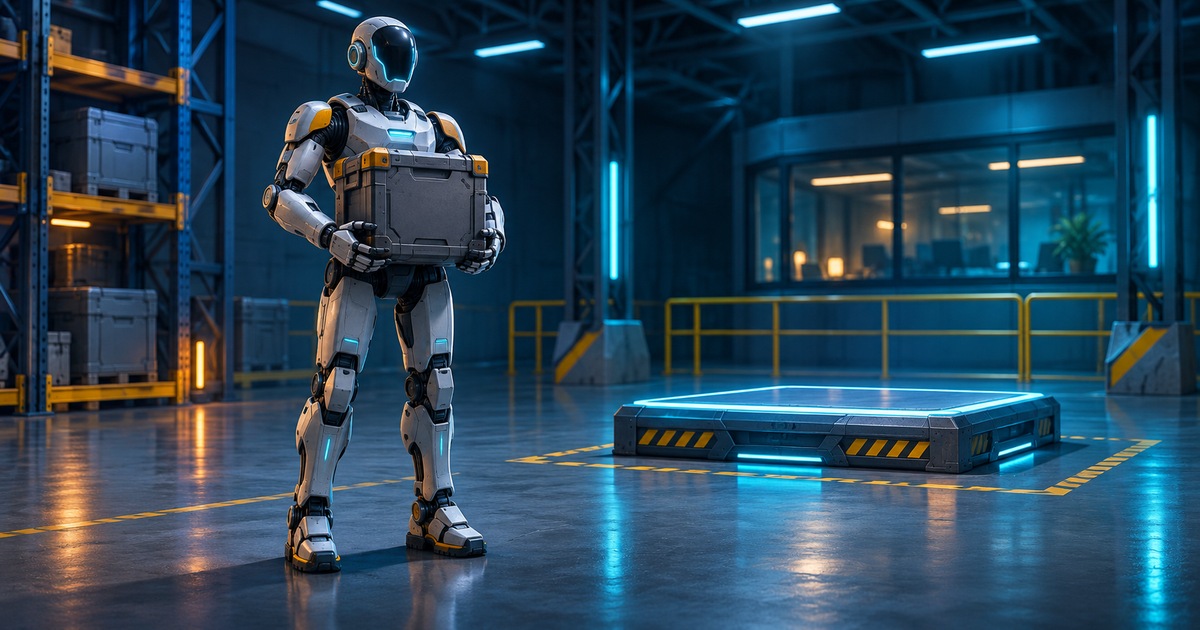
Foundation Future Industries is presenting Phantom MKII as a humanoid for demanding workplaces. Kaldata covered the machine on November 23. The current official page lists a payload of up to 90 kg carried close to the body and a claimed runtime of four to six hours. The manufacturer shows testing footage; SIExpo has not independently tested the robot.
The close-carry qualification matters. It does not mean 90 kg at full arm extension throughout every movement. The official description also lists a 3 kWh battery and IP67 protection. We do not treat these specifications as evidence of continuous maximum-load work for the entire stated runtime. The press materials warn that specifications can change.
Why posture matters
Our engineering interpretation is that a single payload value cannot describe an entire work cycle. Lifting from a stand, carrying across a level floor and placing an object on a high shelf impose different demands. An object's size and shape can also constrain the grasp before the maximum mass is reached.
For an illustrative warehouse task, we would specify the start and end positions, height, distance and number of repetitions. We would then measure completion time, interventions and behavior after an unsuccessful grasp. This is an acceptance method we propose, not a result from Foundation's demonstration. A repeatable task description makes comparisons more meaningful than isolated peak values.
Environmental protection is one part of the assessment
An IP67 designation is useful but does not answer every workplace question. Slippery surfaces, narrow passages, sharp edges and people moving nearby require separate assessment. The conditions underlying the runtime figure matter as well. Battery capacity and payload need evaluation within a real operating cycle rather than as unrelated headline numbers.
For an industrial customer, a repeatable test at an authorized site would be more informative than a short clip. It should include safe stopping, recovery after interruption and clear responsibility for maintenance. Demonstrated movement is not equivalent to acceptance of a production process. The equipment must also fit the site's procedures and operating constraints.
The model deserves attention because the company has published concrete specifications and a heavy-work focus. Its economic value still depends on reliability, servicing and cost per completed task. We do not claim Phantom MKII is already deployed at scale, certified for every environment or capable of replacing people in all advertised activities. The verified evidence is the product presentation and current vendor specifications, with those limitations preserved.