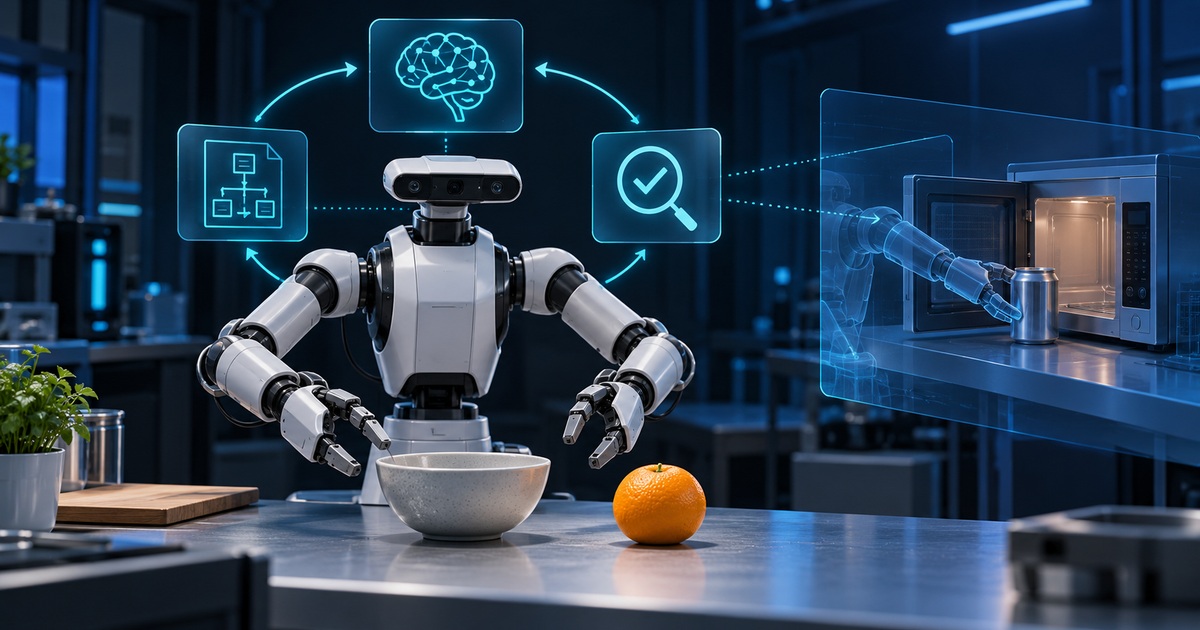
The new discussion concerns the system around the model
In an October 30 Hugging Face analysis, Luca Cilio of Project Sim considers how robot deployments might require less specialist work each time. This is a technical perspective, not the launch of a universal robot. The practical question is how learned skills become a reliably completed job.
A robot can make a correct movement without achieving the intended outcome. Moving to the next operation requires enough evidence about the present state, not merely confidence that a command was issued.
Better orchestration does not mean the problem is solved
In the VoLo paper we checked, the physical evaluation includes 42 trials per compared system. The full configuration completes 18, compared with 6 for the standalone policy. That supports the usefulness of an additional system layer in this particular experiment. It also means most trials of the full configuration do not succeed.
Those figures are not a rating for every robot. The tasks, equipment and conditions bound the conclusion. The same table includes intermediate variants, so it also cannot establish that adding every component necessarily improves every task.
Memory should represent uncertainty too
POT-VLA examines persistent object representations and verifiable relationships in a scene. BATON studies how action choices connect to the constraints of subsequent subtasks. The studies address different parts of the problem and should not be collapsed into one shared success percentage.
As an editorial illustration, consider a container that must pass through a narrow opening. A stable grasp can still be unsuitable for the next movement. Useful memory should retain transition constraints, while verification should distinguish observed facts from assumptions. This explains the systems problem without promising a ready-made solution for arbitrary kitchens or factories.
How we would assess an offer
Our editorial criterion would be how much effort the second deployment saves compared with the first. Must a team rewrite every check? How often does an operator intervene? Can a failed attempt be reproduced? A carefully selected video alone cannot answer these questions.
Before a purchase or pilot, useful evidence would include a task description, trial count, completion criterion and intervention record. Simulation and physical-hardware results should be identified separately. These are evaluation recommendations, not an investment forecast or a report from our own laboratory.
The cost of recovery also deserves attention. Completing a task after a person resets the scene is different from recovering without help. Both may be commercially useful, but the operator must know which service is actually being offered.
What is changing
The new overview assembles arguments that integration can become more repeatable. The older research is linked with its actual versions as context, rather than being presented as a discovery made today. Model progress matters. For the user, the decisive test remains whether the complete robot finishes the job under stated and verified conditions.