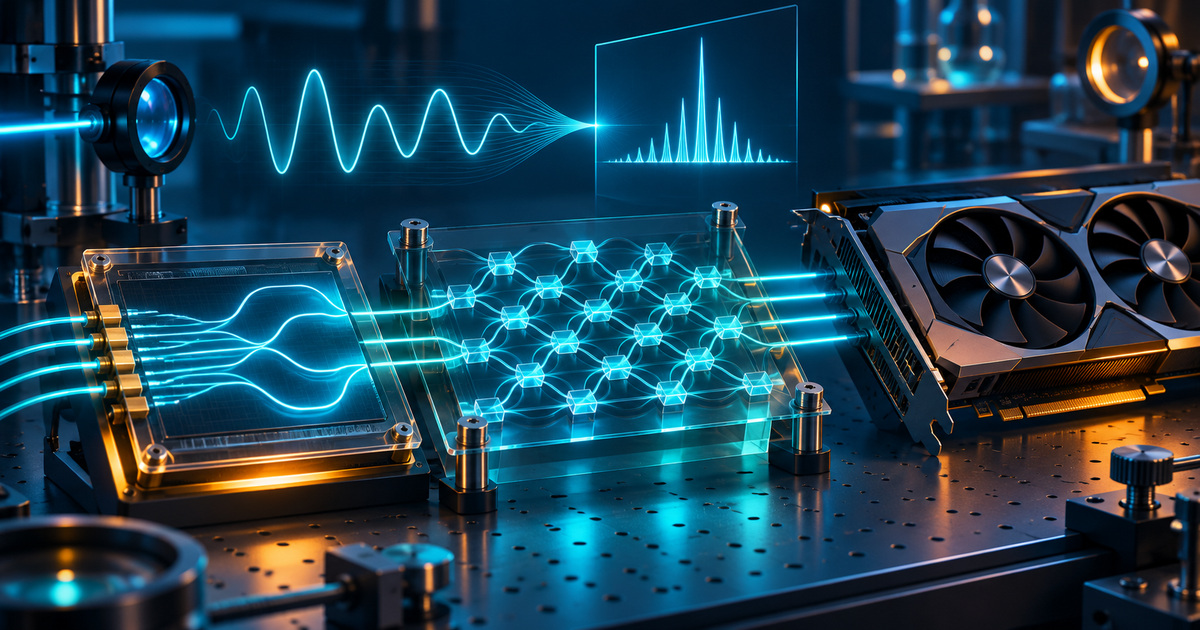
On November 17, Q.ANT introduced NPU Gen 2+ with optical discrete Fourier transforms. At SC26, the company described a hybrid demonstration pairing it with an AMD GPU and a language model, using the photonic operation in an alternative to a computationally demanding attention layer. This is a manufacturer presentation, not an independent comparison of the complete model against a GPU-only system with matched quality, speed and energy use.
The company positions the technology alongside electronic processors. Its stated plan for combined commercial systems concerns the second half of 2027—a future target rather than availability of that product today.
The operation being added
For mathematical background, SciPy's documentation explains the discrete Fourier transform as a transformation between representations of discrete data. It enables a signal to be examined through frequency components. This is a particular mathematical operation, not a general label for every computation in artificial intelligence.
Optical execution is interesting because it uses the physics of light for a specified part of processing. Performing one operation differently is not equivalent to replacing every other step. A language model still has an architecture, data and interactions with the surrounding system.
That distinction also prevents an easy terminology mistake. Fourier-based processing can be relevant to a model architecture without being a universal substitute for arbitrary existing operations. The exact computation and its role need to be described before a comparison can be interpreted.
Why hybrid matters
Consider an editorial example in which software sends suitable work to a specialized coprocessor and performs the rest on conventional hardware. Total time includes preparation, transfer, computation and returned results. A fast specialized operation can be valuable, but measuring only that operation does not describe the complete program.
Energy requires the same distinction. The consumption of one element differs from energy per completed useful task. A practical comparison should include the other components and preserve an equivalent result. These are editorial criteria for future evaluation, not identified Q.ANT defects.
An application can also have different bottlenecks at different batch sizes. A configuration that benefits from a large regular workload may behave differently for small interactive requests. This is an example of a test dimension, not a reported property of the demonstrated system.
Algorithm changes belong in the comparison
If the mathematical organization of the model changes, the comparison is not purely about hardware. Evaluators need to understand the effect on answer quality and intended tasks. Matching input length does not guarantee equivalent output or usefulness.
A convincing report would identify the model version, operation, evaluation data and resulting quality. Latency, throughput and energy can then be compared under those conditions. Without those connections, an impressive component-level number can suggest more than the evidence establishes.
The model should also be assessed on representative tasks rather than only on a demonstration that successfully runs. Successful integration establishes that components can work together in that setup. It does not automatically establish the size of the advantage across other workloads.
What to watch after the demonstration
For developers, practical questions concern the interface, data preparation and numerical accuracy. Operators will care about interaction with other accelerators, monitoring and repeatability. These are evaluation questions, not confirmed features attributed to the platform.
Another useful measurement is how much work actually passes through the optical block. If it accelerates a small fraction, overall benefit depends on the remaining execution. If a large part of the architecture changes, quality assessment needs to be correspondingly broader. In either case, the scope of the claim is part of the result.
Q.ANT's announcement is noteworthy as an attempt to expand the mathematical operations available in photonic hardware. For now, the accurate reading is a hybrid research and product direction. The next persuasive evidence will connect the optical operation to complete-model benefit with clearly stated conditions and answer quality.