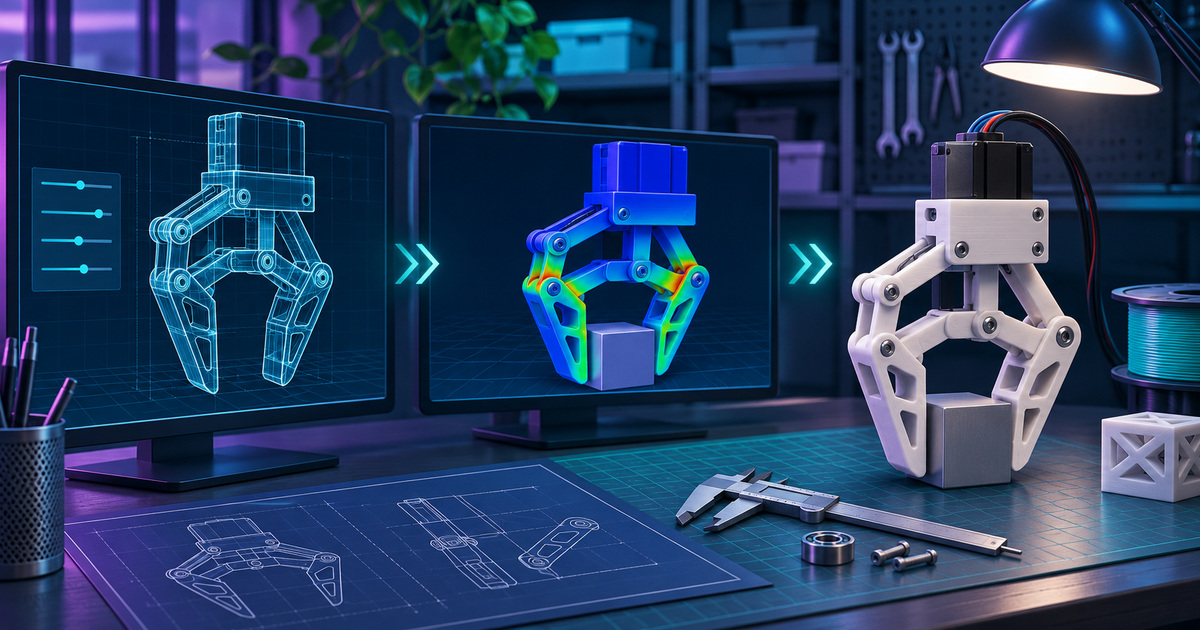
Siemens described a demonstration with AGIBOT on November 16 in which an agentic workflow prepares a gripper for a humanoid robot. It moves from an object and task description through geometry changes in Designcenter, simulation and interface validation to additive-manufacturing preparation. This is previously uncovered news from the week, not a new November 22 launch.
The company separates the demonstrated engineering sequence from a planned adaptive production cell. We therefore do not describe the future production stage as a completed deployment. We have not measured design time or established that an agent can produce safe parts for every possible task.
The significance is the connection between engineering decisions. A part's shape, contact with an object and compatibility with a robot are not independent pictures. If the starting task changes, it should be clear which checks are repeated. This is our editorial reading of the challenge, not an additional reported result.
One possible acceptance example would use an object with known dimensions and a bounded mass range. A team could define successful holding and permitted movements in advance. The proposed geometry would then be evaluated against those criteria, rather than only whether it looks appropriate on screen. We have not carried out that procedure.
Virtual validation and the manufactured part also provide different evidence. Physical production introduces material, process and deviations that must be considered in the actual environment. A print-ready file alone is not certification of the finished component's behavior. We provide no manufacturing dimensions or instructions for building a real robotic gripper.
For traceability, it is helpful to connect the requirement, geometry version, checks and approved variant. If someone edits a part after simulation, the previous result should not automatically apply to the new version. This is a proposed general control for engineering artifacts, considered in the context of the demonstration.
The announcement points toward agents orchestrating engineering work. Its value should be assessed through the quality of generated and checked variants, not just the convenience of a text request. The planned connection to production warrants a later report with specific conditions and results when those become available.